On this page
In the CBSE Geography curriculum for 2026-27, Chapter 7, "Composition and Structure of Atmosphere", opens Unit IV (Climate) of *Fundamentals of Physical Geography*, and Chapters 7 to 10 together carry 8 marks. The NCERT chapter appears in the Reprint 2026-27 edition, so it is current, not dropped.
If you studied the layers of the atmosphere in Class 7, you already know the five names. Class 11 asks for more: why each gas matters, where each one stops, and why the layers sit at the heights they do.
What is the atmosphere made of?
The NCERT chapter splits the atmosphere into three parts: gases, water vapour and dust particles. It adds that 99 per cent of the atmosphere's mass lies within 32 km of the surface.
Gases
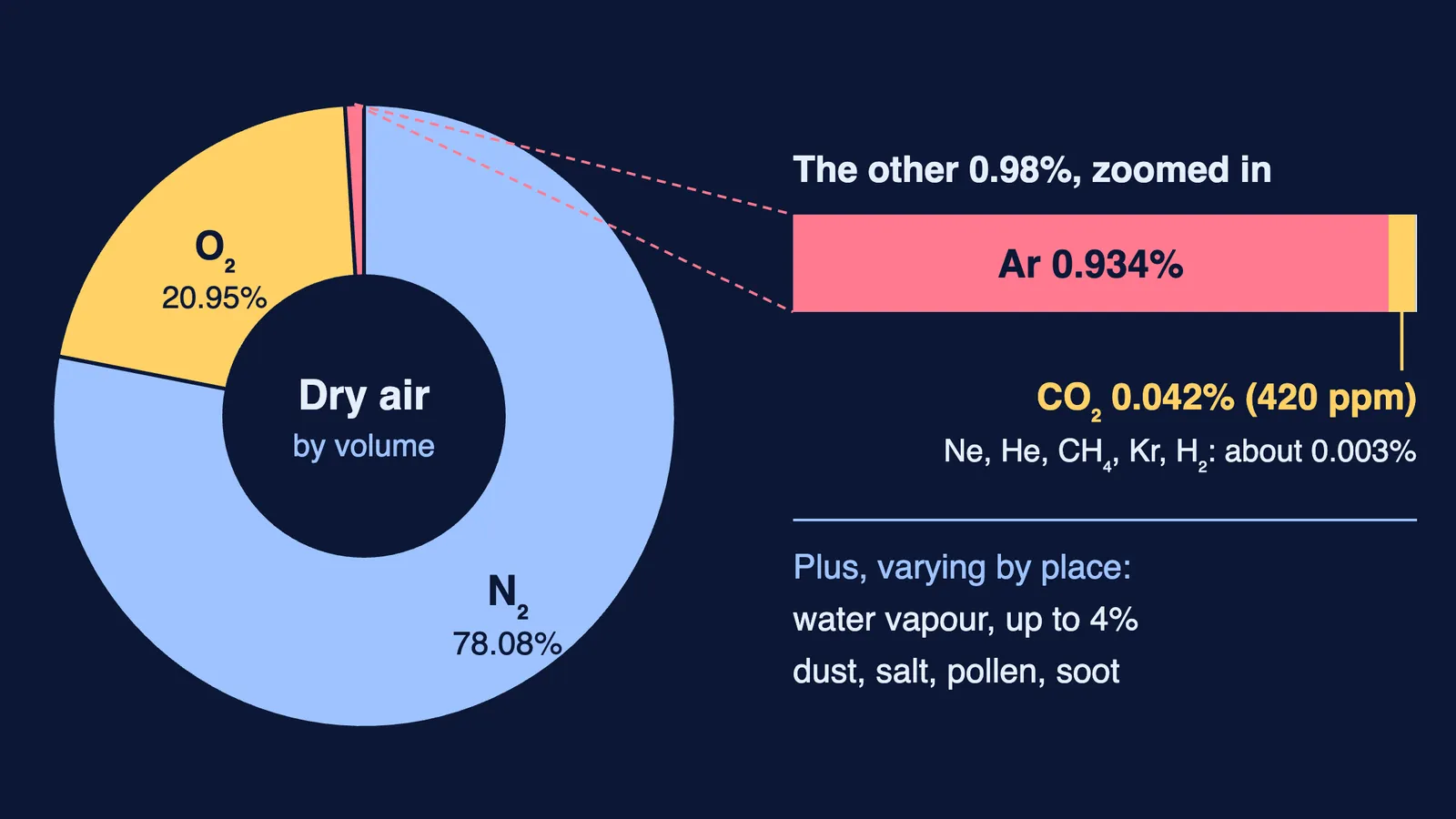
By volume, dry air is 78.08% nitrogen, 20.95% oxygen and 0.934% argon (9,340 ppm), according to NASA's Earth fact sheet. The same sheet lists carbon dioxide at 420 ppm, then traces of neon, helium, methane, krypton and hydrogen.
That CO2 figure keeps climbing. At Mauna Loa, the NOAA annual mean was 427.35 ppm in 2025, up from 418.53 ppm in 2022. NCERT says the rise comes mainly from burning fossil fuels.
Two gases get special attention in the chapter:
Carbon dioxide is transparent to incoming solar radiation but opaque to outgoing terrestrial radiation, which makes it largely responsible for the greenhouse effect.
Ozone sits between 10 and 50 km and absorbs ultraviolet rays from the sun. Our post on why the ozone layer matters for living things explains what that UV does to DNA and eyes.
The mix also changes with height: oxygen becomes almost negligible at 120 km, and carbon dioxide and water vapour are found only up to 90 km.
Water vapour and dust
Water vapour is the variable part. NCERT says it may be four per cent of air by volume in the warm, wet tropics and less than one per cent in cold or dry deserts and polar regions. It falls with altitude and from the equator towards the poles, and acts like a blanket by trapping the earth's radiated heat.
Dust includes sea salt, fine soil, smoke-soot, ash, pollen and broken-up meteor particles. NCERT says dust and salt particles act as hygroscopic nuclei: water vapour condenses around them to form clouds.
What are the five layers of the atmosphere?
The textbook divides the atmosphere into five layers by temperature. Learn them with their boundaries:
Troposphere: average height 13 km, about 8 km at the poles and 18 km at the equator, thickest at the equator because strong convection carries heat high. All weather happens here, and temperature falls by 1°C for every 165 m. Its upper boundary, the tropopause, is about minus 80°C over the equator and minus 45°C over the poles.
Stratosphere: up to 50 km, home of the ozone layer.
Mesosphere: up to 80 km; temperature falls again, to about minus 100°C at 80 km. Its top is the mesopause.
Thermosphere: NCERT's text describes the zone above the mesopause as the ionosphere, 80 to 400 km, with charged particles that reflect radio waves back to earth. Temperature rises with height here.
Exosphere: the highest, most rarefied layer, merging into space.
Note that the list names the thermosphere, but the textbook's description of the layer above the mesopause calls it the ionosphere. In an answer, write "thermosphere (ionosphere, 80 to 400 km)" so the examiner sees both terms.
How do you use the 1°C per 165 m rule?
This is the chapter's one number you can calculate with. Say the ground in Chennai is at 30°C. At 3,300 m, the drop is 3,300 ÷ 165 = 20°C, so the air is near 10°C. At 9,900 m, the drop is 60°C, so about minus 30°C. Rounded, the rule is about 6°C per km.
It is an average, so real air on a given day can differ, but it is enough for a short-answer calculation.
If heat, convection and lapse rates still feel like facts to memorise rather than understand, the Fermi Concept Library gives each physics and chemistry concept its own lesson and its place in the map.
How do you write the 150-word answers?
The chapter ends with two long questions: describe the composition, and draw, label and describe the structure. A plan for each:
Composition: three heads (gases, water vapour, dust); for gases, give nitrogen, oxygen and argon, then CO2 and ozone with one job each; for water vapour, the 4% versus 1% contrast; for dust, the cloud nuclei point.
Structure: a vertical diagram with heights on the side (13, 50, 80, 400 km), the ozone layer drawn inside the stratosphere, and one line per layer on what makes it different.
The atmosphere sits on top of a planet covered earlier in the same book; our guide to the interior of the Earth for Class 11 covers the layers below your feet.