On this page
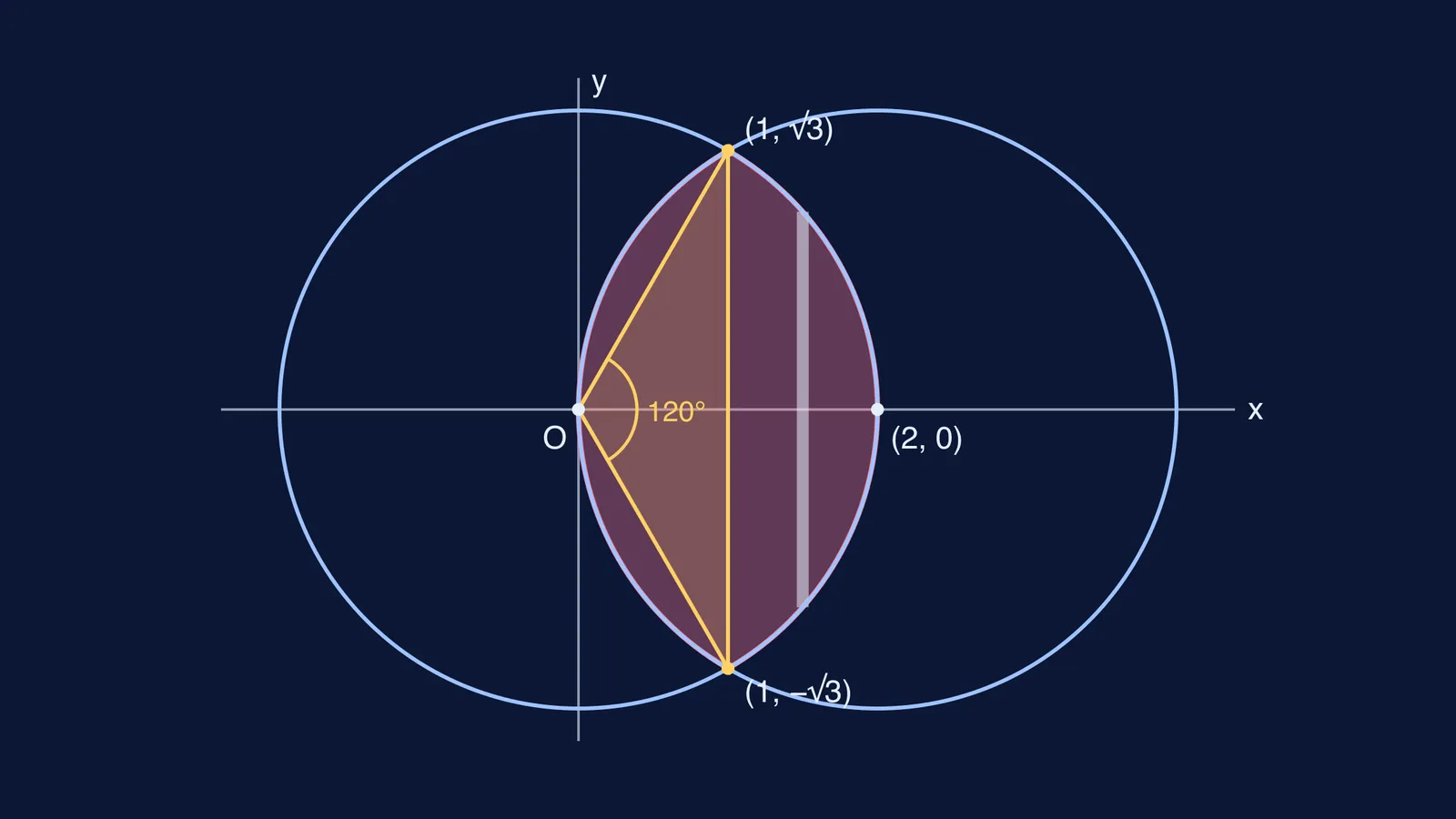
Two circles of radius 2, one centred at the origin and one at (2, 0), overlap in a lens shape. This standard Class 12 "application of integrals" question is good practice because two different methods solve it.
Where do the two circles meet?
Write the circles: x² + y² = 4 and (x − 2)² + y² = 4.
Subtract the second from the first: x² − (x − 2)² = 0, which simplifies to 4x − 4 = 0, so x = 1.
Put x = 1 back in: y² = 3, so y = ±√3.
The circles meet at (1, √3) and (1, −√3), and the line x = 1 is their common chord. The lens is symmetric about the x-axis and about the line x = 1, so it splits into four identical quarter-pieces.
How do you find the common area by integration?
To the right of x = 1, the lens is bounded by the first circle, y = √(4 − x²), from x = 1 to x = 2. One quarter of the lens is the area under that curve and above the x-axis, so the whole lens is
A = 4 ∫ from 1 to 2 of √(4 − x²) dx.
The standard antiderivative is ∫√(a² − x²) dx = ½[x√(a² − x²) + a² sin⁻¹(x/a)] + C, as listed in this table of integrals of irrational functions. With a = 2:
At x = 2: ½[2 · 0 + 4 sin⁻¹(1)] = ½ · 4 · π/2 = π.
At x = 1: ½[1 · √3 + 4 sin⁻¹(½)] = √3/2 + π/3.
Subtract: π − π/3 − √3/2 = 2π/3 − √3/2.
Multiply by 4: A = 8π/3 − 2√3.
You can also slice the lens with horizontal strips instead. Each strip runs from the second circle, x = 2 − √(4 − y²), to the first, x = √(4 − y²), so A = 2 ∫ from 0 to √3 of (2√(4 − y²) − 2) dy, which also simplifies to 8π/3 − 2√3. Our guide to finding area with horizontal strips explains when this choice saves work.
How does sector minus triangle give the same answer?
The chord x = 1 cuts off a minor segment from each circle, and the lens is exactly those two segments.
Look at the first circle, centre O. The radius to (1, √3) makes an angle with the x-axis whose cosine is 1/2, so that angle is 60°. The chord therefore subtends 120°, or 2π/3 radians, at O.
Sector area = ½r²θ = ½ · 4 · 2π/3 = 4π/3.
Triangle area = ½r² sin θ = ½ · 4 · (√3/2) = √3.
Segment area = 4π/3 − √3.
This is the segment formula A = ½R²(θ − sin θ), the sector minus the isosceles triangle, as given by Wolfram MathWorld on the circular segment. The second circle gives an identical segment, so the lens is 2(4π/3 − √3) = 8π/3 − 2√3. Practise this step with our post on the area of a minor segment of a circle.
Do the two answers really match?
Both methods give 8π/3 − 2√3, which is about 8.378 − 3.464 = 4.913 square units.
As a third check: for two equal circles of radius R whose centres are d apart, the overlap is 2R² cos⁻¹(d/2R) − ½d√(4R² − d²), according to Wolfram MathWorld's circle-circle intersection page. With R = 2 and d = 2 this is 8 · π/3 − √12 = 8π/3 − 2√3. Same answer.
Which method should you use in an exam?
If the question says "using integration", you must show the integral. Use sector minus triangle as a quick check on your final answer.
If it only asks for the area, sector minus triangle is faster for two circles, because the angle at each centre is easy to find.
If one boundary is a parabola, line or ellipse, integration is usually the most direct route. The same method appears in our worked post on the area common to a circle and a parabola.
Sketch and shade the region before integrating. Typical errors are using the wrong curve on one side of the chord, or limits 0 to 2 instead of 1 to 2.
If your answer and your check do not agree, the Fermi Problem Library has worked problems with a step-by-step solver that explains the reasoning rather than printing an answer, so you can find the exact line where yours went wrong. If the gap is in the idea itself, such as why a sector's area is ½r²θ, the Fermi Concept Library gives each concept its own lesson.
Try it next with two circles of radius 3 whose centres are 3 apart. You should get 6π − 9√3/2.