

On this page
The area common to a circle and a parabola tests three things at once: solving two equations together, reading a sketch, and evaluating two different integrals. The method is the same for any standard-form pair. Find where the curves cross, cut along the chord through those points, and add the two pieces.
The topic is in the syllabus. The JEE Main 2026 syllabus published by NTA lists determining areas of regions bounded by simple curves in standard forms under Unit 8, Integral Calculus, and names ∫√(a² ± x²) dx among the integrals you should be able to evaluate. NCERT's Class 12 chapter, Application of Integrals, uses ∫√(a² − x²) dx to derive the area of a circle.
How do you find the area common to a circle and a parabola?
Use this four-step frame for any circle and parabola in standard form.
Sketch both curves. Mark the parabola's vertex and direction, and the circle's centre and radius.
Find the intersections. Substitute the parabola's y² into the circle's equation to get a quadratic in x. Keep only roots that give a real y.
Split the region. Draw the line through the intersection points (vertical for y² = 4ax). On one side the boundary is the parabola; on the other, the circle.
Add the pieces. If both curves are symmetric about the same axis, work out one half and double it.
Worked example: y² = 6x and x² + y² = 16
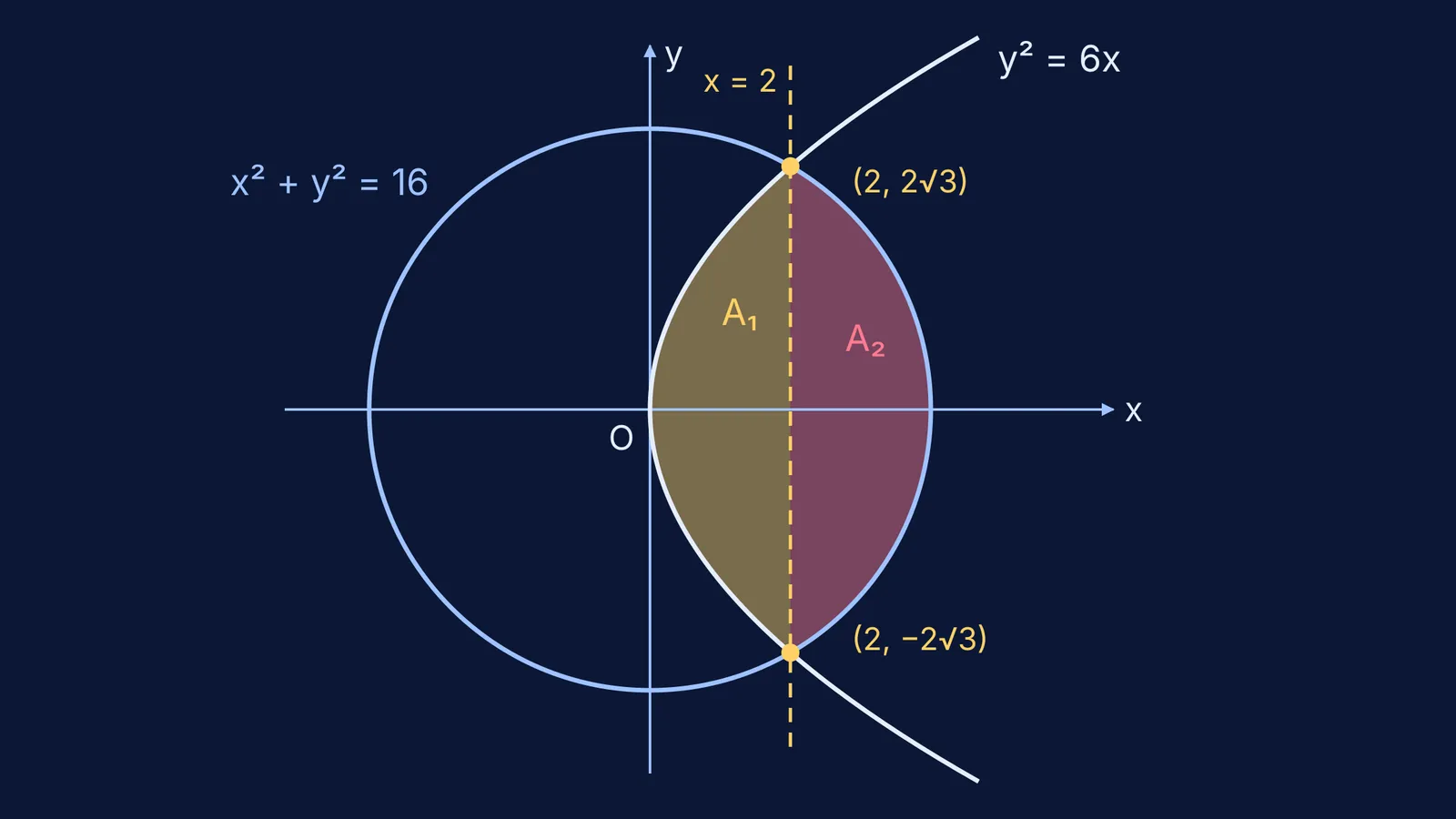
Step 1: The parabola has its vertex at the origin and opens right. The circle has centre at the origin and radius 4.
Step 2: Substitute y² = 6x into the circle: x² + 6x − 16 = 0, which factorises as (x + 8)(x − 2) = 0. The root x = −8 would need y² = −48, so reject it. With x = 2, y² = 12, so the curves meet at (2, 2√3) and (2, −2√3).
Step 3: The line x = 2 splits the region. A₁, from the vertex to x = 2, is bounded by the parabola. A₂, from x = 2 to x = 4, is bounded by the circle.
Step 4, upper half of A₁: the integral of √6 · √x from 0 to 2 is √6 · (2/3) · 2^(3/2) = 8√3/3.
Upper half of A₂: use ∫√(a² − x²) dx = (x/2)√(a² − x²) + (a²/2) sin⁻¹(x/a), the result NCERT applies in its circle example. With a = 4, the bracket is 8 · (π/2) = 4π at x = 4, and √12 + 8 · (π/6) = 2√3 + 4π/3 at x = 2. The difference is 8π/3 − 2√3.
Add and double: 2 × (8√3/3 + 8π/3 − 2√3) = 16π/3 + 4√3/3 = (4/3)(4π + √3), about 19.06 square units.
Can you skip the integral for the circle part?
Yes. The piece A₂ is a circular segment, the region between a chord and its arc. Wolfram MathWorld gives the area of a circular segment as ½R²(θ − sin θ), where θ is the central angle in radians.
Here the chord x = 2 sits at distance 2 from the centre of a circle of radius 4. So cos(θ/2) = 2/4, θ/2 = π/3 and θ = 2π/3. The segment area is ½ × 16 × (2π/3 − √3/2) = 16π/3 − 4√3. That is all of A₂ in one line, with no doubling. If the formula is new to you, our explainer on the area of a minor segment of a circle walks through it.
The parabola piece has a shortcut too. Archimedes proved in The Quadrature of the Parabola that a parabolic segment has 4/3 the area of the triangle whose base is the chord and whose third vertex is where the tangent runs parallel to the chord. Here that vertex is the origin, so the triangle has base 4√3, height 2 and area 4√3, giving A₁ = 16√3/3. Add A₂ and you get the same total. Two methods that agree are a strong check in an exam hall.
What mistakes cost marks on this question?
Keeping the x = −8 root. Always check that y² comes out non-negative.
Integrating the circle from 0 to 4, which adds area inside the circle but outside the parabola.
Forgetting to double after working with the upper half, or doubling the segment formula, which already covers both halves.
Using degrees in the segment formula. θ must be in radians.
Where to practise next
If the ∫√(a² − x²) step feels memorised rather than understood, see how the area of a circle, πr², comes from a definite integral and why the integral of √(4 − x²) from 0 to 2 is a quarter circle.
For more practice, the Fermi Problem Library has worked problems with a step-by-step solver that explains the reasoning rather than printing an answer. If parabolas or segments are the shaky part, the Fermi Concept Library gives each concept its own lesson.


