

On this page
When calculus students first encounter the definite integral ∫₀² √(4 − x²) dx, their instinct is often to reach for pen, paper, and substitution formulas. Yet you can evaluate this entire problem in five seconds without writing a single line of calculus.
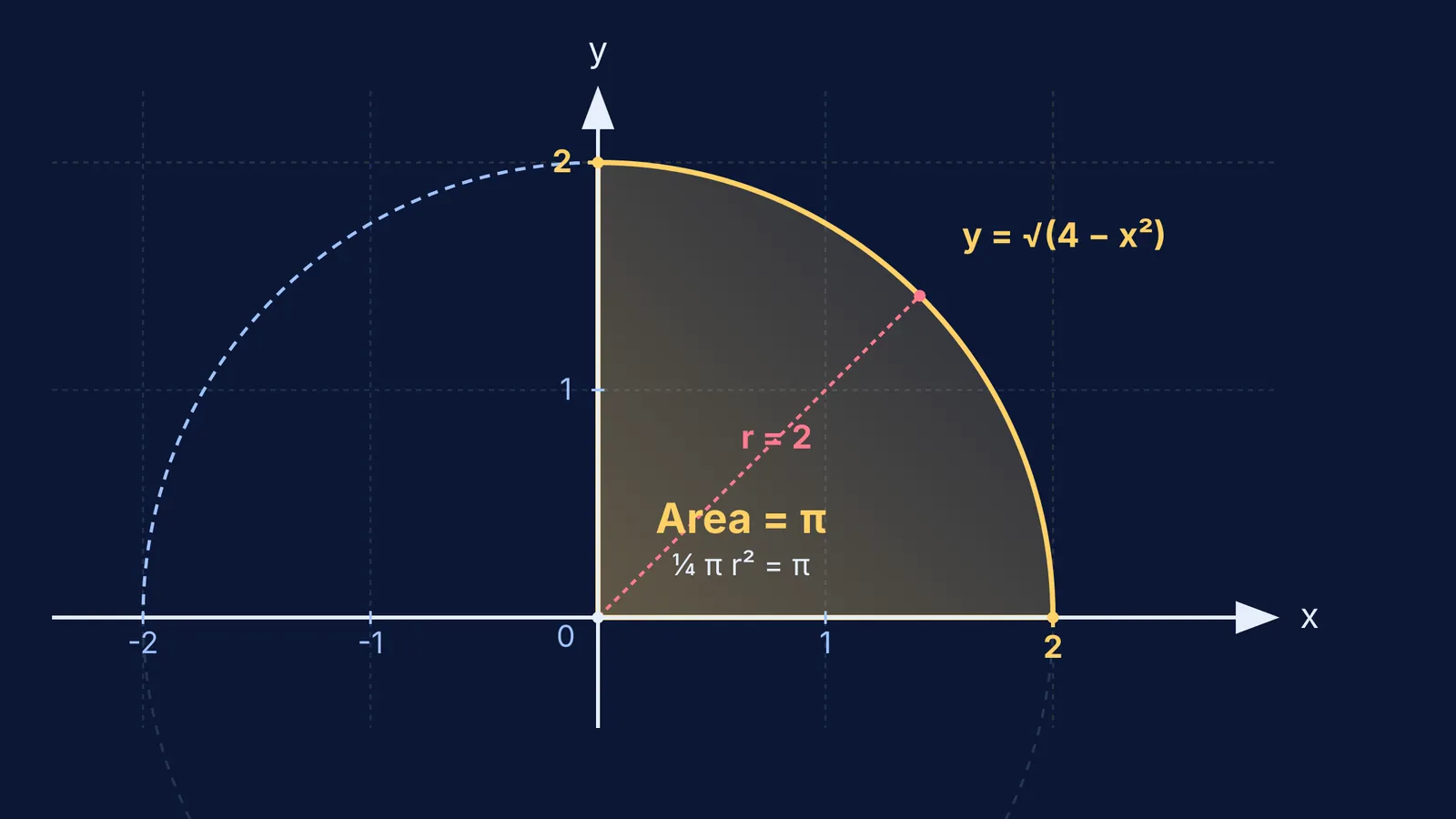
The reason lies in the geometric meaning of a definite integral. A definite integral ∫ₐᵇ f(x) dx calculates the net signed area bounded by the curve y = f(x), the x-axis, and the vertical lines x = a and x = b. Here, the integrand is: y = √(4 − x²)
Squaring both sides gives y² = 4 − x², which rearranges to the equation of a circle: x² + y² = 2²
Because the radical denotes the non-negative square root, y ≥ 0. The graph of y = √(4 − x²) is therefore the upper semicircle of radius r = 2 centered at (0, 0). The limits run from x = 0 to x = 2. In the first quadrant, this region is bounded by the y-axis, the x-axis, and the circular arc. It forms exactly one quarter of the circle.
As covered in the NCERT Class 12 Mathematics curriculum, the area of a circle with radius r is πr². A quarter circle has one-fourth of that area: Area = (1/4) × πr² = (1/4) × π × 2² = π
The definite integral equals π by inspection.
How do you solve the integral using trigonometric substitution?
To appreciate the power of the geometric shortcut, compare it with the standard analytical route. The traditional method uses the trigonometric substitution x = 2 sin θ:
Differentiate: dx = 2 cos θ dθ.
Transform the limits: x = 0 gives θ = 0, and x = 2 gives θ = π/2.
Simplify the radical: √(4 − 4 sin² θ) = 2 cos θ.
Integrate:
∫₀² √(4 − x²) dx = ∫₀^(π/2) (2 cos θ)(2 cos θ dθ) = 4 ∫₀^(π/2) cos² θ dθ
Apply the identity cos² θ = (1 + cos 2θ)/2:
2 ∫₀^(π/2) (1 + cos 2θ) dθ = 2 [θ + (sin 2θ)/2]₀^(π/2) = π
You can also use the standard formula for integrals of √(a² − x²): [(x/2)√(4 − x²) + 2 sin⁻¹(x/2)]₀² = 2 sin⁻¹(1) − 0 = 2(π/2) = π
Both algebraic methods arrive at π, but each requires multiple substitution steps and boundary conversions. In competitive exams like JEE Main, conducted by the National Testing Agency, students face 25 mathematics questions per paper and average under 3 minutes per question. Spending two minutes on mechanical algebra when five seconds of geometry suffices drains time needed for tougher problems.
How do you spot geometric shortcuts in definite integrals?
Spotting geometric shortcuts requires treating the integrand as a curve y = f(x) in the coordinate plane rather than an algebraic expression to invert. Look for three visual patterns:
Semicircles: Expressions matching √(r² − x²) represent origin-centered semicircles. Expressions with completed squares like √(r² − (x − h)²) represent semicircles shifted horizontally to center (h, 0).
Triangles and trapezia: Linear expressions like (mx + c) or absolute values like |x − c| create straight boundaries that form polygons against the axis.
Composite regions: Sums like x + √(r² − x²) split into a polynomial triangle plus a circular slice.
When practicing on the Fermi Problem Library, the step-by-step solver explains the reasoning rather than printing an answer, helping you recognise visual structures before writing algebraic steps.
Which other definite integrals can you solve as geometric areas?
Once you identify the underlying geometry, several common exam integrals can be evaluated directly:
Full upper semicircle:
∫₋₂² √(4 − x²) dx Because the limits span the full diameter from −2 to 2, this integral represents the entire upper semicircle of radius 2: Area = (1/2)π(2)² = 2π
Shifted semicircle:
∫₂⁶ √(-x² + 8x − 12) dx Completing the square gives 4 − (x − 4)², which is a semicircle of radius 2 centered at (4, 0). The limits run from x = 2 to x = 6 (the diameter), yielding an area of (1/2)π(2)² = 2π.
Combined triangle and quarter circle:
∫₀² (x + √(4 − x²)) dx By linearity, this splits into ∫₀² x dx + ∫₀² √(4 − x²) dx. The first part is a right triangle with base 2 and height 2 (area 2), and the second is the quarter circle (area π). The sum is 2 + π.
Modulus V-shape:
∫₋₃³ |x| dx The graph of y = |x| forms two symmetric right triangles with base 3 and height 3, giving total area 2 × [(1/2)(3)(3)] = 9.
Pairing these visual checks with tools like finding area using horizontal strips builds mathematical flexibility. For timed tests, effective time management in the exam hall relies on spotting these shapes instantly.
How can you avoid common traps with geometric integrals?
Geometric integration is fast, but you must avoid three frequent traps:
Mismatched limits: For ∫₀¹ √(4 − x²) dx, the upper limit x = 1 stops short of the radius r = 2. This is not a quarter circle; it is a composite region combining a sector and a triangle. Here, standard calculus formulas are safer.
Net signed area: Definite integrals compute net signed area. Any region below the x-axis subtracts from the integral, unlike geometric area which is always positive.
Inverse derivatives: The function √(4 − x²) defines a circle, but 1/√(4 − x²) is the derivative of sin⁻¹(x/2), which measures an angle, not a circular area.
For students mapping calculus to coordinate geometry, the Fermi Concept Library covers every concept in mathematics and physics, connecting algebraic formulas with visual representations.


