On this page
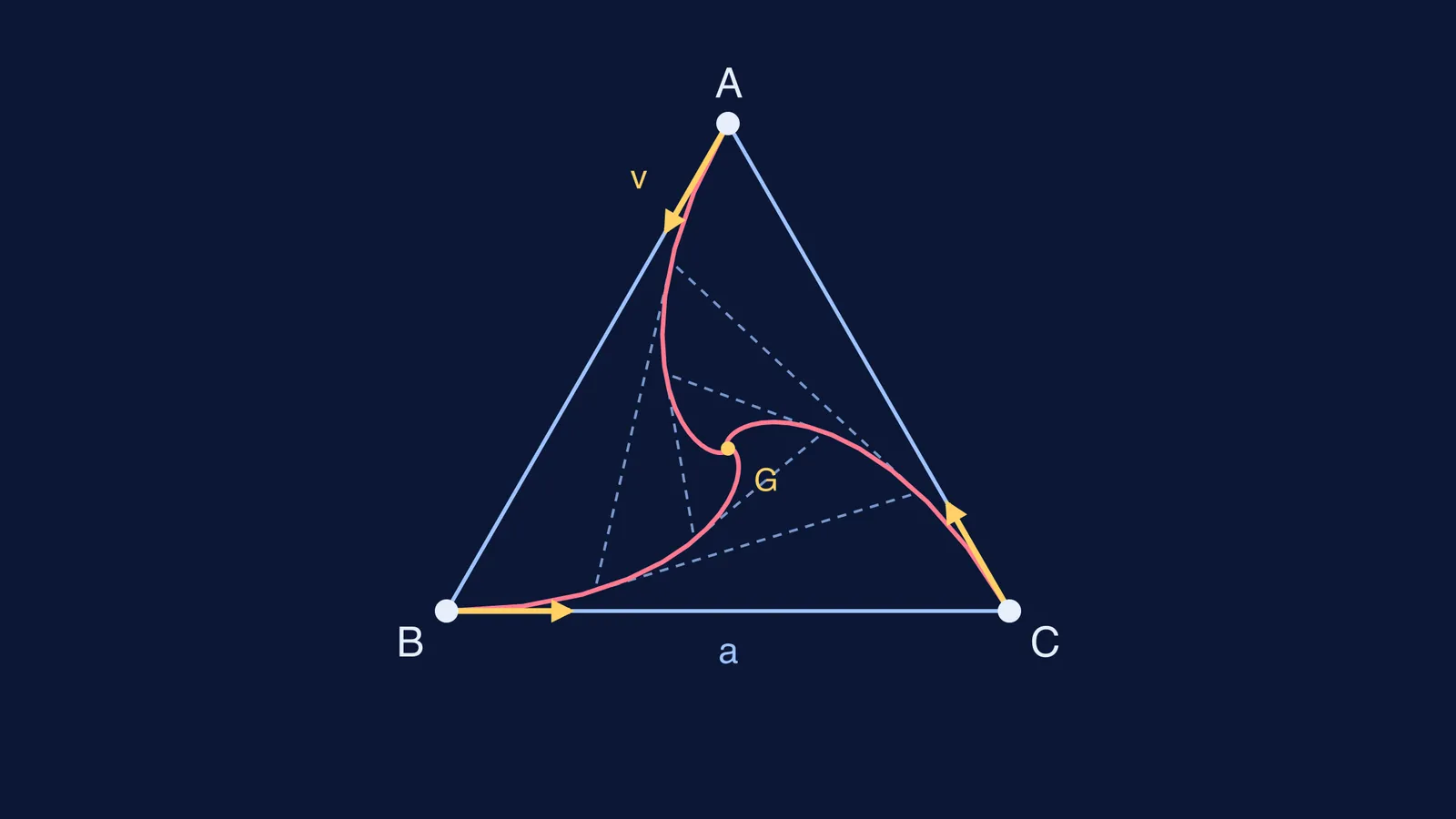
Three particles sit at the corners of an equilateral triangle of side a. Each moves with constant speed v, always heading straight at the next one: A chases B, B chases C, C chases A. It looks like calculus, but it is a one-line relative velocity problem.
What is the chasing-particles problem?
Mathematicians call it the mice problem, or the beetle problem: n creatures start at the corners of a regular n-sided polygon and each runs at constant speed towards its neighbour, as described on Wolfram MathWorld. MathWorld's references include Édouard Lucas's "Problem of the Three Dogs" and a question by Henri Brocard, both published in 1877. Each mouse traces a logarithmic spiral, and the spirals meet at the centre of the polygon, according to the Wikipedia entry on the mice problem.
The key idea is symmetry. All three follow the same rule from equivalent starting points, so the triangle rotates and shrinks but stays equilateral, and its centroid G never moves. So they meet at G.
Why is the approach speed 3v/2?
Two things shorten side AB.
A moves straight along AB towards B at speed v. That shortens AB at rate v.
B moves along BC, not along BA. The angle between BC and BA is the triangle's angle, 60°, so B's velocity has a component v cos60° = v/2 pointing back towards A.
The sideways part of B's velocity, v sin60°, is perpendicular to AB and does not change its length at that instant. So the rate at which the side shrinks is v + v cos60° = 3v/2.
Because the triangle stays equilateral, every angle stays 60°, so the closing speed is 3v/2 at every instant, not just at the start. A gap a closing at a constant 3v/2 reaches zero after:
t = a ÷ (3v/2) = 2a/3v
Each particle moves at speed v for that time, so each travels a distance v × 2a/3v = 2a/3. MathWorld's mice problem page gives the same 2/3 for a triangle of unit side.
How long do the particles take to meet? A worked example
Take a = 1.2 m and v = 0.4 m/s.
Closing speed along a side: 0.4 + 0.4 × cos60° = 0.4 + 0.2 = 0.6 m/s.
Time to meet: 1.2 ÷ 0.6 = 2 s. The formula agrees: 2 × 1.2 ÷ (3 × 0.4) = 2 s.
Distance each particle covers: 0.4 × 2 = 0.8 m, which is 2a/3.
Where they meet: the centroid, 1.2 ÷ √3 ≈ 0.69 m from each corner.
You never need the spiral's equation to get the time.
This is the same habit as in two people walking towards each other and two trains passing each other: find the gap, find how fast it closes, divide.
What about a square or any n-sided polygon?
The same argument works for n particles on a regular polygon of side a. Its interior angle is 180° − 360°/n, the target's velocity has a component v cos(interior angle) back towards the chaser, and so the closing speed is v[1 − cos(2π/n)]. For unit side and speed, neighbouring mice close at 1 − cos(2π/n) and meet after 1/(1 − cos(2π/n)), according to the mice problem article. With side a and speed v:
t = a ÷ v(1 − cos(2π/n))
Triangle, n = 3: 1 − cos120° = 3/2, so t = 2a/3v.
Square, n = 4: 1 − cos90° = 1, so t = a/v. The target moves at right angles to the chaser and does not help close the gap.
Hexagon, n = 6: 1 − cos60° = 1/2, so t = 2a/v. The target now runs partly away from the chaser.
Very large n: cos(2π/n) approaches 1, so the time grows without limit.
Sanity check, n = 2: two particles running straight at each other, 1 − cos180° = 2, so t = a/2v, the head-on answer.
If polygon angles feel shaky, our post on the area of a regular polygon with n sides walks through the same angles.
Where do students go wrong?
Using 2v as the closing speed, as if B ran straight at A. Only the component of B's velocity along BA counts.
Using cos30° with the side length a. The 30° angle belongs with the distance to the centre, a/√3, not with the side.
Treating 3v/2 as true only at the start. It holds throughout because the angles never change.
When a chase problem keeps giving you the wrong number, the Fermi Problem Library has worked problems with a step-by-step solver that explains the reasoning rather than printing an answer, so you can see which velocity component you dropped. If relative velocity itself is the gap, start with the lesson on it in the Fermi Concept Library.
Try it yourself: work out the time for a square of side 2 m with v = 0.5 m/s. You should get 4 s.