On this page
Riya and Aman stand 4.5 km apart on a straight road and start walking towards each other. When do they meet, and where? It takes one idea and three short steps, and once you see why the speeds add, the chasing and late-start versions stop being separate tricks.
Why do you add speeds when two people walk towards each other?
OpenStax University Physics states that the velocity of a particle relative to one frame equals its velocity relative to a second frame plus the velocity of the second frame relative to the first.
Relative speed is the rate at which the gap between two moving objects changes.
Take Riya's direction as positive. Her velocity is +vR; Aman walks the other way, so his is -vA. Aman's velocity as seen by Riya is (-vA) - (+vR) = -(vA + vR). The minus sign only says he is coming towards her. The size, vA + vR, is how fast the gap shrinks. So for opposite directions the speeds add.
When do you subtract speeds instead?
If both walk the same way, both velocities are positive. Aman's velocity relative to Riya becomes vA - vR. If Aman is behind and faster, he closes the gap at that difference. If their speeds are equal, the gap never changes and they never meet. If he is slower, the gap grows.
How do you find the time and place where they meet?
Use the same three steps every time:
Find the gap at the moment both people are moving.
Find the closing speed: sum for opposite directions, difference for the same direction.
Divide the gap by the closing speed to get the time, then multiply each person's own speed by that time to get where they meet.
For two people walking towards each other, the meeting point measured from the first person's start is the gap times their speed, divided by the sum of the speeds. So they meet nearer the slower walker's start. The examples below use made-up speeds with the frame rule from OpenStax.
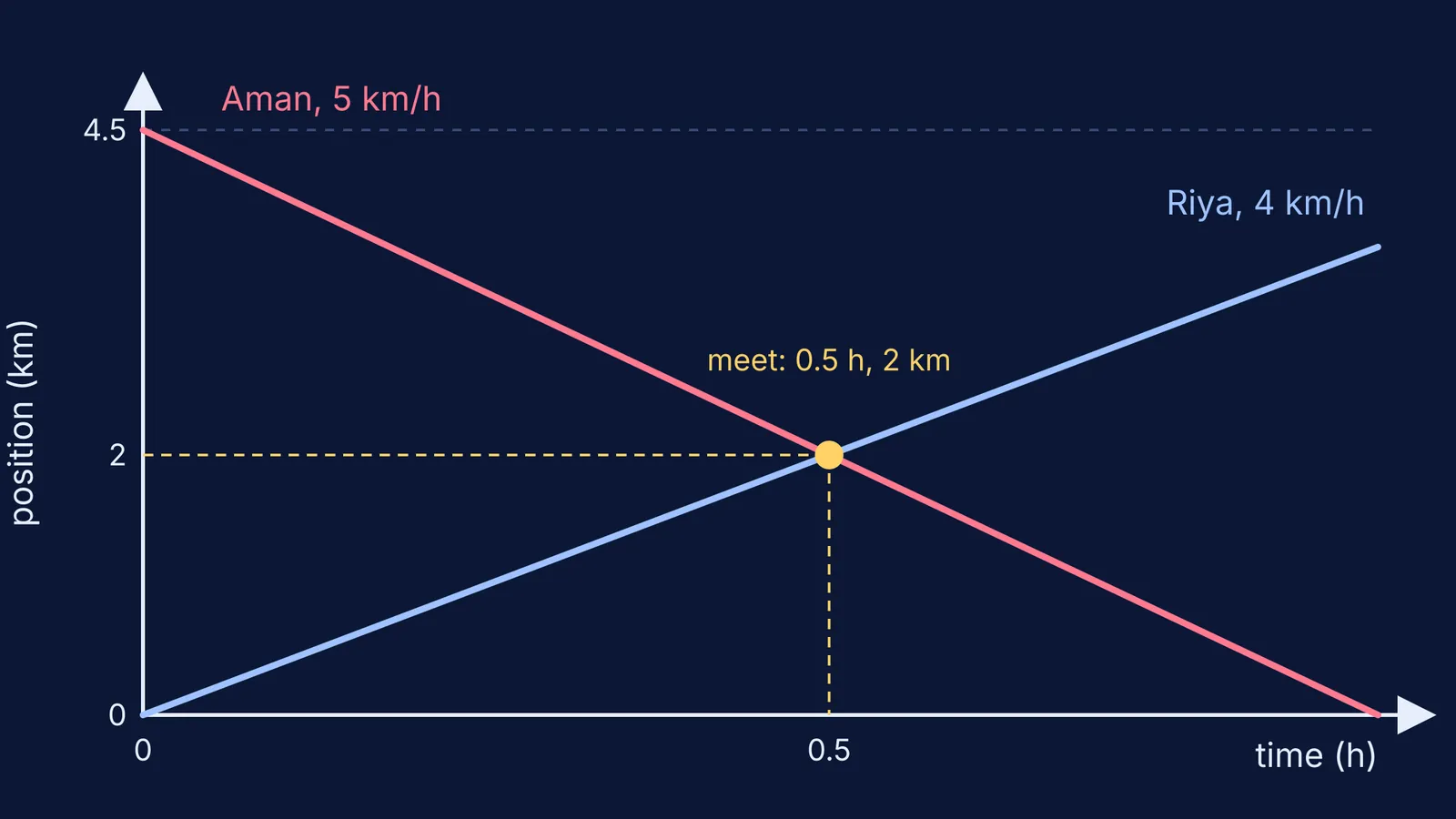
Worked example 1, walking towards each other: Riya walks at 4 km/h and Aman at 5 km/h, starting 4.5 km apart at the same moment.
Closing speed: 4 + 5 = 9 km/h.
Time: 4.5 / 9 = 0.5 h, which is 30 minutes.
Riya walks 4 x 0.5 = 2 km. Aman walks 5 x 0.5 = 2.5 km.
Check: 2 + 2.5 = 4.5 km, the full gap.
They meet 2 km from Riya's start, which is nearer her end because she is slower.
Worked example 2, one person starts late: same road, same speeds, but Aman leaves 18 minutes after Riya. Do not add speeds yet. For those 18 minutes (0.3 h), only Riya moves, covering 4 x 0.3 = 1.2 km. The gap is now 4.5 - 1.2 = 3.3 km.
Time after Aman starts: 3.3 / 9 h, which is 22 minutes.
Riya has walked for 18 + 22 = 40 minutes, so about 2.67 km from her start.
Aman has walked 5 x 22/60, about 1.83 km.
Check: 2.67 + 1.83 = 4.5 km.
Worked example 3, walking the same way: Aman is 0.5 km behind Riya and both walk in the same direction. Closing speed is 5 - 4 = 1 km/h, so he catches her after 0.5 h. Aman walks 2.5 km and Riya 2 km: the distances differ by the gap instead of adding to it. For more, see our guide to chase and overtaking problems in kinematics.
What mistakes cost marks in these problems?
Adding speeds from time zero when one person starts late, instead of first removing the head-start distance.
Mixing minutes and hours: convert 18 minutes to 0.3 h before multiplying by km/h.
Using the closing speed to find how far each person walks. Each person walks their own speed times the time.
Giving a meeting distance without saying from whose start.
Skipping the check: distances should add up to the gap for opposite directions and differ by it for the same direction.
Where else does this idea show up?
The same closing-speed idea runs through train problems, where the gap is the sum of the train lengths, as in our walkthrough of a train crossing a bridge. It also explains moving walkways, as in the escalator walking time problem.
If you get the right setup but keep losing marks on the steps, the Fermi Problem Library has worked problems with a step-by-step solver that explains the reasoning rather than printing an answer. If the sign rule still feels shaky, the Fermi Concept Library gives each physics concept its own lesson and its place in the map.
Try this one yourself: 6 km apart, speeds 3 km/h and 5 km/h, opposite directions. You should get 45 minutes and 2.25 km from the slower walker's start.