

On this page
In short
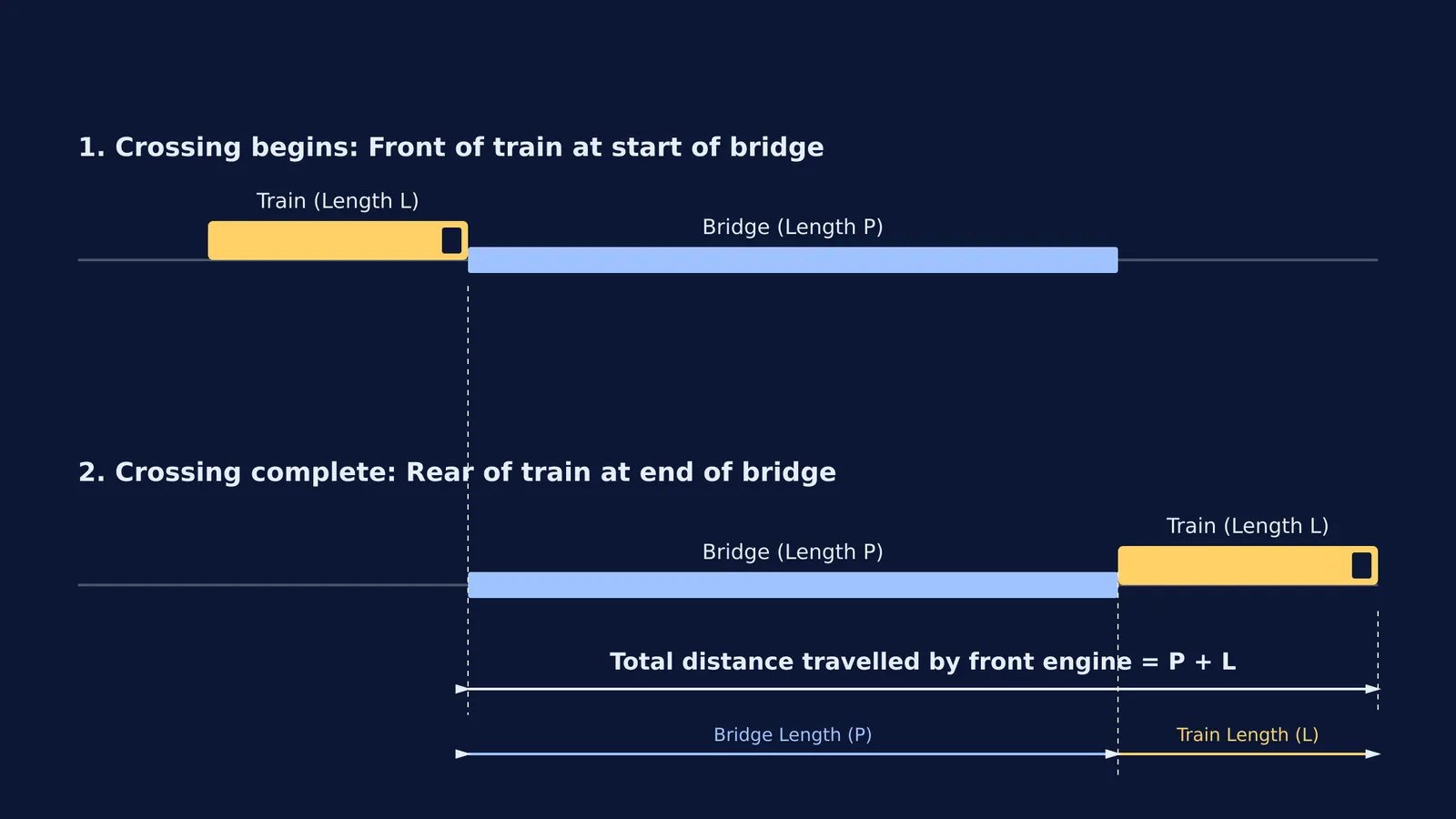
To find the time taken by a train to cross a bridge, you must add the length of the train to the length of the bridge. For instance, a 150-metre train crossing a 250-metre platform at 20 m/s takes exactly 20 seconds.
When you first learn the formula `Time = Distance / Speed`, distance usually means the straightforward gap between point A and point B. But when a physics problem asks for the time a train takes to cross a bridge or a platform, the standard rule changes: the distance you use in the formula is the length of the bridge *plus* the length of the train itself.
Why do we add the train's own length? Many students memorise this rule without understanding it, which leads to mistakes when the problem gets more complicated. The answer lies in what it means for a long object to physically "cross" a boundary.
Why is a train different from a single point?
If a person runs across a 100-metre bridge, the distance they cover is simply 100 metres because speed is the rate at which an object covers distance. In these simple problems, we treat the runner as a single point in space.
A train, however, is a long object. If a 400-metre-long train enters a 1,000-metre bridge, the crossing begins the precise moment the *front* engine rolls onto the start of the bridge. The front engine then travels exactly 1,000 metres to reach the far side.
Has the train crossed the bridge? Not yet. The front engine is safely off the bridge, but 400 metres of carriages are still trailing behind it on the tracks.
When does a train completely cross a bridge?
For the train to have completely crossed the bridge, the *rear* carriage must clear the far end.
To pull that last carriage off, the front engine must keep moving forward by exactly the length of the train. It has already travelled 1,000 metres (the length of the bridge), and now it must travel another 400 metres (its own length).
This means the front of the train has travelled 1,400 metres in total. Because every part of the train travels at the exact same speed, the time taken is calculated using this total distance.
If you struggle to picture this geometry in an exam, the Fermi Concept Library contains interactive lessons for every concept in physics, chemistry, biology, mathematics and computing, each with its own lesson and its place in the map.
What happens when two trains cross each other?
The exact same logic applies when two trains cross each other on parallel tracks. They have only "crossed" when the rear of the first train passes the rear of the second train.
To calculate the time this takes, we rely on relative velocity. In classical mechanics, the relative velocity of an object B with respect to observer A is the velocity of B measured in A's rest frame, calculated as vB − vA.
If the trains are moving in opposite directions, they close the gap faster. Their relative speed is the sum of their individual speeds.
If they are moving in the same direction (one overtaking the other), their relative speed is the difference between their speeds.
Regardless of the direction they travel, the total distance to be covered is always the sum of both train lengths. The faster train must pull its entire length past the entire length of the slower train before the crossing is complete.
How long does a train take to cross a platform?
Let's put this into practice using standard kinematic principles and unit conversions. A 150-metre-long train is travelling at 72 km/h. How long will it take to cross a 250-metre platform?
Find the total distance: Train length + Platform length = 150 + 250 = 400 metres.
Convert the speed: We need consistent units. To convert 72 km/h to metres per second (m/s), we divide by 3.6 (which is mathematically identical to multiplying by 5/18), giving 20 m/s.
Calculate the time: `Time = Distance / Speed` = 400 / 20 = 20 seconds.
It will take the train exactly 20 seconds to clear the platform.
If you want to test your understanding of motion, the Fermi Problem Library has worked problems with a step-by-step solver that explains the reasoning rather than printing an answer. You can also review how to set up the equations of motion or practice finding the average speed vs average velocity for complex journeys. Understanding the physical meaning of distance makes these numericals much easier to solve reliably.


