On this page
Business environment is where Business Studies stops looking inside the firm and looks out of the window. Case questions on it are easy marks once you can name the right dimension fast. Below: the 2026-27 syllabus, the ideas and a drill.
What does the CBSE 2026-27 syllabus include for business environment?
In the CBSE Business Studies curriculum for 2026-27, business environment is Unit 3 of Part A, and Units 1 to 3 together carry 16 of the 80 theory marks.
The curriculum lists three things for this unit: the concept and importance of business environment, its five dimensions (economic, social, technological, political and legal), and the concept and features of demonetisation. The 2025-26 curriculum listed exactly the same topics.
One thing to know: the NCERT chapter on business environment (reprint 2026-27) also covers the features and a long section on the 1991 policy changes, with their impact listed in its summary. The Unit 3 list names neither. But the same curriculum notes, in its Class XI part, that a "concept" includes meaning and features, so learn the features properly. Ask your teacher whether tests will include the 1991 section.
What is business environment, and what are its features?
NCERT defines business environment as the sum of all individuals, institutions and forces outside a business's control that may affect its performance: consumers, competitors, consumer groups, the government, courts and the media among them.
The textbook describes seven features:
Totality of external forces: everything outside the firm, taken together.
Specific and general forces: specific forces (customers, competitors, suppliers, investors) touch one firm directly; general forces (social, political, legal, technological) touch all firms, and any single firm only indirectly.
Inter-relatedness: the parts affect each other, so a social change can create an economic one.
Dynamic nature: it keeps changing.
Uncertainty: the future is hard to predict, more so in fast-moving fields such as fashion or IT.
Complexity: it is easier to understand in parts than as a whole.
Relativity: it differs from country to country and region to region.
What are the five dimensions of business environment?
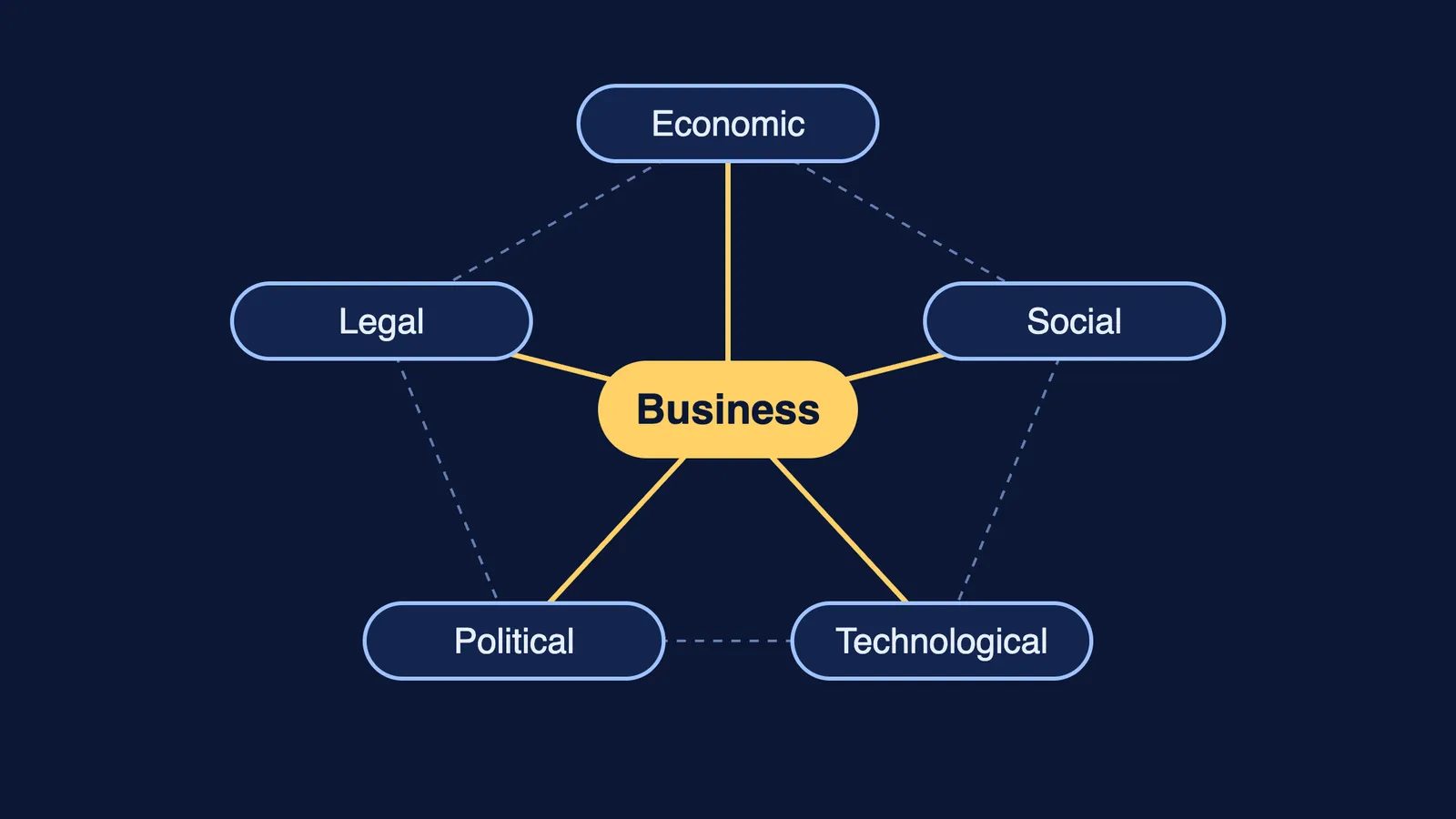
The NCERT chapter groups the general environment into five dimensions:
Economic: interest rates, inflation, people's disposable income, stock market indices and the value of the rupee.
Social: customs, traditions, values, social trends and what society expects of business.
Technological: scientific advances and innovations that create new products and new ways of producing and selling.
Political: how stable and peaceful the country is, and how elected representatives regard business.
Legal: laws passed by the legislature, government orders, court judgments, and decisions of commissions and agencies, whether central, state or local.
The textbook gives six reasons this matters: it helps a firm spot opportunities early (the first-mover advantage), spot threats, get resources, cope with rapid change, plan and set policy, and improve performance. The planning point leads into Unit 4; for Unit 2, see our guide to the principles of management of Fayol and Taylor.
What were demonetisation and the 1991 policy changes?
On 8 November 2016 the government withdrew the legal-tender status of the ₹500 and ₹1,000 notes, and the NCERT chapter says this made 86% of the money in circulation invalid. Its aims were to curb corruption, counterfeiting and black money. The textbook lists four features: a tax administration measure, a signal that tax evasion would not be tolerated, a shift of savings into the formal financial system, and a push towards a less-cash economy.
In its 1991 section, the textbook says the government announced a new industrial policy in July 1991 built on liberalisation, privatisation and globalisation. Its summary lists seven effects on business: more competition, more demanding customers, fast-changing technology, the need to change, the need to develop human resources, market orientation, and less budgetary support for the public sector. Economics students: see our guide to the 1991 LPG reforms, which covers the economy's side.
How do you answer a case question on business environment?
Use four steps:
Underline the phrase that describes a change outside the firm.
Ask what caused it: money, people, machines, government stability, or a law.
Name the dimension.
Quote the line from the case as your evidence.
Try it on this made-up case. Riya runs a small company in Pune that sells ready-to-cook millet mixes.
"Banks cut interest rates on small business loans." Economic: interest rates.
"More working parents want quick, healthy meals." Social: a lifestyle trend.
"Quick-commerce apps now deliver groceries in minutes." Technological: a new way of selling.
"A new rule requires clearer nutrition labels on packets." Legal: a regulation.
"The state has had a stable government for years, so investors are confident." Political: stability.
For extra marks, name a feature too: a health trend (social) that leads to a labelling rule (legal) shows inter-relatedness. Labelling rules also connect to consumer protection under the 2019 Act.
If you also take mathematics, the Fermi Problem Library has worked problems with a step-by-step solver that explains the reasoning rather than printing an answer.
Next step: write the five dimensions from memory and invent one case line for each.