On this page
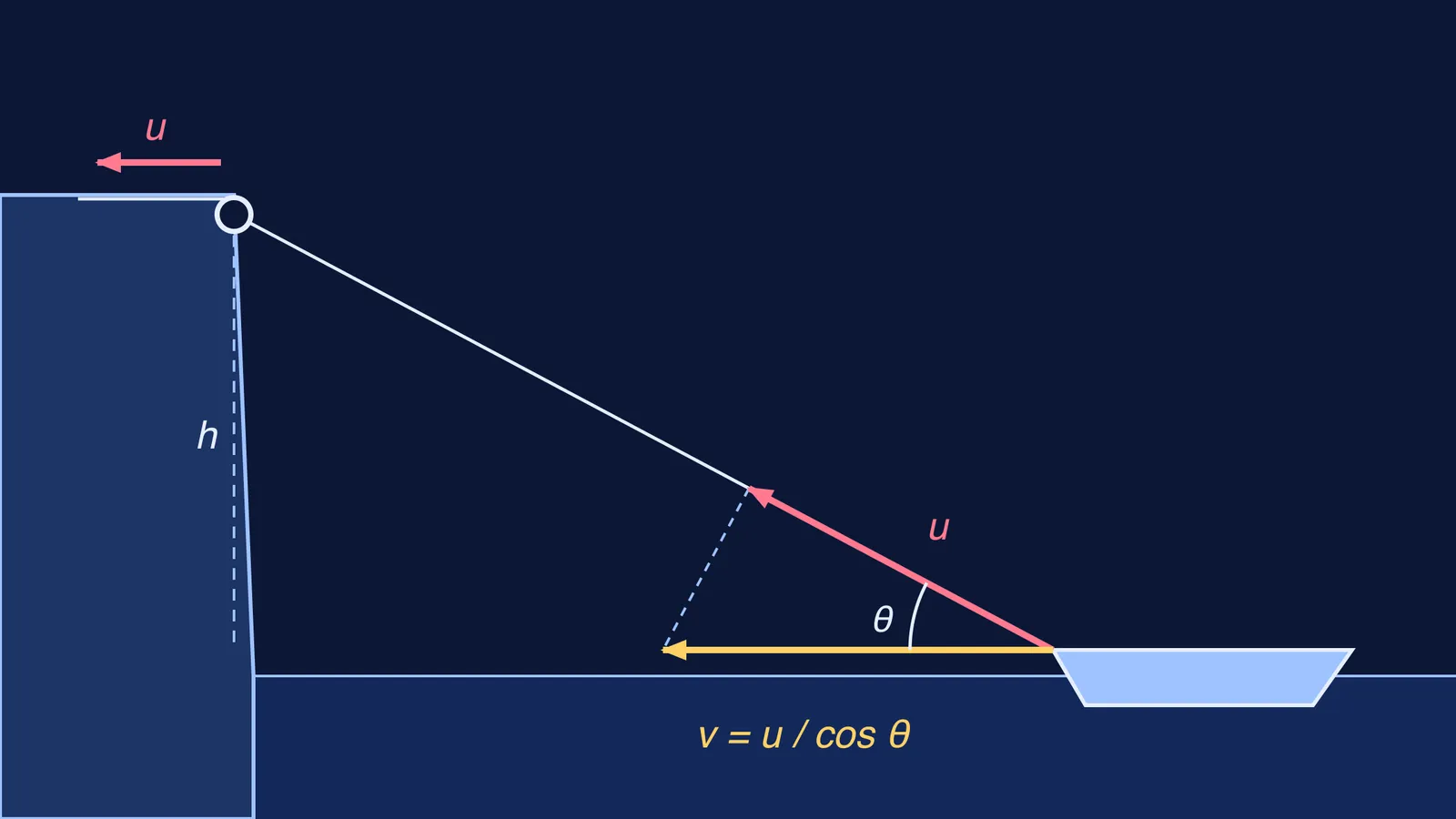
Someone stands on a cliff or a jetty and pulls in a rope tied to the front of a boat. The rope comes in at a steady speed u. How fast does the boat move? A common guess is u, or u cos θ. Both are wrong. The boat moves at u/cos θ, which is faster than the rope.
Below are two ways to get the answer, a worked example and a check you can run on any string problem.
Why does the boat move faster than the rope?
The rope cannot stretch, so only one thing is fixed: how fast the rope's length shrinks. That rate is u. But the boat does not move along the rope. It moves along the water, at an angle θ to the rope.
Split the boat's velocity v into two parts: one along the rope, one at right angles to it. The part along the rope is v cos θ. The part at right angles only swings the rope around the pulley. So the rope's length shrinks at v cos θ, and that must equal u:
v cos θ = u
so v = u/cos θ
When the boat is far away, θ is small, cos θ is close to 1 and v is only a little more than u. As the boat comes in, θ grows, cos θ shrinks and the boat speeds up. For a refresher, read our guide to the projection of a vector.
How do you derive v = u/cos θ with calculus?
The OpenStax calculus textbook gives a five-step method for related rates: name the variables, state what is given, find an equation linking them, differentiate with the chain rule, then substitute (OpenStax Calculus Volume 1, section 4.1). Here it works like this.
Let h be the height of the pulley above the bow, x the horizontal distance of the boat, and L the length of rope from bow to pulley.
Given: dL/dt = −u (the rope is getting shorter). Wanted: dx/dt.
Pythagoras: x² + h² = L².
Differentiate, with h constant: 2x (dx/dt) = 2L (dL/dt).
So dx/dt = (L/x)(dL/dt) = −u (L/x).
Since x/L = cos θ, the boat's speed is u/cos θ. The minus sign only says x is decreasing. For more practice with this method, see our guide to solving related rates problems step by step.
Worked example: how fast is the boat 8 m from the dock?
A Dartmouth calculus worksheet sets this version: the pulley is 1 m higher than the bow, the rope is pulled in at 1 m/s, and you want the boat's speed when it is 8 m from the dock (Dartmouth Math 3, related rates worksheet).
Rope length: L = √(8² + 1²) = √65 ≈ 8.06 m
cos θ = 8/√65 ≈ 0.992
Boat speed: v = 1/0.992 ≈ 1.008 m/s
Far out, the boat is barely faster than the rope. Bring it closer (our own calculation, same formula):
At x = 1 m: L = √2 m, so v = √2 ≈ 1.41 m/s
At x = 0.5 m: L ≈ 1.118 m, so v ≈ 2.24 m/s
The pull stays steady, yet the boat keeps speeding up.
Does the boat accelerate even if the rope speed is constant?
Yes. Differentiate v = uL/x once more and you get a = u²h²/x³, directed towards the cliff. With u = 1 m/s and h = 1 m, that is about 0.002 m/s² at 8 m but 8 m/s² at 0.5 m. Very close to the cliff the simple model stops being realistic.
The same idea, that a fixed length forces a link between two velocities, also gives you the angular velocity of a rod from the speeds of its two ends.
What is the common mistake in rope constraint problems?
The common slip is writing v = u cos θ, by resolving the rope's speed onto the water. Use this check before you write any constraint equation:
Which object's direction of motion do you know for sure? (The boat: horizontal.)
Take that object's velocity and resolve it along the string.
Set that component equal to the rate the string is pulled in.
Sanity test: should the answer be bigger or smaller than u? If the object moves at an angle to the string, it must be faster than the string.
If you want more of these, the Fermi Problem Library has worked problems with a step-by-step solver that explains the reasoning rather than printing an answer. If the picture of a velocity splitting along and across a rope still feels abstract, the Fermi Simulation Lab has interactive simulations for ideas that are easier to see than to read.