On this page
When you are given a rod of length L and the velocity vectors of its two ends, A and B, finding the rod's angular velocity (ω) is a standard mechanics problem. It tests a fundamental idea in physics: the geometry of a rigid body in two-dimensional motion. Whether you are learning mechanics or preparing for exams, you need a reliable method to relate these separate velocities.
What is the condition for a rigid body?
A rigid body is defined as an idealised object where the distance between any two given points remains perfectly constant over time. It cannot stretch, compress, or bend under any applied force.
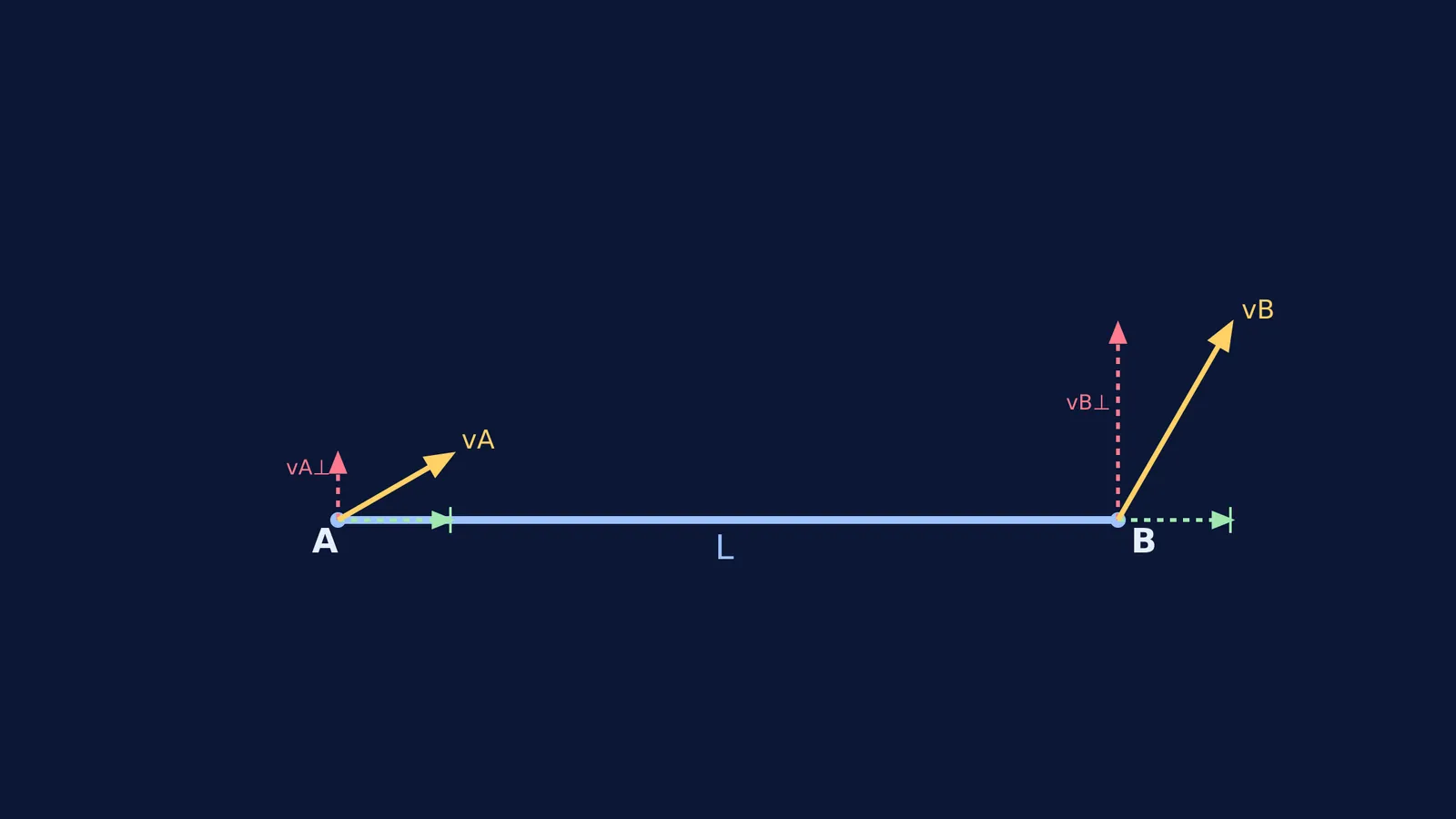
For a solid rod AB, this means the structural distance L between end A and end B never changes. Consequently, the component of velocity *along* the line joining A and B must be exactly the same for both ends. If one end had a higher velocity component along the longitudinal axis of the rod than the other, the rod would either be stretching apart or compressing together, which violates the definition of rigidity.
Why is the relative velocity perpendicular to the rod?
Because the parallel velocity components of both ends are mathematically identical, any measurable difference in their overall velocity vectors must exist entirely perpendicular to the rod.
According to the standard kinematic equations of rigid body dynamics, the velocity of any point on a rigid body is the sum of a reference point's translational velocity and a rotational component. As a result, the relative velocity between any two points is always perpendicular to the line connecting them (Rigid body dynamics, Wikipedia). The rod can translate through space in any direction, but its rotation is strictly governed by these perpendicular differences.
How do you find the angular velocity of a rod from the velocities of its ends?
To find the angular velocity ω, you only need the perpendicular components of the velocities at the ends. The relative perpendicular velocity of one end with respect to the other is the specific motion that causes the rod to rotate.
Here is the step-by-step framework to solve these problems without confusion:
Resolve the vectors: Break down the given velocity vectors of both ends (vA and vB) into components parallel to the rod and perpendicular to the rod (vA⊥ and vB⊥).
Check the parallel components: Verify that the parallel component of A equals the parallel component of B. If you are missing one of the initial speeds in a problem, you can use this equivalence to find it.
Find the relative perpendicular velocity: Subtract the perpendicular component of A from the perpendicular component of B. If they point in the same transverse direction (e.g., both "up" relative to the rod), subtract their magnitudes (|vB⊥ − vA⊥|). If they point in opposite directions, add their magnitudes.
Calculate angular velocity: Divide this relative perpendicular velocity by the total length of the rod (L).
The formula is: ω = |vB⊥ ± vA⊥| / L
If you want to review rigid body constraints and standard formulas before trying more problems, the Fermi Concept Library contains every concept in physics, each with its own lesson and its place in the map.
A worked example
Let's apply this framework to a specific calculation.
Suppose a rigid rod AB of length 2 metres is moving in a plane. At a given instant, end A has a velocity of 10 m/s at an angle of 30° to the rod. End B moves such that its velocity makes an angle of 60° with the rod, on the same side. What is the angular velocity of the rod?
Step 1: Equate the parallel components End A has a parallel velocity of 10 cos(30°) = 10 × (√3 / 2) = 5√3 m/s. Because the rod is rigid, end B must have the exact same parallel velocity: vB cos(60°) = 5√3 vB × 0.5 = 5√3 vB = 10√3 m/s (approximately 17.32 m/s).
Step 2: Find the perpendicular components End A has a perpendicular velocity of 10 sin(30°) = 10 × 0.5 = 5 m/s. End B has a perpendicular velocity of 10√3 sin(60°) = 10√3 × (√3 / 2) = 15 m/s.
Step 3: Calculate angular velocity Both perpendicular components point in the same direction (same side of the rod). The relative perpendicular velocity is the difference between them: 15 − 5 = 10 m/s. Finally, divide by the rod's length (2 metres): ω = 10 / 2 = 5 rad/s.
When you get stuck on a tricky relative velocity problem, the Fermi Problem Library provides worked problems with a step-by-step solver that explains the reasoning rather than printing an answer.
What is the instantaneous center of rotation?
Another powerful method for finding angular velocity is locating the Instantaneous Center of Rotation (ICR). At any given moment, a moving rigid body in a 2D plane appears to be purely rotating around a single mathematical point.
If you know the directions of the velocity vectors at ends A and B, you can find the ICR geometrically. Draw a line perpendicular to vA starting from point A, and another line perpendicular to vB starting from point B. The exact point where these two lines intersect is the ICR.
Once you have the ICR, the angular velocity ω is simply the speed of any point divided by its distance from the ICR: ω = vA / rA = vB / rB
By mastering the difference between parallel and perpendicular components, you can avoid the common rotational motion mistakes that frequently appear in exams. Using both the component method and the ICR method ensures you have a robust toolkit for any rigid body scenario, such as a bead sliding on a smooth rotating rod.