

On this page
A projection asks one question: how much of vector a lies along vector b? Picture light shining straight down onto the line of b. The shadow a casts on that line is the projection, and the formula, the sign and the perpendicular part all follow from one dot product.
How do you find the projection of one vector on another?
NCERT's Class 12 Mathematics textbook (Chapter 10, Vector Algebra, section 10.6.2) gives the projection of a on b as a·b̂, which is the same as (a·b)/|b| (NCERT, Vector Algebra). OpenStax Calculus Volume 3 calls this number the scalar projection and writes the vector projection as (a·b/|b|²)b, a vector along b (OpenStax, The Dot Product).
So the method is four steps:
Find the dot product: a·b = a1b1 + a2b2 + a3b3.
Find the length of b: |b| = √(b1² + b2² + b3²).
Divide: scalar projection = a·b/|b|. This is a number, and it can be negative.
For the vector projection, multiply that number by the unit vector b/|b|, which gives (a·b/|b|²)b.
Notice that you divide by the length of b, the vector you are projecting onto. Dividing by |a| gives the projection of b on a instead. The two are equal only in special cases, which we work through in when the projection of a on b equals b on a.
Worked example: projecting a = i + 3j on b = 3i + j
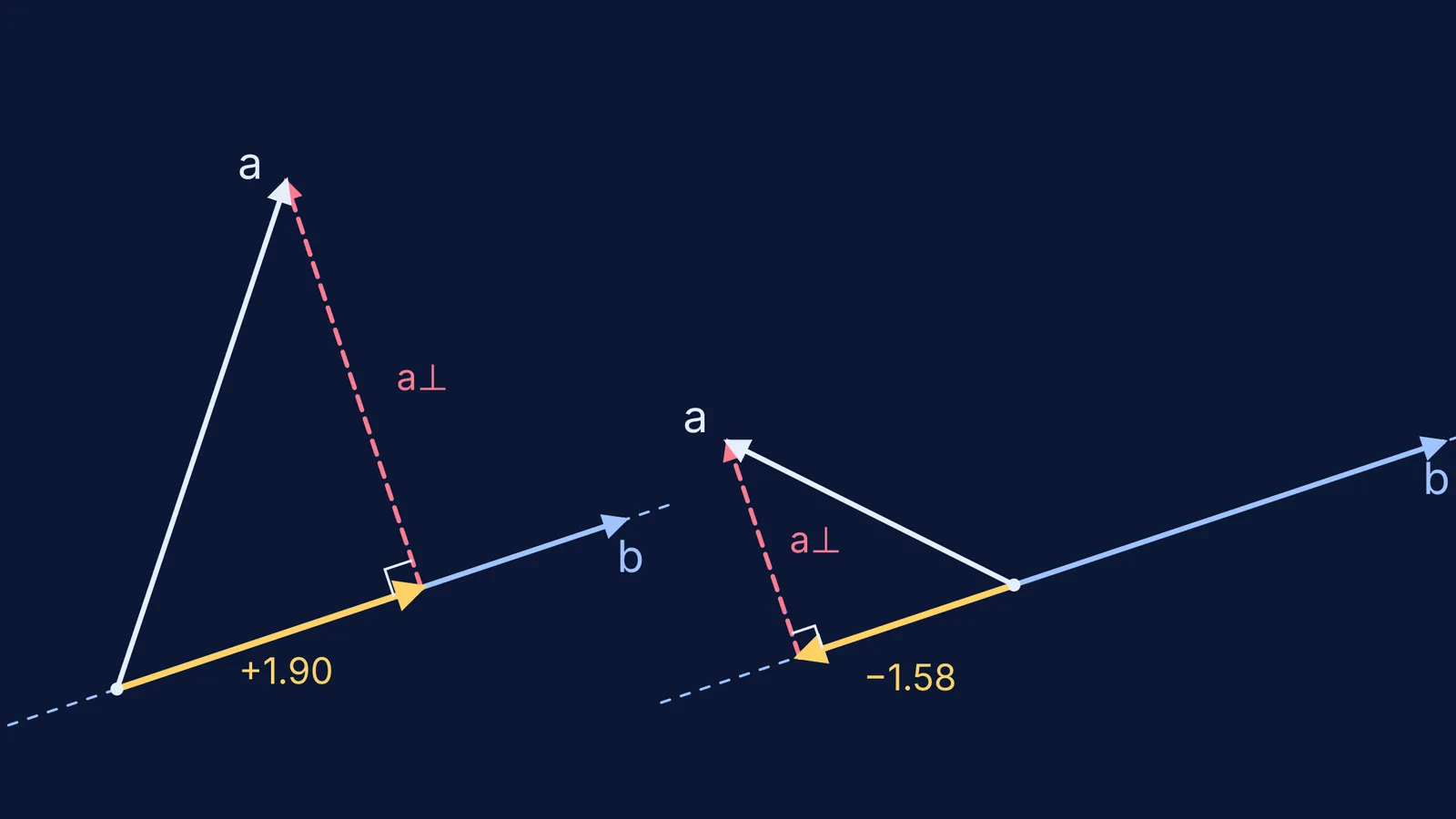
This is the left half of the diagram above.
Dot product: a·b = (1)(3) + (3)(1) = 6.
Length of b: |b| = √(9 + 1) = √10.
Scalar projection: 6/√10 = 3√10/5, about 1.90.
Vector projection: (6/10)(3i + j) = 1.8i + 0.6j.
Check it: the length of 1.8i + 0.6j is √(3.24 + 0.36) = √3.6, about 1.90, matching the scalar projection.
What does a negative projection mean?
NCERT defines the dot product as a·b = |a||b|cos θ, where θ is the angle between the vectors (NCERT, Vector Algebra). Divide both sides by |b| and the scalar projection becomes |a|cos θ. Lengths are never negative, so the sign comes only from cos θ.
θ less than 90°: positive, the shadow points along b.
θ equal to 90°: zero; NCERT notes the projection vector is the zero vector.
θ more than 90°: negative, the shadow points opposite to b.
NCERT says the same thing in words: the projection vector points the same way as the line or the opposite way, depending on whether cos θ is positive or negative.
Try a = −2i + j on the same b = 3i + j (the right half of the diagram). The dot product is −6 + 1 = −5, so the scalar projection is −5/√10, about −1.58. The vector projection is (−5/10)(3i + j) = −1.5i − 0.5j, which points backwards along b. To see the obtuse case move, our post on vector projection as a shadow at 120° walks through it.
How do you find the part of a perpendicular to b?
Whatever is not the shadow is the part of a at right angles to b:
a⊥ = a − (a·b/|b|²)b
OpenStax uses exactly this split in its Example 2.28, writing a vector as the sum of its projection and an orthogonal part, then checking that their dot product is zero (OpenStax, The Dot Product).
For the first example, a⊥ = (i + 3j) − (1.8i + 0.6j) = −0.8i + 2.4j. Two quick checks:
Dot with b: (−0.8)(3) + (2.4)(1) = 0, so it really is perpendicular.
Pythagoras: |a|² = 10, and 3.6 + 6.4 = 10, where 3.6 is the squared projection and 6.4 is |a⊥|².
For the negative example, a⊥ = (−2i + j) − (−1.5i − 0.5j) = −0.5i + 1.5j, and (−0.5)(3) + (1.5)(1) = 0 again.
Physics asks for this split constantly, such as the part of a force along a ramp and the part pressing into it. It is the same idea as finding the angle between vectors with the dot product, read the other way round.
Which mistakes cost marks in projection questions?
Run this checklist before you move on:
Did you divide by |b|, the vector you are projecting onto, and not |a|?
For the vector projection, did you divide by |b|², not |b|? Dividing by |b| once gives a vector of the wrong length.
Did you keep the minus sign and say what it means?
Does your perpendicular part dot with b to give zero?
Do the squared projection and |a⊥|² add up to |a|²?
If one of these checks fails and you cannot see why, the Fermi Problem Library has worked problems with a step-by-step solver that explains the reasoning rather than printing an answer. If the dot product itself feels shaky, start with its lesson in the Fermi Concept Library, then redo both examples without looking.


