

On this page
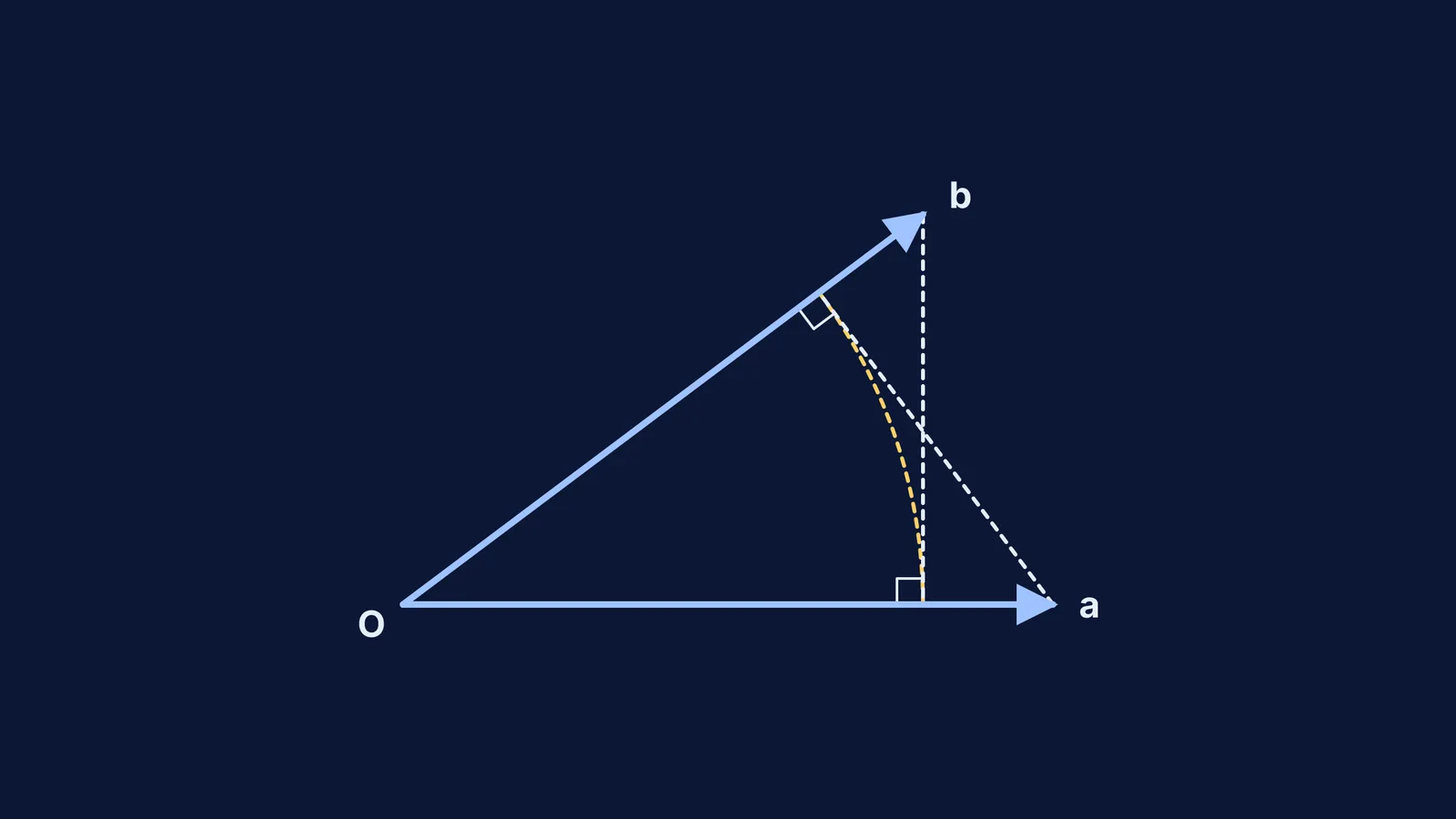
When you shine a light directly above a vector, its "shadow" on another vector is called the scalar projection. A common question in vector algebra is: when do two vectors cast the exact same shadow on each other?
To find out, we have to look at the formula for scalar projection and set the two projections equal.
What is the formula for scalar projection?
The scalar projection of a vector a onto a non-zero vector b gives the length of the projection, and it is written as a single number. According to Wikipedia's definitions of vector projection, it is calculated using the dot product: the scalar projection of a on b is (a·b)/|b|.
Similarly, if we reverse the roles, the scalar projection of b onto a is (a·b)/|a|.
Notice that the numerator is the dot product (a·b) in both cases, because the dot product is commutative. The only difference is the denominator, which is always the magnitude of the vector being projected *onto*.
When are the projections of a on b and b on a equal?
To find when these two shadows match, we set their formulas equal to each other:
(a·b) / |b| = (a·b) / |a|
Next, we multiply both sides by |a||b| to clear the fractions:
|a|(a·b) = |b|(a·b)
Now, we bring everything to one side of the equation:
|a|(a·b) − |b|(a·b) = 0
Finally, we factor out the common term (a·b):
(a·b) ( |a| − |b| ) = 0
For this product to be zero, one of the two factors must be zero. This gives us two possible conditions:
a·b = 0
|a| − |b| = 0, which means |a| = |b|
If you are stuck on the rules of vector projections, the Fermi Concept Library has every concept in physics, chemistry, biology, mathematics and computing, each with its own lesson and its place in the map.
What do these conditions mean geometrically?
The algebra tells us there are exactly two situations where the projections are equal.
Condition 1: The vectors are perpendicular If a·b = 0, the two vectors are orthogonal (perpendicular). Because the angle between them is 90°, neither vector casts a shadow on the other. Both projections are exactly zero, so they are naturally equal.
Condition 2: The vectors have the same magnitude If |a| = |b|, the two vectors have the same length. If you place them tail-to-tail, they form two sides of an isosceles triangle. Because of this symmetry, the perpendicular dropped from a to b cuts off the exact same length as the perpendicular dropped from b to a.
If you are tackling problems like this and want to see how to avoid standard pitfalls, read our guide on Vectors in JEE physics: common errors and how to avoid them.
How does this work in a practical example?
Let's test this rule with a practical example. We will use a pair of vectors that have the same length. Suppose we have a vector a = (3, 4) and a vector b = (4, 3).
First, we need to find their magnitudes. The magnitude of a 2D vector (x, y) is √(x² + y²):
The length of a is |a| = √(3² + 4²) = √(9 + 16) = √25 = 5.
The length of b is |b| = √(4² + 3²) = √(16 + 9) = √25 = 5.
Because |a| = |b|, our mathematical rule says their projections onto each other must be equal. Let's calculate those projections directly to be absolutely sure.
The dot product of the two vectors is the sum of the products of their corresponding components: a·b = (3 × 4) + (4 × 3) = 12 + 12 = 24.
Now, we can find the projection of a on b: (a·b) / |b| = 24 / 5 = 4.8.
Next, we find the projection of b on a: (a·b) / |a| = 24 / 5 = 4.8.
As expected, both projections are exactly 4.8. When you try to solve a complex vector problem and do not know the next step, the Fermi Problem Library has worked problems with a step-by-step solver that explains the reasoning rather than printing an answer.
Let's look at a second example to test the other condition: when the vectors are perpendicular. Suppose a = (2, 0) and b = (0, 3). These vectors lie along the x-axis and y-axis, respectively.
Their magnitudes are different: |a| = 2 and |b| = 3. However, their dot product is: a·b = (2 × 0) + (0 × 3) = 0 + 0 = 0.
The projection of a on b is 0 / 3 = 0. The projection of b on a is 0 / 2 = 0.
Even though their lengths are different, the perpendicular relationship means they cast no shadow on each other. Both projections are exactly zero, so they are equal.
For more practice with dot and cross products, review Vector algebra for JEE maths: dot, cross and triple products.


