On this page
Can a voltmeter measure the barrier potential of a p-n junction?
The question "Can the potential barrier across a p-n junction be measured by simply connecting a voltmeter across the junction?" appears in the NCERT Exemplar for Class 12 Physics. The short answer is no.
Start with what the NCERT Class 12 textbook, Chapter 14 says. Electrons diffuse from n to p and holes from p to n, leaving behind fixed charged ions. The n-side ends up positive relative to the p-side, and this potential difference is the barrier potential. The textbook also says that in a p-n junction under equilibrium there is no net current, because diffusion current and drift current balance. And a real diode is a p-n junction with metallic contacts at its ends. That last detail is the key to the whole question.
If the n-p charge separation is new to you, read how the depletion layer forms in a p-n junction first.
Why do the contact potentials cancel the barrier?
A voltmeter connects through metal probes and wires, so you never measure "p to n". You measure a loop: metal to p, p to n, n to metal, then back through the meter.
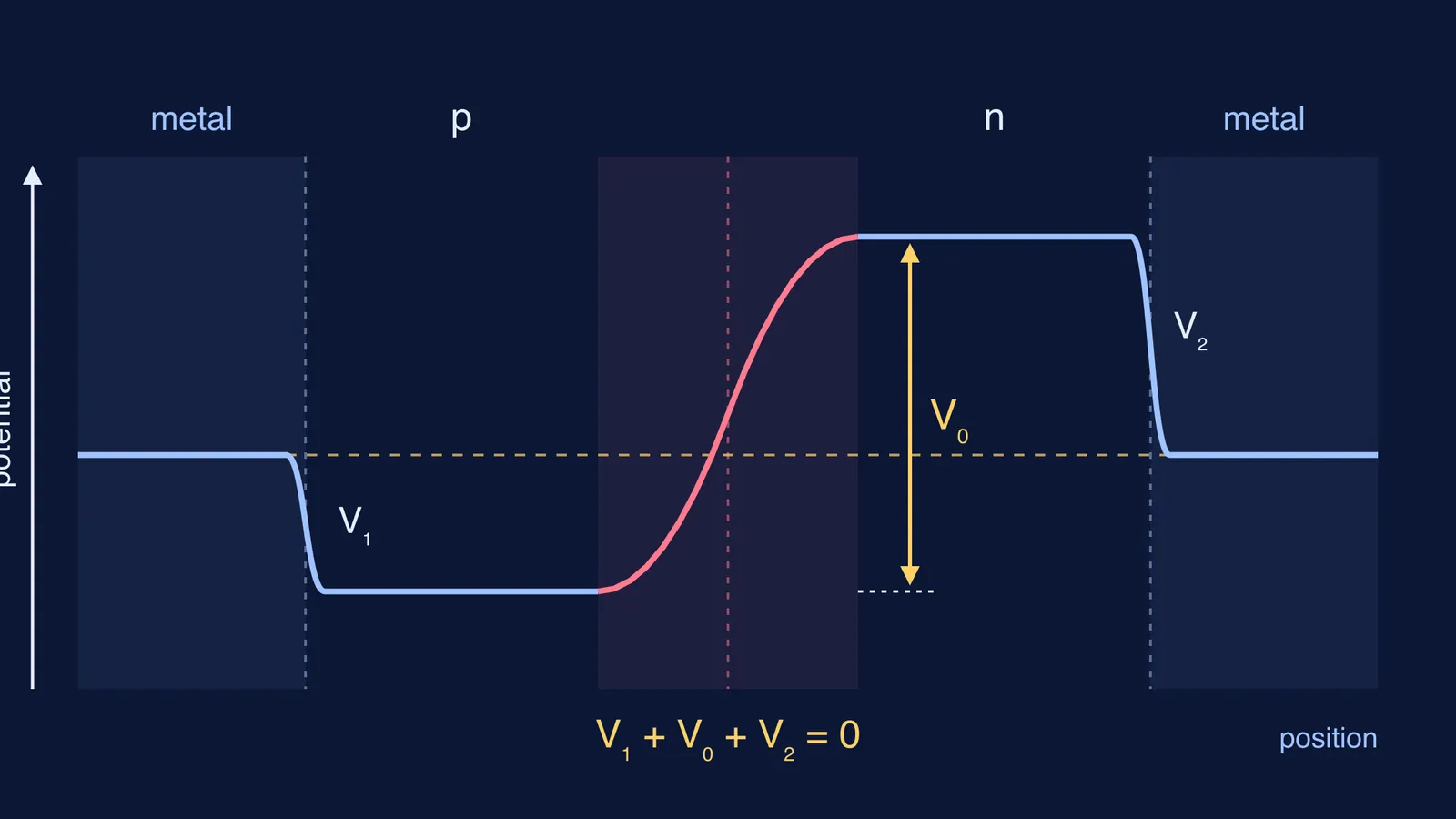
Every place two different materials touch, carriers flow until equilibrium, just as they do at the p-n junction. Each contact therefore develops its own contact potential. Call them V1 (metal to p) and V2 (n to metal). Around the closed loop, in equilibrium:
V1 + V0 + V2 = 0
Safa Kasap of the University of Saskatchewan states this directly in his pn junction e-booklet: the built-in voltage "is not the voltage across the diode which is made up of Vo as well as the contact potentials at the metal to semiconductor junctions at the electrodes." He adds: "If we add Vo and the contact potentials at the electroded ends we will find zero."
In the diagram above, the potential steps down at one contact, climbs by V0 across the junction and steps down again, so both metal ends finish level.
Why can't an unbiased diode push current through the meter?
Suppose a diode on your desk, at the same temperature as the room, showed a steady voltage. A resistor connected across it would keep warming, turning the room's heat into electrical work with nothing else changing. The second law of thermodynamics rules that out.
The NCERT picture says the same thing: at equilibrium, diffusion and drift cancel and the net current is zero. An unbiased diode in the dark cannot drive current through any external path, including a meter. This is the same idea behind asking whether current can flow without a potential difference: the loop needs a net emf, and here the net emf is zero.
Isn't the voltmeter's high resistance the real reason?
Some answer keys say the voltmeter's resistance is too high compared with the junction. Even a perfect voltmeter with infinite resistance would read zero, because the potentials around the loop add to zero. Resistance changes how much current a source can push. It cannot create a reading where there is no net emf.
How big is the hidden barrier voltage?
Kasap's booklet gives the built-in potential as V0 = (kT/e) ln(NaNd/ni²).
Use NCERT's own numbers from Example 14.2: silicon has 5 × 10^28 atoms per m³, 1 ppm doping gives 5 × 10^22 dopant atoms per m³, and ni = 1.5 × 10^16 per m³. Take Na = Nd = 5 × 10^22 per m³.
kT/e at 300 K: with k = 1.380649 × 10^-23 J/K (NIST) and e = 1.602176634 × 10^-19 C (NIST), kT/e = 0.0259 V.
NaNd/ni² = (2.5 × 10^45) / (2.25 × 10^32) = 1.11 × 10^13.
ln(1.11 × 10^13) = 30.0.
V0 = 0.0259 × 30.0 = 0.78 V.
So about 0.78 V sits across the junction, and the two contact potentials must add to about -0.78 V. The voltmeter reads 0 V.
If you want to check the arithmetic of problems like this one line at a time, the Fermi Problem Library has worked problems with a step-by-step solver that explains the reasoning rather than printing an answer.
How do you write this answer in the exam?
For a 2 or 3 mark answer, hit these points in order:
No, the voltmeter reads zero.
Connecting a voltmeter creates two metal-semiconductor contacts, each with its own contact potential.
In equilibrium, the two contact potentials and the barrier potential add to zero around the loop.
So there is no net emf, and the junction drives no current through the meter. If it did, it would turn surrounding heat into steady electrical work, which the second law forbids.
For more traps in this chapter, see common mistakes in semiconductor questions. If contact potential and equilibrium still feel shaky, the Fermi Concept Library gives every concept in physics its own lesson, so you can revisit diffusion and drift first.