On this page
Write each side using the angle θ and this question takes a few lines. The same idea answers the usual follow-up about |a × b|² + (a · b)².
If |a × b| = a · b, what is the angle between the vectors?
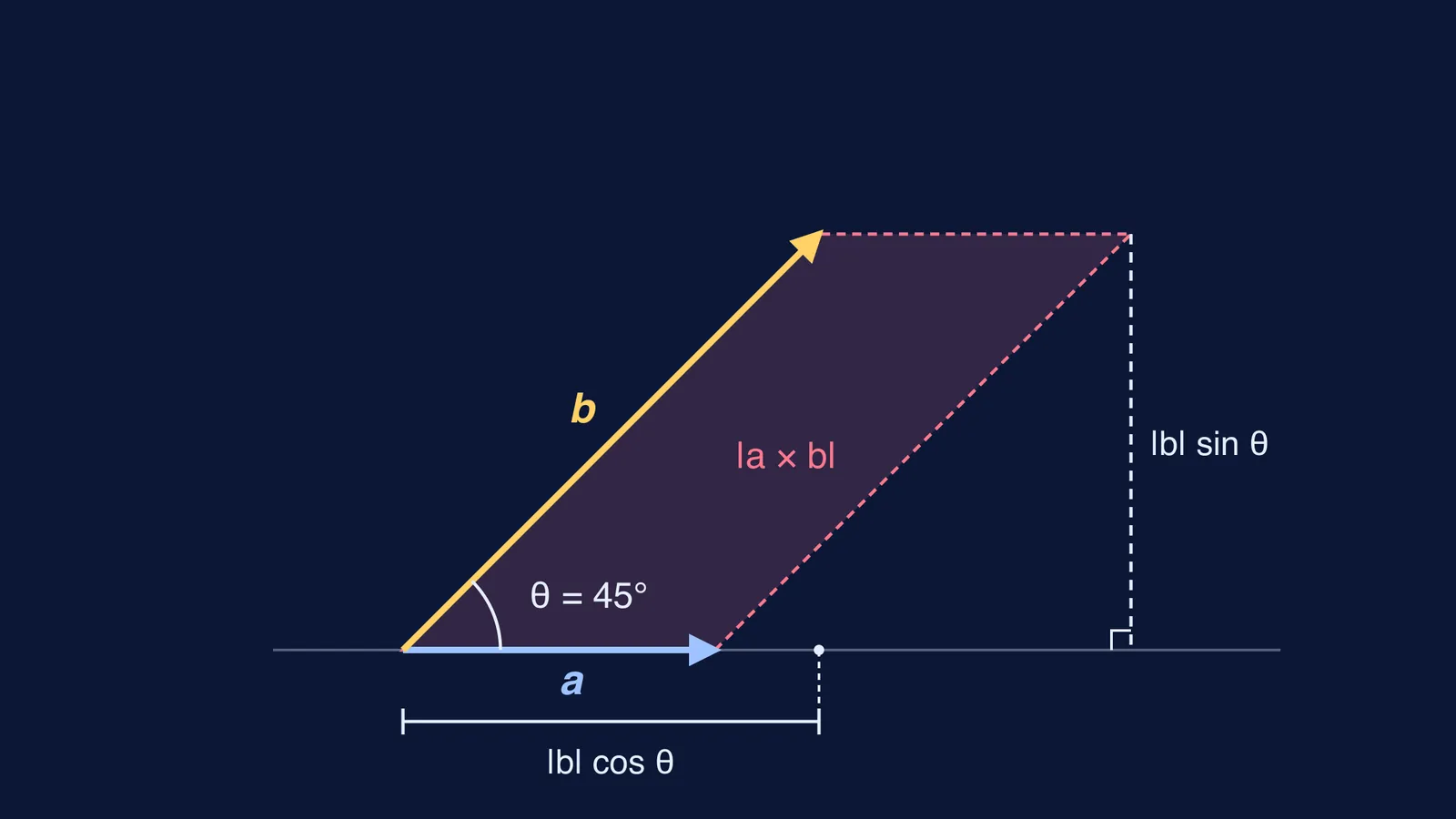
Start from the two definitions. The dot product of two vectors is the product of their magnitudes and the cosine of the angle between them, a · b = |a||b| cos θ, with 0 ≤ θ ≤ π (OpenStax Calculus Volume 3, Theorem 2.4). The magnitude of the cross product is |a × b| = |a||b| sin θ, for 0° ≤ θ ≤ 180° (OpenStax Calculus Volume 3, Theorem 2.7).
Now solve it step by step:
Write both sides with θ: |a||b| sin θ = |a||b| cos θ.
Cancel |a||b|, which is not zero for non-zero vectors.
Divide both sides by cos θ to get tan θ = 1.
Check the division was safe: at θ = 90°, cos θ = 0 but sin θ = 1, so the sides would be |a||b| and 0. So cos θ is not zero.
Find θ in the range 0° to 180°. Only 45° has tan θ = 1 there, so θ = 45°, or π/4 radians.
For a refresher, see how to find the angle between vectors using the dot product.
What is |a × b|² + (a · b)² equal to?
It always equals |a|²|b|², whatever the angle. The OpenStax proof of Theorem 2.7 uses exactly this step, |a × b|² = |a|²|b|² − (a · b)² (OpenStax Calculus Volume 3, section 2.4). Move the dot-product term across and you get |a × b|² + (a · b)² = |a|²|b|², which is Lagrange's identity. The quick reason: sin²θ + cos²θ = 1, multiplied through by |a|²|b|².
At 45° there is a bonus. Since sin 45° = cos 45°, the two terms are equal, so each one is exactly half of |a|²|b|². Our longer post on Lagrange's identity for cross and dot products shows the component proof.
A worked example with numbers
Take a = 3i and b = 4i + 4j.
Magnitudes: |a| = 3 and |b| = √(16 + 16) = √32 = 4√2.
Dot product: a · b = 3 × 4 + 0 × 4 = 12.
Cross product: a × b = 3i × (4i + 4j) = 12(i × i) + 12(i × j) = 0 + 12k, so |a × b| = 12.
The condition holds: |a × b| = a · b = 12.
Check the angle: cos θ = 12 ÷ (3 × 4√2) = 1/√2, so θ = 45°.
Check the identity: |a × b|² + (a · b)² = 144 + 144 = 288, and |a|²|b|² = 9 × 32 = 288.
Now the exam version. Suppose |a| = 3, |b| = 4 and |a × b| = a · b.
Angle: θ = 45°, as above.
Dot product: a · b = 3 × 4 × cos 45° = 12/√2 = 6√2.
Cross-product magnitude: also 6√2.
|a × b|² + (a · b)² = 72 + 72 = 144, which is 3² × 4². You can write this one down without finding θ at all.
|a + b|² = |a|² + |b|² + 2(a · b) = 9 + 16 + 12√2 = 25 + 12√2.
What if the condition is slightly different?
Use the same divide-by-cos method when one symbol changes:
|a × b| = a · b gives tan θ = 1, so θ = 45°.
|a × b| = |a · b| gives |tan θ| = 1, so θ = 45° or 135°.
|a × b| = √3 (a · b) gives tan θ = √3, so θ = 60°.
√3 |a × b| = a · b gives tan θ = 1/√3, so θ = 30°.
|a × b| = 0 means the vectors are parallel, so θ = 0° or 180°. Our post on when the cross product of two vectors is zero covers that case.
A three-question check before you write the answer
Is there an absolute value on the dot product? If not, a · b cannot be negative here, and 135° is out.
Did you divide by something that could be zero? Check the case cos θ = 0 separately.
Do your numbers satisfy |a × b|² + (a · b)² = |a|²|b|²? If not, there is an arithmetic slip.
If you slip on the follow-up parts, the Fermi Problem Library has worked problems with a step-by-step solver that explains the reasoning rather than printing an answer. If the trouble is the definitions themselves, the Fermi Concept Library gives every concept in mathematics its own lesson and its place in the map.