On this page
Draw a circle, the tangent at a point A, and a chord AB from that point. The alternate segment theorem tells you which angle inside the circle equals the angle between them. Once you can spot it, many tangent questions shrink to one step.
What does the alternate segment theorem say?
Euclid stated it as Proposition 32 of Book III of the Elements: "If a straight line touches a circle, and from the point of contact there is drawn across, in the circle, a straight line cutting the circle, then the angles which it makes with the tangent equal the angles in the alternate segments of the circle" (Euclid's Elements, Book III, Proposition 32, D. E. Joyce's edition).
In modern terms, the angle between a chord and the tangent at one of its endpoints equals the angle in the alternate segment; the result is also called the tangent-chord theorem (Brilliant, Alternate Segment Theorem).
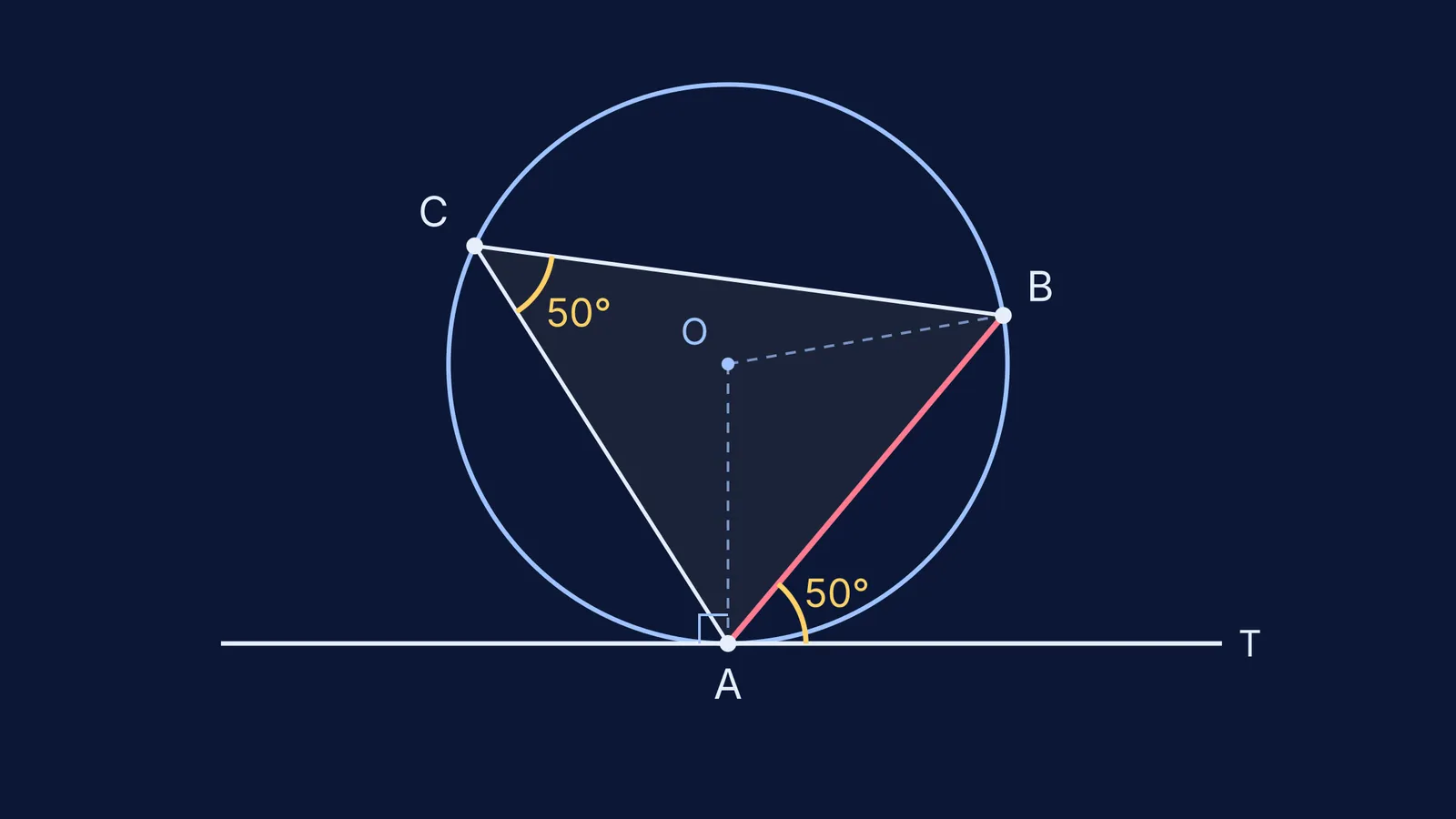
"Alternate" is the word that trips people up. A chord cuts the circle into two segments. The angle between tangent AT and chord AB opens into one; the angle it equals, ∠ACB, has its vertex C in the other. In the diagram at the top, both are 50°.
How do you prove the alternate segment theorem?
The proof needs two earlier results from Book III. A radius drawn to the point of contact is perpendicular to the tangent (Proposition 18). The angle at the centre is double the angle at the circumference standing on the same arc (Proposition 20).
Let O be the centre, and let the tangent AT make an acute angle x with the chord AB. Let C be any point on the major arc.
OA is perpendicular to AT, so ∠OAB = 90° − x.
OA and OB are both radii, so triangle OAB is isosceles and ∠OBA = 90° − x.
The angles of triangle OAB add to 180°, so ∠AOB = 180° − 2(90° − x) = 2x.
The angle at the circumference is half the angle at the centre, so ∠ACB = x.
On the other side of the chord, the tangent makes 180° − x with AB, which should equal the angle at any point D on the minor arc. It does: in cyclic quadrilateral ACBD, opposite angles of a cyclic quadrilateral add to two right angles (Proposition 22), so ∠ADB = 180° − x.
Euclid's own proof instead uses the diameter through A and the right angle in a semicircle (Proposition 31), which you can test on our page on the angle in a semicircle and other circle theorems.
Worked example: how do you find angles from a tangent?
Triangle ABC is drawn inside a circle, and a straight line is the tangent at A. On B's side, the tangent makes 64° with AB. On C's side, it makes 48° with AC. Find all three angles of the triangle.
Chord AB: the angle in the alternate segment is the angle at C, so ∠ACB = 64°.
Chord AC: the angle in the alternate segment is the angle at B, so ∠ABC = 48°.
Angle sum of the triangle: ∠BAC = 180° − 64° − 48° = 68°.
Check: the three angles at A sit on a straight line, and 64° + 68° + 48° = 180°. If this fails, you matched a chord to the wrong angle.
Where is the alternate segment theorem used?
Use it whenever a problem gives a tangent and asks about angles inside the circle. A classic example:
Claim: if the tangent at A is parallel to the chord BC, then AB = AC.
By the alternate segment theorem, the angle between the tangent and AB (on B's side) equals ∠ACB.
The tangent is parallel to BC, so the same angle equals ∠ABC, as alternate angles with AB as the transversal.
So ∠ABC = ∠ACB, and triangle ABC is isosceles with AB = AC.
It also pairs well with two tangents from an outside point P touching at A and B: triangle PAB is isosceles, and each base angle equals the angle on AB in the alternate segment. Our explainer on why tangents from an external point are equal covers the first half of that argument.
What mistakes should you check for?
Before you write the answer, check:
Wrong partner. The matching angle stands on the chord with its vertex elsewhere on the circle, never at A.
Wrong line. The chord must start at the point of contact.
Wrong side. The tangent makes x on one side of the chord and 180° − x on the other; each matches the segment opposite it.
No check. The angles at the point of contact along the tangent must add to 180°.
For more tangent problems, the Fermi Problem Library has worked problems with a step-by-step solver that explains the reasoning rather than printing an answer. If the angle-at-the-centre result feels shaky, it has its own lesson in the Fermi Concept Library.