On this page
Mixture questions turn up in school arithmetic, aptitude tests and chemistry numericals. Most reduce to one question: in what ratio should two things be mixed to land on a price or strength between them? The alligation method answers it with two subtractions.
What is the alligation method?
Alligation is “an old-fashioned and practical method of solving arithmetic problems related to mixtures of ingredients or materials”, according to the Wikipedia entry on alligation, which notes that pharmacies still use it for quick calculations. The version you need is the cross-difference rule:
Write the cheaper (or weaker) value on the left and the dearer (or stronger) value on the right.
Write the mean, the price or strength you want, in the middle.
Subtract across: dearer minus mean, and mean minus cheaper.
Cheaper : dearer = (dearer − mean) : (mean − cheaper).
Each ingredient gets the difference from the other side. That swap is the whole trick, and the step most people get backwards.
How do you solve a milk and water mixture problem?
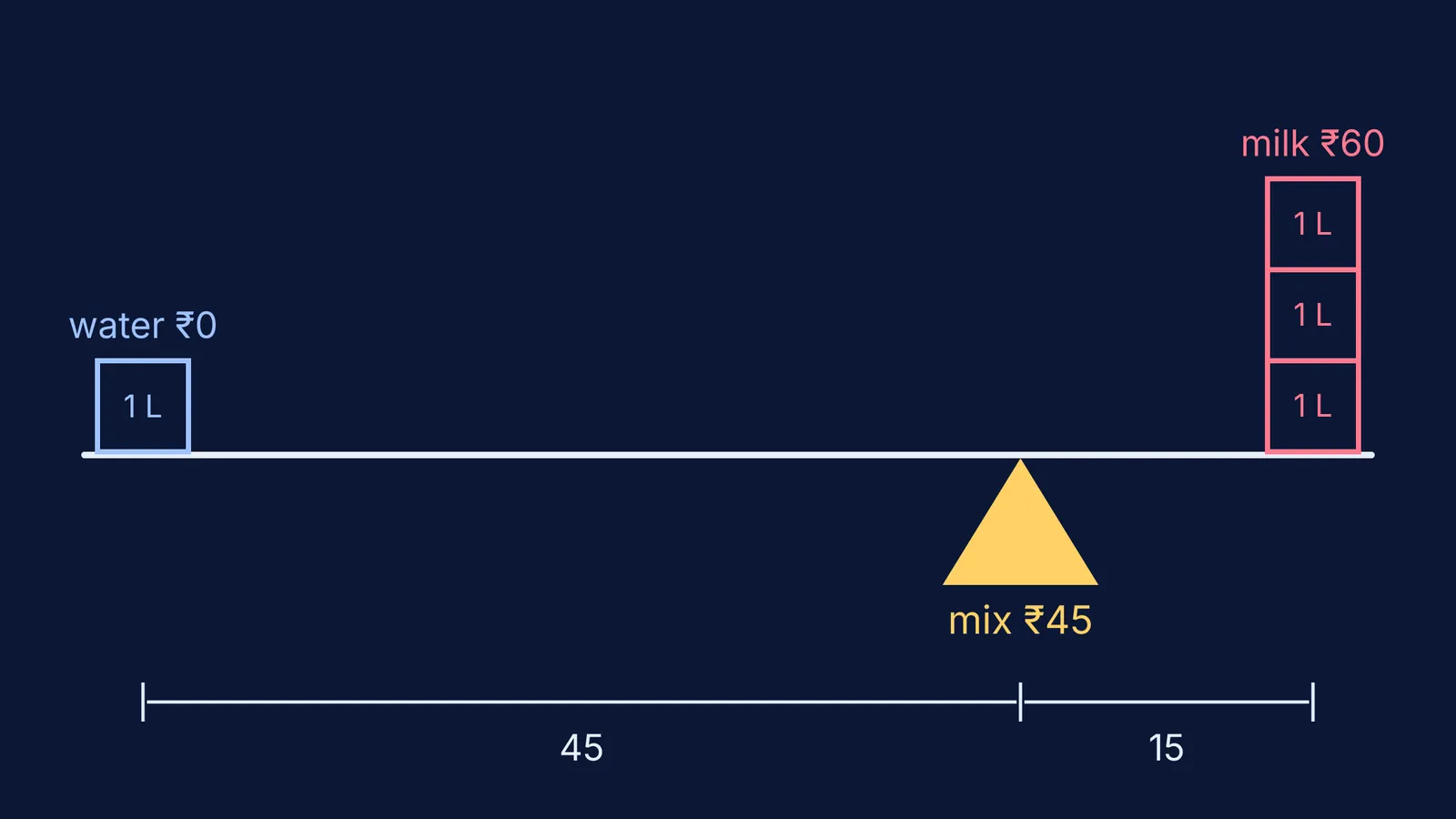
Milk costs ₹60 a litre and water is free. In what ratio should you mix them so the mixture is worth ₹45 a litre?
Water (₹0) gets 60 − 45 = 15.
Milk (₹60) gets 45 − 0 = 45.
Water : milk = 15 : 45 = 1 : 3.
Check: 3 litres of milk cost ₹180. Add 1 litre of water and you have 4 litres for ₹180, which is ₹45 a litre.
A common variant hides the mean behind a profit. A seller sells the mixture at ₹54 a litre and makes a 20% profit on cost. The mixture's cost is 54 ÷ 1.2 = ₹45 a litre, so you are back to 1 : 3. Always alligate on cost price, never on selling price.
Why does the cross-difference rule work?
Mix x litres at price c with y litres at price d to get price m. The total cost is the same either way, so cx + dy = m(x + y). Rearranging gives x(m − c) = y(d − m), so x : y = (d − m) : (m − c). Alligation is a weighted average run backwards.
The diagram at the top shows it as a seesaw: the mixture is the pivot, and each side's quantity times its distance from the pivot must balance (1 × 45 = 3 × 15). It is the same idea as dividing a line segment in a given ratio, which our post on the ratio in which an axis divides a segment works through.
How does alligation work for alloys?
Alloy A is 60% copper and alloy B is 80% copper. How do you make 40 kg of a 75% copper alloy?
A gets 80 − 75 = 5; B gets 75 − 60 = 15.
A : B = 1 : 3, so you need 10 kg of A and 30 kg of B.
Check: 6 kg + 24 kg = 30 kg of copper in 40 kg, which is 75%.
Gold works the same way. The Bureau of Indian Standards hallmarking FAQ lists gold fineness grades in parts per thousand, including 22K (916), 20K (833) and 18K (750). To make 20K from 22K and 18K, the differences are 833 − 750 = 83 and 916 − 833 = 83, so you mix them 1 : 1. This works because the metals in an alloy keep their identity, as our explainer on why an alloy is a mixture and not a compound sets out.
Chlorine-35 has a mass of 34.969 Da, chlorine-37 has 36.966 Da, and chlorine's standard atomic weight lies between 35.446 and 35.457, according to the IUPAC isotope commission (CIAAW). Taking 35.45, the cross gives 1.516 : 0.481, about 3.15 : 1, or roughly 76% chlorine-35, inside the 75.5–76.1% range CIAAW lists. Our post on why chlorine's atomic mass is 35.5 runs the same average forwards.
Where do students go wrong with mixture problems?
Flipping the ratio. The difference you find next to the dearer item belongs to the cheaper one.
Mixing up units. Weight by the quantity the strength is measured per: price per litre goes with litres, percentage by mass goes with kilograms.
Using the selling price. Convert to cost price first, as in the profit example.
Repeated removal and replacement. If 4 litres are taken from 40 litres of milk and replaced with water, twice, the milk left is 40 × (1 − 4/40)² = 32.4 litres. That needs a different formula, not alligation.
If the ratio keeps coming out upside down, practise on problems where you can see every step. The Fermi Problem Library has worked problems with a step-by-step solver that explains the reasoning rather than printing an answer. If weighted averages themselves feel shaky, start with the lesson in the Fermi Concept Library.