On this page
If you have learnt the lanthanoid contraction, the actinoid version looks like the same story told one row lower. It mostly is, with two twists that examiners like: 5f electrons shield even worse than 4f electrons, and relativity matters much more in these heavy atoms. The same orbitals also explain why actinoids are chemically busier than lanthanoids.
What is actinoid contraction?
Actinoid contraction is the steady decrease in atomic and ionic size from actinium to lawrencium as electrons fill the 5f subshell. The lanthanoid contraction is the same trend from lanthanum to lutetium as the 4f subshell fills.
A 1998 study in the Journal of Chemical Physics puts the ionic-radius figures side by side. Shannon's ionic radii for six-coordinate M³⁺ ions give a lanthanoid contraction of 0.17 Å. Ionic radii estimated by David and colleagues give an actinoid contraction of 0.18 Å, and another research group argued that 0.22 Å is more reasonable. In picometres, the lanthanoid ions shrink from 103 pm for La³⁺ to 86 pm for Lu³⁺.
Both series add 14 f electrons, so a larger total contraction means the actinoid series shrinks a little more per step on average. The same paper notes that experimental data on the last actinoids are scarce, so the actinoid figure is less certain. For the lanthanoid side on its own, see our explainer on the cause and consequences of lanthanoid contraction.
Why is actinoid contraction greater than lanthanoid contraction?
In both series, each step adds one proton to the nucleus and one electron to an f subshell. The new f electron screens the new proton only partly, so the outer electrons feel a slightly larger effective nuclear charge and are pulled in. Two things make this stronger in actinoids.
5f electrons shield worse than 4f electrons. This is the textbook answer. The LibreTexts notes on the actinides/Descriptive_Chemistry/Elements_Organized_by_Block/4_f-Block_Elements/The_Actinides/1General_Properties_and_Reactions_of_The_Actinides) say the 5f orbitals do not shield each other from the nucleus effectively. Each added proton is screened less, so the pull on the outer electrons grows faster across the series.
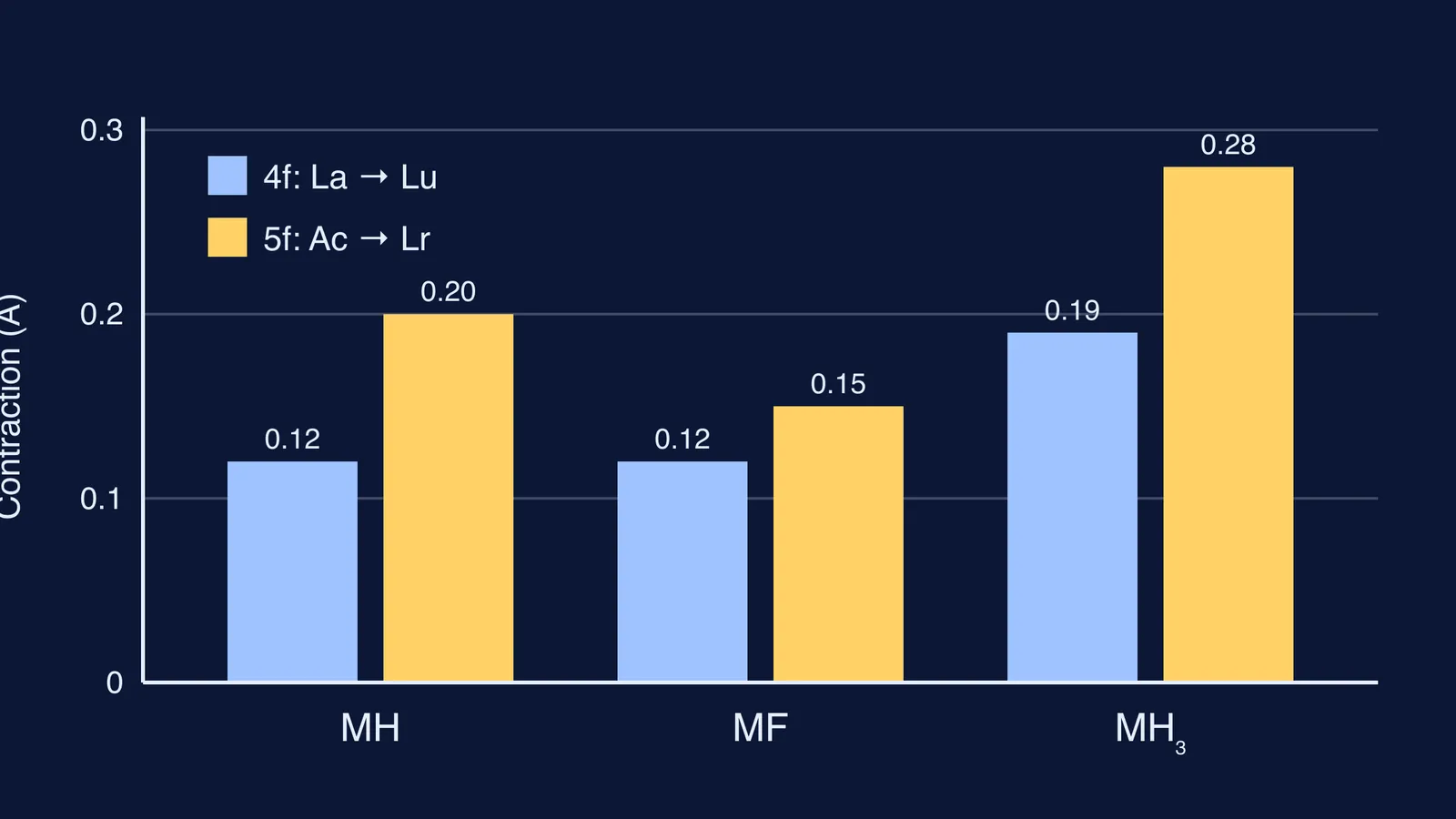
Relativity is stronger in heavier atoms. The 1998 study calculated both contractions in simple molecules, with and without relativity. The lanthanoid contraction came out at 0.12, 0.12 and 0.19 Å for the monohydrides, monofluorides and trihydrides; the actinoid contraction at 0.20, 0.15 and 0.28 Å (Laerdahl and colleagues, 1998). The authors concluded that the larger actinoid contraction is a consequence of relativistic effects, which cause 40-50% of it in these compounds, against 10-30% of the lanthanoid contraction.
For a board or JEE answer, the shielding line is the core; the relativity point is the deeper story from research.
Why do actinoids show more oxidation states than lanthanoids?
Lanthanoids mostly stay at +3, with a few exceptions such as why Ce⁴⁺ oxidises and Eu²⁺ reduces. The reason is where the 4f electrons sit. In the Ln³⁺ ions, the outermost electrons are the 5s and 5p, not the 4f. The 1998 paper describes lutetium's 4f orbitals as inner-valence because they are more radially contracted than the 5s and 5p (Laerdahl and colleagues). Tucked inside like this, the 4f electrons rarely take part in bonding.
Actinoids are different. There is a small energy gap between the 5fⁿ7s² and 5fⁿ⁻¹6d7s² configurations, according to the LibreTexts actinide notes/Descriptive_Chemistry/Elements_Organized_by_Block/4_f-Block_Elements/The_Actinides/1General_Properties_and_Reactions_of_The_Actinides). Electrons from 5f, 6d and 7s can all be used, so many oxidation states become possible. The same notes list uranium compounds from +3 to +6, with +4 and +6 most important, and neptunium and plutonium from +3 to +7, though the highest states are not very stable.
For the other trends that set the two series apart, see our post on the difference between lanthanoids and actinoids.
How do you write the reasoning in an exam answer?
Examiners reward a chain where each link follows from the one before. Use this order:
Configuration: lanthanoids fill 4f; actinoids fill 5f.
Shielding: f electrons shield poorly, and 5f electrons shield worse than 4f.
Effective nuclear charge: it rises faster across the actinoids.
Size: radii fall more per element, so the actinoid contraction is greater.
Oxidation states, a separate link: 5f, 6d and 7s are close in energy, so actinoids such as Np and Pu reach +7, while lanthanoids mostly stay at +3.
Three mistakes cost marks:
Writing that 5f electrons shield more. It is the reverse.
Explaining the wide oxidation states by contraction alone. That point rests on the closeness of the 5f, 6d and 7s energies.
Quoting a size without saying which ion. The 0.17 Å lanthanoid figure is for six-coordinate M³⁺ ions.
If a link in the chain feels shaky, such as effective nuclear charge, the Fermi Concept Library gives each chemistry concept its own lesson and its place in the map, so you can trace back to the missing piece. To practise writing reasoning out, the Fermi Problem Library has worked problems with a step-by-step solver that explains the reasoning rather than printing an answer.
Next time you see the word contraction in an f-block question, start from shielding and let the rest follow.