On this page
Bridges, pipelines and car bodies depend on joints made by people trained and tested to make them. In India, that route can start after Class 8 and run to a master's degree.
What does a welding job actually involve?
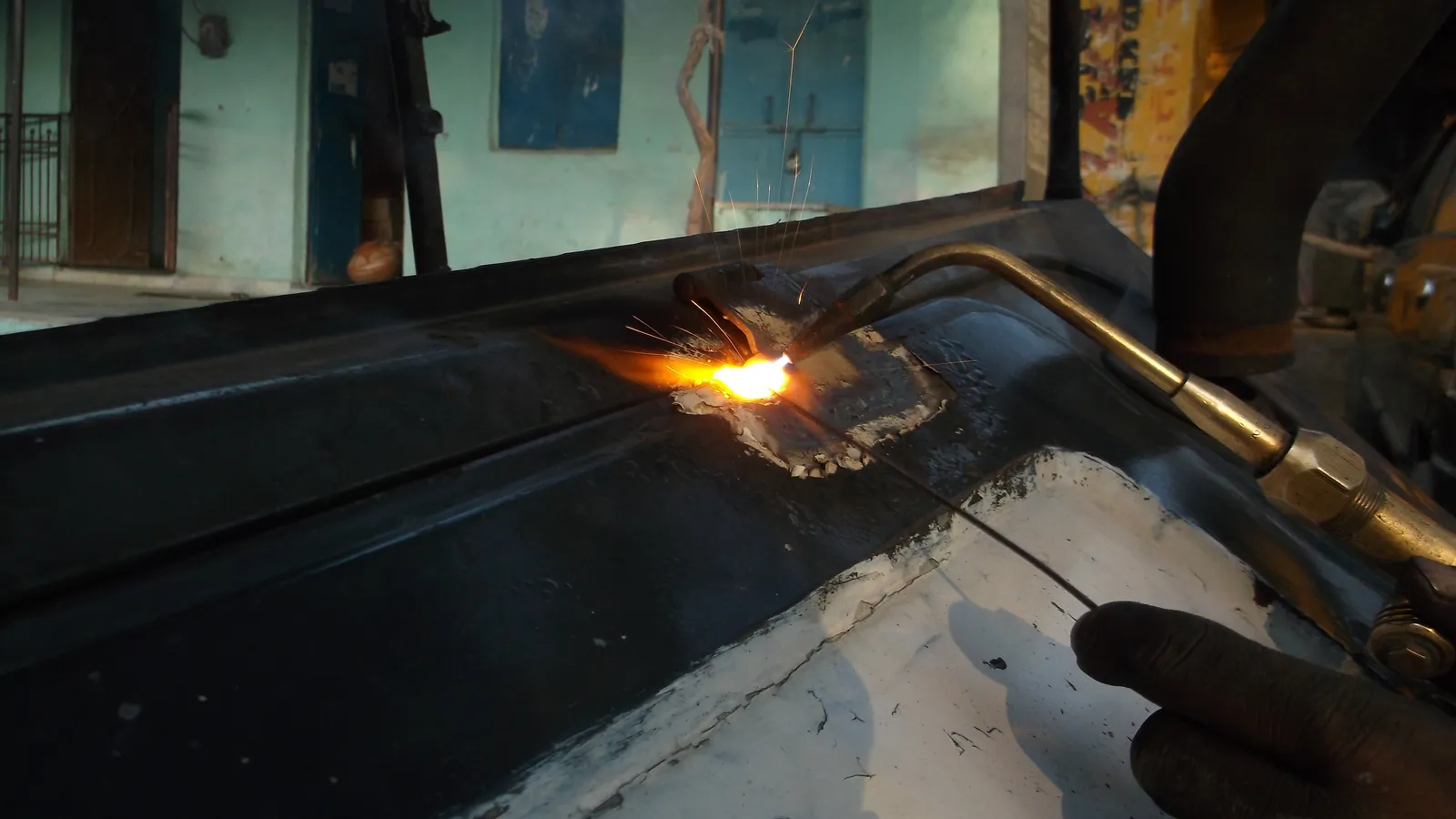
Welding joins metal parts using heat, sometimes with pressure or a filler metal. The ITI Welder syllabus trains you for jobs including gas, electric arc, resistance, TIG and MIG/MAG welder, gas cutter, brazer, repair welder and plasma cutter (DGT Welder curriculum, CTS 3.0).
Beyond the welding itself are inspectors, supervisors and welding engineers, who plan and check the work.
How do you become a welder after Class 8 or 10?
The usual starting point is the Welder trade at an Industrial Training Institute (ITI), run under the Directorate General of Training's Craftsmen Training Scheme. According to the DGT curriculum:
Duration and entry: one year, open to anyone who has passed Class 8 and is at least 14 on the first day of the academic session.
Training: 1,200 notional hours, 840 of them trade practical, plus 150 hours of on-the-job training or a group project.
Processes: oxy-acetylene welding and cutting, brazing, shielded metal arc, gas metal arc, gas tungsten arc, spot welding, plasma cutting and arc gouging, with destructive and non-destructive testing.
Passing: at least 60% in trade practical and formative assessment and 33% in other subjects; passing trainees are awarded the National Trade Certificate (NTC).
Next steps listed there: a technician job, an apprenticeship leading to the National Apprenticeship Certificate, instructor training to teach in ITIs, or DGT's Advanced Diploma (Vocational). Our comparison of ITI or polytechnic after Class 10 sets them side by side.
Which welding certification matches your qualification?
The International Institute of Welding (IIW) qualifies and certifies International Welding Engineers (IWE), Technologists (IWT), Specialists (IWS) and Practitioners (IWP), alongside International Welding Inspectors and International Welders (IIW).
In India these diplomas are awarded by the Indian Institute of Welding, founded in 1966 with its registered office in Kolkata, which is IIW's Authorised Nominated Body for the country (IIW-India). Standard-route courses are taught at Approved Training Bodies (IIW-India routes to qualification). Its access-conditions document sets the minimum entry for each standard route (IIW-India access conditions):
IWE: a degree in engineering, or a recognised equivalent such as the Associate Membership Examination of IIW-India or of the Institution of Engineers (India).
IWT: a diploma in engineering of at least three years' full-time study after secondary school.
IWS: a technician certificate of at least two years after secondary school, age 21 or more and two years of job-related experience. Another route takes Class 10 with English, maths and science, an ITI certificate in a metal-working trade, at least three years of welding-related work and age 22 or more.
IWP: secondary school, a valid welder qualification to ISO 9606 or ASME IX 6G (or equivalent), and age 21 or more, including three years as a certified welder.
Is there a degree in welding engineering?
Yes, at master's level. NIT Tiruchirappalli's Department of Metallurgical and Materials Engineering runs an M.Tech in Welding Engineering, and its curriculum for students admitted in 2024 totals 80 credits over four semesters (NIT Trichy curriculum). Core courses include Design of Weldments, Joining of Materials, Welding Metallurgy and Welding Codes and Standards, with electives such as Non-Destructive Testing and Life Assessment of Welded Structures.
An M.Tech normally follows a bachelor's degree; check the institute's admission notice each year for the branches it accepts and how to apply. Our guide to the scope of metallurgical and materials engineering in India covers one natural first degree.
What could the route look like, year by year?
A worked example, using the DGT curriculum and the IIW-India access conditions. A student passes Class 10 at 15, with English, maths and science.
Age 15 to 16: ITI Welder, one year, ending with the NTC.
Next few years: an apprenticeship or job (check the minimum-age rules that apply to it), aiming to pass a welder qualification test to ISO 9606 or ASME IX on the processes the employer uses.
Until 22: keep welding; three years of work may come before the IWS minimum age.
Age 22: apply for IWS through the ITI route. IIW-India may set an entry test first, and a preparatory IWS-0 course is there for anyone who needs it.
On this route, age often sets the timing, so the years in between are for building a record of qualified welds.
Where does school science come in?
Much of the theory is school chemistry and physics: why welders burn ethyne in oxygen, not air, how heat changes a metal's structure, how current sets an arc. If one idea is shaky, the Fermi Concept Library gives every concept in physics, chemistry and mathematics its own lesson, so you can fix the gap before the trade theory builds on it.