On this page
Your Class 10 chemistry book asks why welders burn ethyne with oxygen and not with air. The answer comes down to two things you can work out yourself: how much oxygen ethyne needs, and what else comes along when that oxygen is taken from air.
Why is a mixture of ethyne and oxygen used for welding?
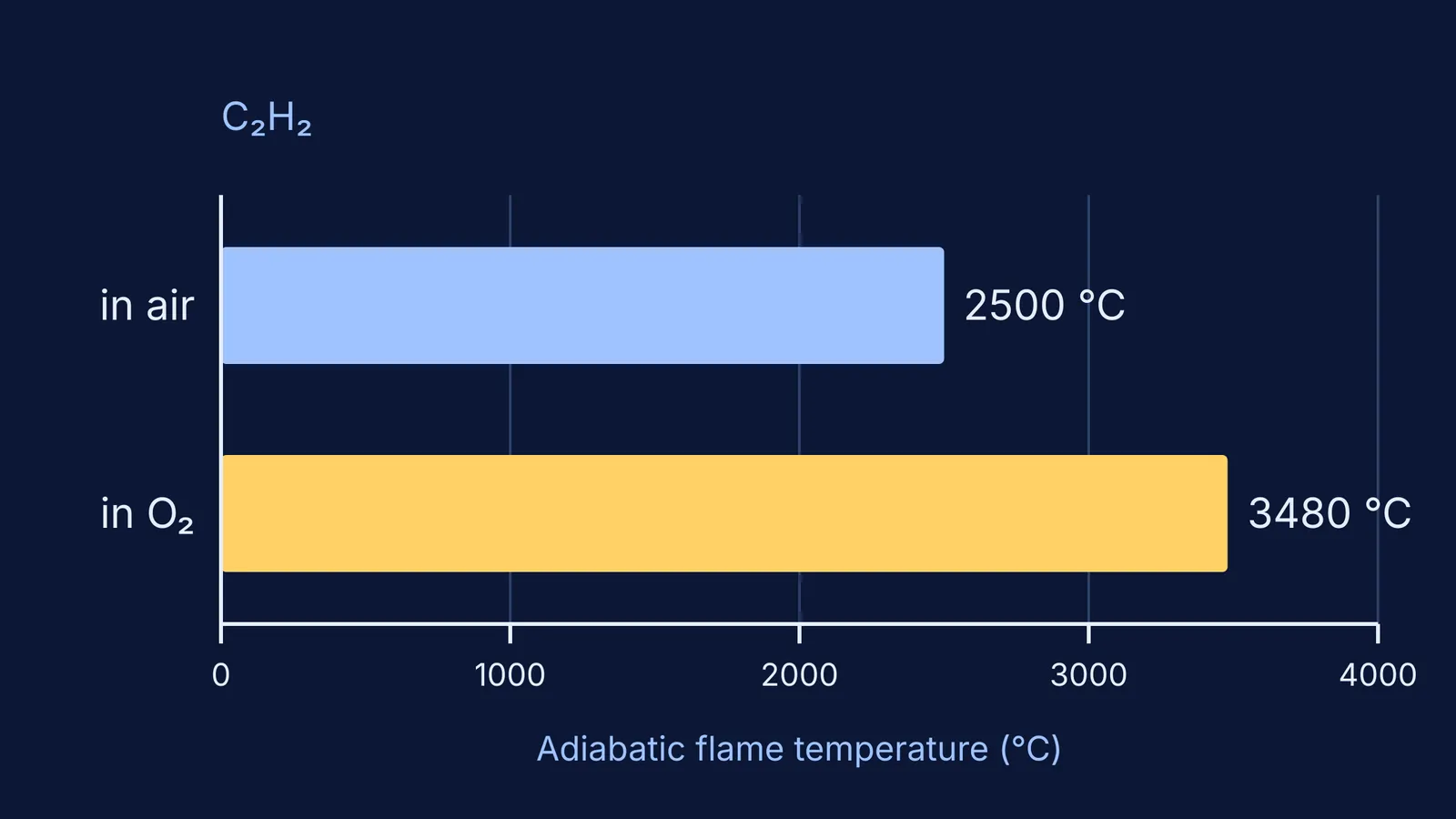
Welding steel means melting the edges of two pieces so they run together, so you need a flame much hotter than a kitchen burner. The theoretical (adiabatic) flame temperature of acetylene is 3,480 °C when it burns in oxygen and 2,500 °C when it burns in air, according to the Engineering ToolBox table of flame temperatures. Those figures assume a perfectly mixed gas starting at 20 °C.
The American Welding Society gives about 5,400 °F (roughly 2,980 °C) at the tip of the inner cone of an oxygen-acetylene torch, and about 3,000 °F (roughly 1,650 °C) for an air-acetylene torch (AWS Welding Digest, November 2023). AWS lists oxygen-acetylene for welding steel, and air-acetylene for lighter jobs such as brazing small-diameter copper tubing and soldering copper pipe joints.
Why does ethyne burn with a sooty flame in air?
Ethyne, C2H2, is rich in carbon: 24 of every 26 grams is carbon, about 92% by mass. To burn completely it needs a lot of oxygen. India's official welder trade theory, published by NIMI for vocational training, states that "for complete combustion /burning one volume of acetylene requires two and a half volumes of oxygen" (NIMI Welder Trade Theory).
In open air, oxygen only reaches the gas by mixing in from the edges of the flame. Fuel in the middle runs short, and some carbon is left unburnt as tiny glowing particles. That is the yellow, smoky flame: incomplete combustion you can see. A 1919 welding manual by a US Army welding instructor put it plainly: "Burning in a free state, its carbon content is so rich that complete combustion is impossible, and stringy black particles will be noticed floating through the air" (Oxy-Acetylene Welding Manual, Project Gutenberg). The same idea explains why unsaturated hydrocarbons burn with a sooty flame in general.
Soot is also lost heat. Carbon that leaves as soot, or as carbon monoxide, has not given out all the energy it could have.
Worked example: where does the heat go in air?
A balanced equation shows the nitrogen problem. Take air as about 21% oxygen, the figure the American Welding Society uses.
Balance it: 2C2H2 + 5O2 → 4CO2 + 2H2O. So one ethyne molecule needs 2.5 oxygen molecules, which matches the NIMI ratio above.
In pure oxygen, burning one ethyne molecule leaves 2 CO2 + 1 H2O, which is 3 hot gas molecules.
In air, 2.5 oxygen molecules come with 2.5 ÷ 0.21 ≈ 11.9 molecules of air in total. About 9.4 of those are not oxygen, mostly nitrogen. They do not burn, but they still have to be heated.
Now the same heat is shared among 3 + 9.4 = 12.4 gas molecules, roughly four times as many.
More molecules for the same heat means a lower temperature.
The real gap is smaller than four times, because different gases need different amounts of heat to warm up, but the direction holds. To compare fuels by the heat they give, see how to calculate the calorific value of a fuel.
How does a welding torch actually burn the gas?
Here is a detail that is easy to miss: a torch does not feed all 2.5 volumes of oxygen from the cylinder. For a neutral flame, NIMI says equal volumes of acetylene and oxygen leave the blowpipe, and "the flame takes an additional 1.5 liters of oxygen from the surrounding atmosphere" (NIMI Welder Trade Theory).
The first stage, in the inner cone, turns ethyne and cylinder oxygen into carbon monoxide and hydrogen. The outer flame then burns those to carbon dioxide and water using oxygen from the air. NIMI places the greatest heat just ahead of the inner cone, which is where the welder holds the metal. Add up the volumes, 1 from the cylinder plus 1.5 from the air, and you get the same 2.5 as the balanced equation.
How do you write this answer in an exam?
A three-mark answer needs three clear points:
Ethyne burnt in oxygen burns completely, giving a clean, very hot flame that can melt steel.
Air is only about one-fifth oxygen, so ethyne burnt in air burns incompletely, giving a sooty, yellow flame.
The nitrogen in air takes up part of the heat, and unburnt carbon carries away energy, so the flame in air is too cool for welding.
Two common slips: writing that air has "no oxygen", and leaving out the reason the flame is hotter. If the term "incomplete combustion" still feels fuzzy, the Fermi Concept Library covers every concept in chemistry, each with its own lesson and its place in the map. For practice with numericals like the worked example above, the Fermi Problem Library has worked problems with a step-by-step solver that explains the reasoning rather than printing an answer.
For another way to make metal hot enough to join, read how Hans Goldschmidt used the thermite reaction to weld rails.