On this page
If you are in Class 10, a mental ability paper rewards a skill you can train. Series, analogy, coding and odd-one-out questions are built from a short list of rules. Once you know the list and can spot which rule a question uses, you stop guessing.
What is a mental ability test, and is NTSE still held?
The Ministry of Education's revised NMMS scholarship guidelines define the Mental Ability Test as 90 multiple-choice questions "testing verbal and non-verbal meta-cognitive abilities like reasoning and critical thinking". The same document says questions may be on analogy, classification, numerical series, pattern perception and hidden figures. Each test lasts 90 minutes.
NMMS is a Class 8 test. The Class 10 test with this kind of paper was the National Talent Search Examination (NTSE). NCERT's 2019 NTSE information brochure set the state-level mental ability paper at 100 questions in 120 minutes, with no negative marking.
In October 2022, NCERT said the scheme had been approved only until 31 March 2021 and had been "stalled till further orders", as Careers360 reported. Before you plan around NTSE, check NCERT's NTSE page for any newer notice. Our explainer on whether NTSE is still conducted and what to take instead covers the options.
How do you solve series, analogy and coding questions?
For a number or letter series, try these checks in order:
Differences between neighbouring terms, then the differences of those differences.
Ratios: is each term multiplied or divided by something?
Squares, cubes or primes hiding in the terms.
Two series woven together: odd positions follow one rule, even positions another.
For letters, convert to positions (A = 1, B = 2 and so on to Z = 26) and run the same checks.
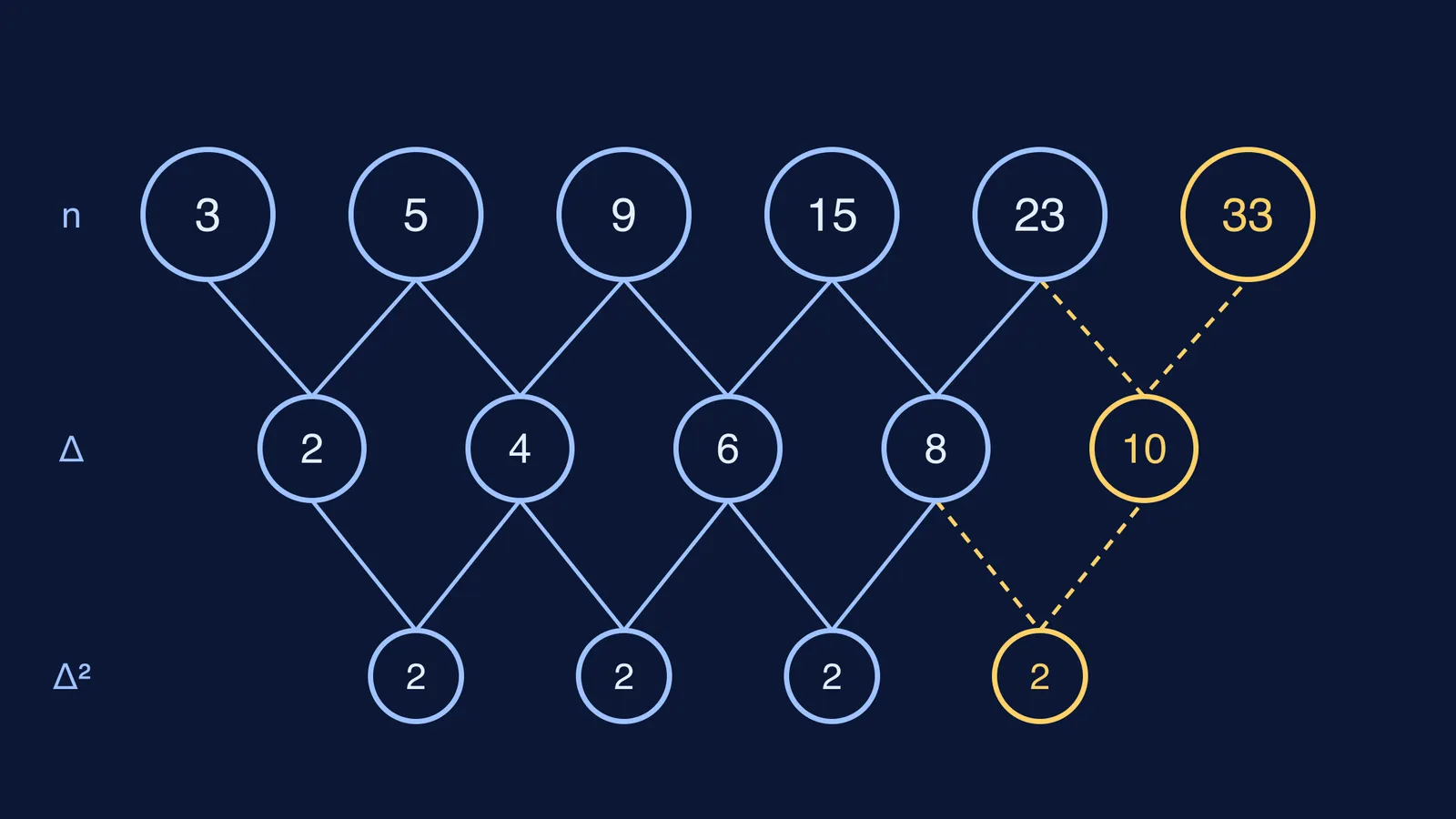
Series: 3, 5, 9, 15, 23, ? The differences are 2, 4, 6, 8. They rise by 2 each time, so the next difference is 10 and the answer is 33.
Analogy: 3 : 27 :: 5 : ? Say the link as a sentence, "27 is 3 cubed", then apply it: 5 cubed is 125.
Coding: if CAT is written as DBU, each letter has moved one place forward, so DOG becomes EPH. Test your rule on every letter of the example, not just the first one.
Odd one out: name the group the others share before you choose. "All are prime except 9" is an answer; "9 looks different" is a guess.
How should a Class 10 student practise reasoning?
Practise mixed sets, not one type at a time. In a 2015 study in the Journal of Educational Psychology, 126 seventh-grade students worked the same maths problems over three months, arranged either by type (blocked) or mixed (interleaved). After a review session, each student sat a surprise test either 1 day or 30 days later, and the interleaved group scored higher at both delays, with the bigger gap at 30 days. The authors explain why: mixed practice makes you choose the strategy from the question itself, as an exam does.
A four-week plan at about 30 minutes a day:
Week 1: one question type per day (series, analogy, coding, classification, figures), untimed. Write the rule in words for every answer.
Week 2: mixed sets of 20, still untimed. Label each question's type before you solve it.
Week 3: mixed sets of 30 at one minute per question.
Week 4: one full paper under real timing at the weekend.
Keep an error log with three columns: question type, the rule you missed, and what you will check first next time. Our guide to reviewing an olympiad paper after a disappointing result shows how to turn wrong answers into rules.
Mental ability papers usually sit beside a subject paper. The 2019 NTSE brochure paired the state-level mental ability paper with a 100-question Scholastic Aptitude Test in science, mathematics and social science. If a maths or science topic keeps tripping you up, the Fermi Concept Library gives every concept in physics, chemistry, biology, mathematics and computing its own lesson. And if you do not know where to begin, Fermi's AI tutor can work out what you already know and build a plan for the session.
How fast do you need to be?
The NMMS guidelines give 90 minutes for 90 questions, which is one minute per question. The 2019 NTSE brochure allowed 120 minutes for 100 questions, about 72 seconds each.
Use two passes. On the first, answer whatever gives up its rule quickly, and mark any question with no rule after about 45 seconds. On the second, return to the marked ones. Check whether your test has negative marking before deciding whether to guess. If timing feels stressful, our phase plan for timed and untimed practice shows when to bring the clock in.
Start this week with one mixed set of 20 questions and an empty error log.