On this page
When you stand up to present a science project, the default approach is often a data dump: a slide of background, a slide of methods, and a slide of results. You might feel that listing facts is the most objective way to share your findings. But this logical-scientific format often leaves audiences overwhelmed and struggling to see why the research matters. To make an impact, you need to frame your presentation around a question, a struggle and a finding.
Why is storytelling important in science communication?
Although storytelling is sometimes viewed with suspicion in science because it sounds like fiction, it is actually one of the most effective structures for sharing complex information. A 2014 study published in the *Proceedings of the National Academy of Sciences* (PNAS) by Michael F. Dahlstrom examined how storytelling works in science communication (Source).
The study found that narratives offer increased comprehension, interest, and engagement compared to traditional scientific reporting. Dahlstrom noted that nonexperts get most of their science information from mass media, which is already heavily biased toward narrative formats.
The study also highlighted that narratives are intrinsically persuasive, which helps audiences process the information. By framing your data as a journey rather than a lecture, you make the science accessible. If you are struggling to simplify a complex topic for your talk, Fermi's AI tutor works out what you already know, builds a plan for the session, and teaches through it, checking understanding as it goes.
How does a story affect the listener's brain?
Telling a story does more than just hold attention; it actually synchronises brain activity between you and your audience. A 2010 study by Greg J. Stephens, Lauren J. Silbert, and Uri Hasson, also published in *PNAS*, used functional magnetic resonance imaging (fMRI) to record brain activity during natural verbal communication (Source).
The researchers found that a speaker's brain activity is spatially and temporally coupled with the listener's activity. When the communication is successful, the listener's brain activity literally mirrors the speaker's, usually with a slight delay. Even more importantly, some areas of the listener's brain exhibit predictive anticipatory responses, meaning they anticipate what the speaker is about to say before the words are even spoken.
This anticipatory coupling was directly linked to better story comprehension. When communication fails—such as when the listener cannot follow the logic—this neural coupling vanishes. For a student presenting a paper, this means your goal is not just to recite data, but to build a logical path so the audience can anticipate your next point. You can practice breaking down complex ideas by reading how to visualise hard physics ideas or learning how to speak confidently in a viva exam.
What happens when you just list facts?
The biggest trap in science presentations is the "And, And, And" structure. This happens when a presenter says, "We did this experiment, and we used this chemical, and we got this result, and it means this."
When you present a flat list of facts, you force the listener's brain to do all the heavy lifting. They have to organise the data, figure out the relationships, and decide why it is important. This causes cognitive overload, which breaks the neural coupling described in the fMRI study. The audience stops anticipating your next point and starts tuning out.
How to structure your presentation as a story?
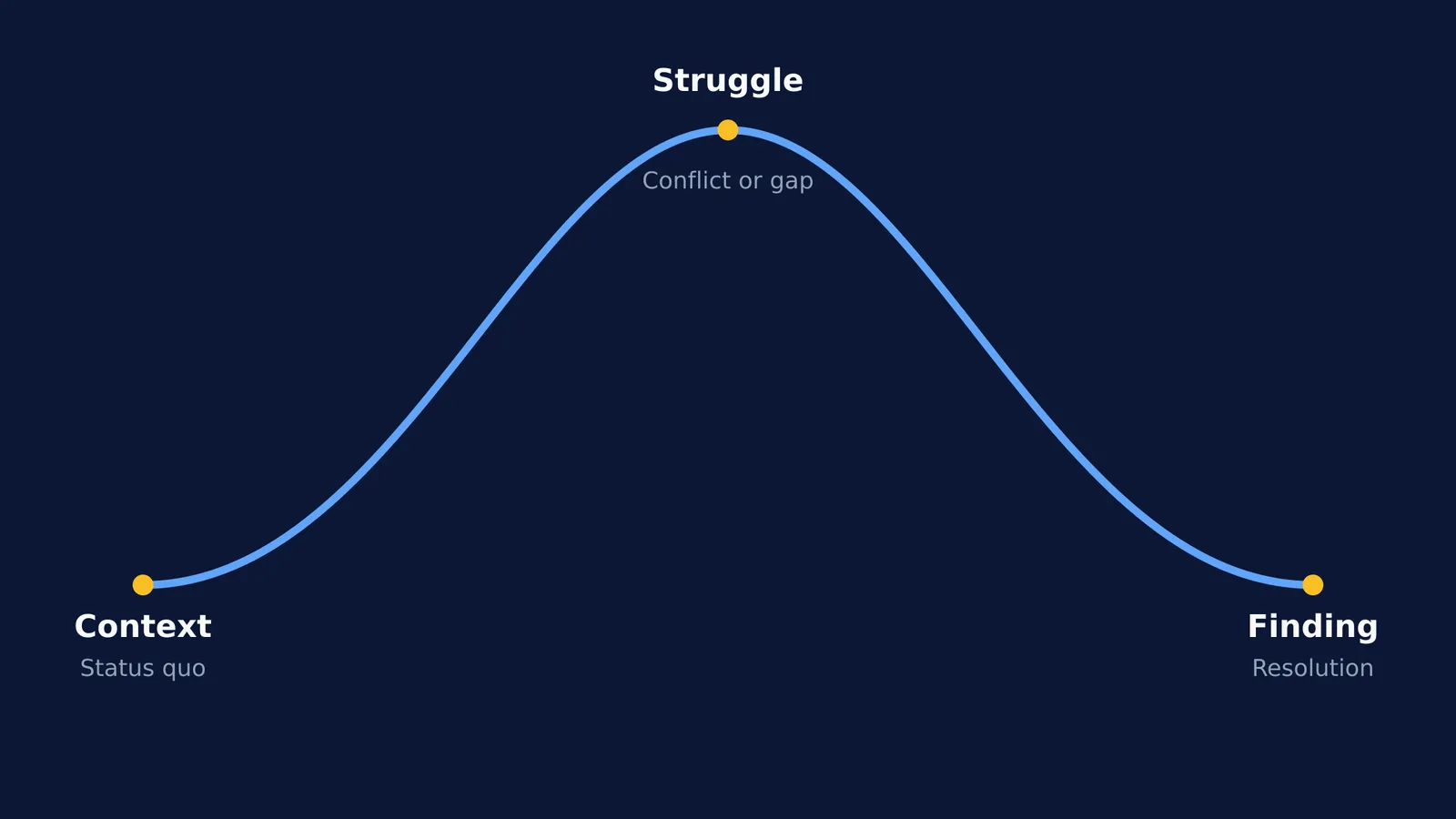
To trigger neural coupling and keep your audience engaged, replace the flat list with a narrative arc. A strong science story can be built in three steps that guide the listener from the known to the unknown, and finally to the resolution.
The Context: Start by establishing the status quo. What is the accepted knowledge or the everyday situation? This gets the audience nodding in agreement and provides the foundation. For example, "We know that friction causes wear and tear in mechanical engines."
The Struggle: Introduce the conflict, the unknown variable, or the problem in the current understanding. This is where you reveal the gap your project attempts to fill, triggering curiosity. For example, "But when the engine is exposed to extreme cold, standard lubricants fail to reduce this friction."
The Finding: Resolve the tension by presenting your research, your method, and your results. Show how your work answers the question raised by the struggle. For example, "Therefore, we tested a new synthetic compound and found it maintains viscosity at sub-zero temperatures."
If your presentation involves a physical process that is hard to picture in words, showing rather than telling can strengthen your narrative. The Fermi Simulation Lab has interactive simulations for the ideas that are easier to see than to read. You can also write your summary, then compare it with AI to ensure your context and your finding are clearly connected before you stand up to speak.
By framing your presentation around a question, a struggle, and a finding, you give your audience a reason to listen and a structure they can easily remember.