On this page
Speed-reading courses and apps promise you can finish a chapter in a third of the time without losing anything. With a pile of NCERT chapters before boards or JEE Main, that sounds ideal. Research on how eyes and minds handle text tells a more useful story: you can go faster, but you pay in understanding, and there are better places to find time.
How fast does a normal person read?
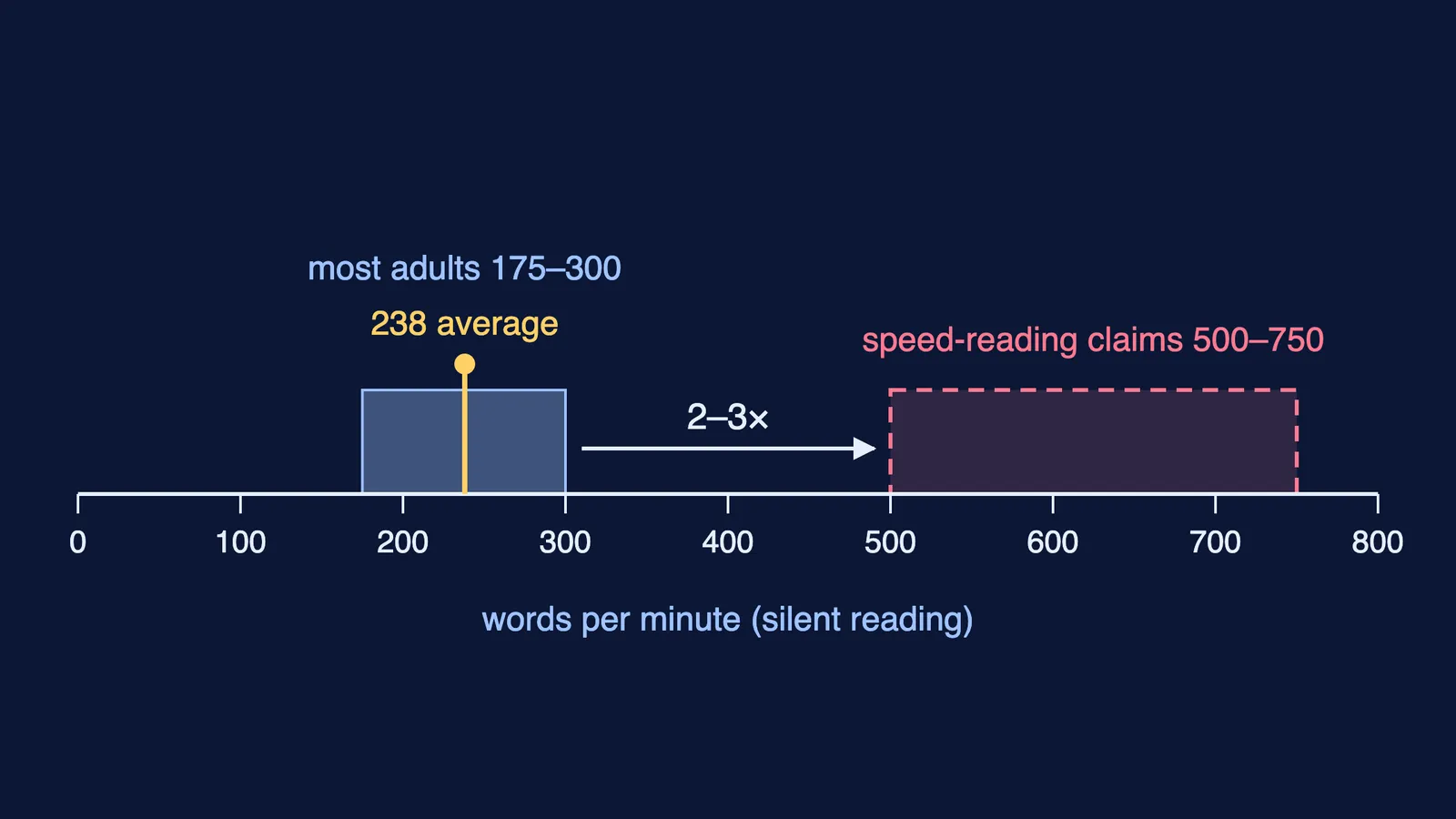
A 2019 meta-analysis of 190 studies with 18,573 participants estimated that adults reading silently in English average 238 words per minute for non-fiction and 260 for fiction (Brysbaert, Journal of Memory and Language). Most adults fall between 175 and 300 words per minute for non-fiction, the same analysis found.
So if a friend finishes the page first, that is ordinary variation, not a trick you are missing. A chemistry chapter full of symbols and units will also go slower than a novel, because each line carries more to think about.
Does speed reading work?
Not in the way it is sold. In 2016, Keith Rayner and colleagues reviewed decades of reading research, from Evelyn Wood's Reading Dynamics programme of 1959 to smartphone apps (Rayner et al., Psychological Science in the Public Interest). They found a trade-off between speed and accuracy. Readers are unlikely to double or triple their speed, from around 250 to 500–750 words per minute, and still understand the text as well as at normal speed.
Your eyes move in quick jumps called saccades, take in a limited window of text at a time, and those movements track moment-to-moment thinking (Rayner, Psychological Bulletin). The 2016 review concludes that language skill is at the heart of reading speed.
What about apps that flash one word at a time?
Some apps show words one by one in the same spot, called rapid serial visual presentation (RSVP), so your eyes never move. The catch is that you cannot look back, and regressions (glancing back to re-read a word) are a natural part of reading.
A 2014 experiment by Elizabeth Schotter, Randy Tran and Keith Rayner hid each word once the reader's eyes moved past it, so nobody could look back (Psychological Science). Comprehension dropped, and not only for ambiguous sentences. Those quick look-backs are part of how you understand.
What actually helps you read faster and remember more?
Rayner's review says the way to read faster while keeping comprehension high is to practise reading and become a more skilled language user, for example with a larger vocabulary. For a student, that means:
Match the speed to the job. Skim to find; read slowly to understand; re-read the line that confused you instead of pushing on.
Fix fuzzy terms once. Words like "molarity" or "normal reaction" slow every page they appear on until you know them.
Read more, regularly. Unseen passages are good training; here is how to make unseen passage practice with AI and check the key.
Test yourself instead of re-reading. A 2013 review of ten study techniques rated practice testing and distributed practice as high utility, and rereading and highlighting as low utility (Dunlosky et al., Psychological Science in the Public Interest).
When a page stops making sense because one idea underneath it is missing, reading faster will not help. Look that idea up in the Fermi Concept Library, which has a lesson for every concept in physics, chemistry, biology, mathematics and computing, then return to the page.
Worked example: where does the time really go?
Say a chapter has 3,000 words. At the 238 words per minute average from the reading-rate meta-analysis, one careful reading takes about 13 minutes. At a promised 500 words per minute it would take 6. Speed reading saves about 7 minutes, at the likely cost of understanding you would then have to rebuild.
A 30-minute block that spends the time better:
Read once at your normal pace (about 13 minutes), marking lines you had to re-read.
Close the book and write the key ideas and formulas from memory (about 7 minutes).
Attempt three or four questions on the chapter (about 7 minutes). If you get stuck, the Fermi Problem Library has worked problems with a step-by-step solver that explains the reasoning.
Re-read only the parts you got wrong (about 3 minutes).
If exam time is the real worry, the bigger gains usually come from how you split the paper: see a minute-per-mark plan for board exams, and if your hand is the bottleneck, how to write faster and neater for board exams.
If reading stays much slower or harder for you than for classmates despite practice, tell a teacher or school counsellor, who can arrange a check with a specialist.