On this page
If you have noticed paper straws with your juice or wooden sticks in your ice-cream, this is why. On 12 August 2021 the Ministry of Environment, Forest and Climate Change notified the Plastic Waste Management Amendment Rules, 2021, and the ban on a list of single-use plastic items took effect across India on 1 July 2022, according to the government's press release of 28 June 2022. Here is what is on the list, what the carry bag rules say, and how to check whether something at your next school event is allowed.
What single-use plastic items are banned in India?
The ban covers manufacture, import, stocking, distribution, sale and use, so it applies to the shopkeeper and the buyer as well as the factory. The Press Information Bureau release lists these single-use plastic items:
Ear buds with plastic sticks
Plastic sticks for balloons
Plastic flags
Candy sticks and ice-cream sticks
Polystyrene (thermocol) for decoration
Plastic plates, cups and glasses
Cutlery such as forks, spoons and knives, plus straws and trays
Wrapping or packing films around sweet boxes
Invitation cards
Cigarette packets
Plastic or PVC banners less than 100 microns thick
Stirrers
The same list appears in the PIB explainer "Ban on Single Use Plastic in India" of 1 July 2022. Notice the pattern: most are things you use for minutes at a party, a wedding or a festival, then throw away.
What are the carry bag thickness rules?
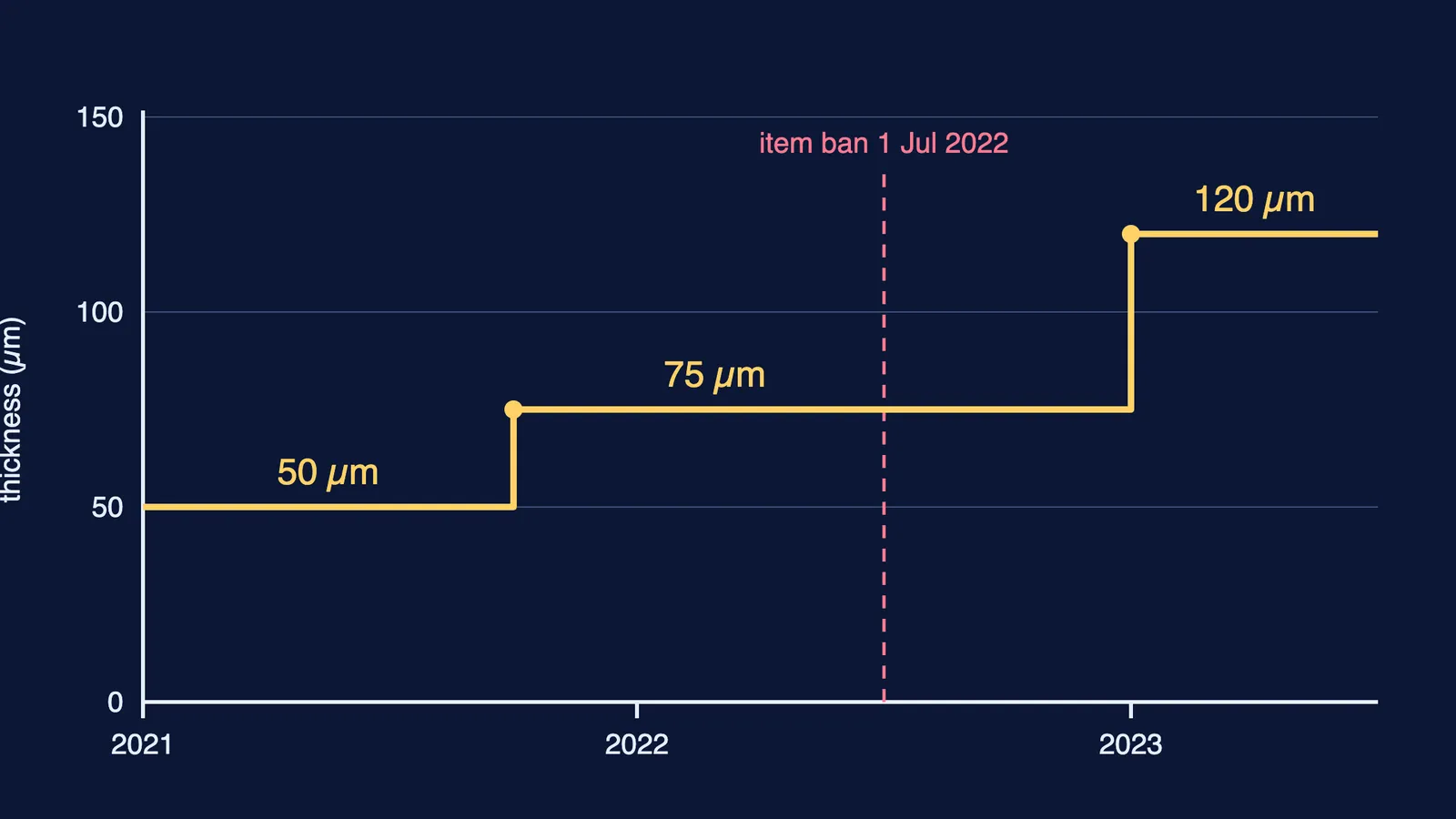
Carry bags were not banned outright. Instead the rules set a minimum thickness. Plastic carry bags thinner than 75 microns were banned from 30 September 2021, and those thinner than 120 microns from 31 December 2022, according to the PIB release. Before the 2021 amendment the limit was 50 microns, as a DD News post reproduced in the PIB explainer notes.
A micron (micrometre) is one-thousandth of a millimetre. Here is a quick worked example in the style of a Class 11 units question:
120 microns = 120 × 0.001 mm = 0.12 mm.
The old limit was 50 microns = 0.05 mm.
120 ÷ 50 = 2.4, so the minimum allowed bag is now 2.4 times as thick as the old minimum.
The smallest mark on your school ruler is 1 mm, which is more than eight times 0.12 mm. That is why you cannot check a bag's thickness with a ruler; you would need an instrument like the screw gauge from your physics lab.
Why did India ban these items?
The official reason lies in how the government describes the banned items: they "have low utility and high littering potential", in the words of the PIB release. The same release calls the ban a step to curb pollution caused by littered and unmanaged plastic waste.
For a sense of scale, the PIB explainer cites a Central Pollution Control Board report (2019-20) that India generates 3.5 million metric tonnes of plastic waste a year. The same explainer gives the global plastic recycling rate as only 9 per cent.
The explainer also lists the harms: single-use plastic is believed to take thousands of years to decompose, which leads to soil and water contamination, and open burning of plastic waste causes air pollution. If you want the chemistry of that last point, read our explainer on why burning plastic is harmful.
How can you check if something is banned?
Planning a class party, a school fest stall or a birthday at home? Run each item through these four questions:
Is it on the list above? If yes, it is out, whatever the shop says.
Is it a plastic carry bag? Then it must be at least 120 microns thick. You cannot judge that by eye, so carrying your own bag is the simple fix.
Is it a banner? Plastic or PVC banners must be at least 100 microns thick; cloth or paper avoids the question.
Is there a reusable swap? Steel tumblers, washable plates and real cutlery do the same job with no rule to check.
A short script for a stall owner who offers a thin bag: "No bag, thanks, I have my own." You do not need to argue the law; the PIB release says the Central Pollution Control Board has launched a Grievance Redressal App to help citizens curb plastic pollution.
How does the ban connect to polymer chemistry?
Polymers turn up in school chemistry, and the ban is a real-world reason to know why polyethylene lasts and why alternatives behave differently. Our posts on how PLA biodegradable plastic breaks down and biodegradable polymers such as PHBV and nylon-2-nylon-6 cover the chemistry.
If polymers or addition versus condensation polymerisation still feel shaky, the Fermi Concept Library covers every concept in chemistry, so you can read up on the idea before you try the questions.
Next time you are handed a plastic spoon, you will know whether it should exist.