On this page
Every science fair sets its own rubric, but the two public ones we checked ask about the same handful of things: the question you asked, how you planned the test, what your data shows, how original the work is, and how well you explain it. The clearest version, with points attached, is the rubric of the Regeneron International Science and Engineering Fair (ISEF).
How are science fair projects judged?
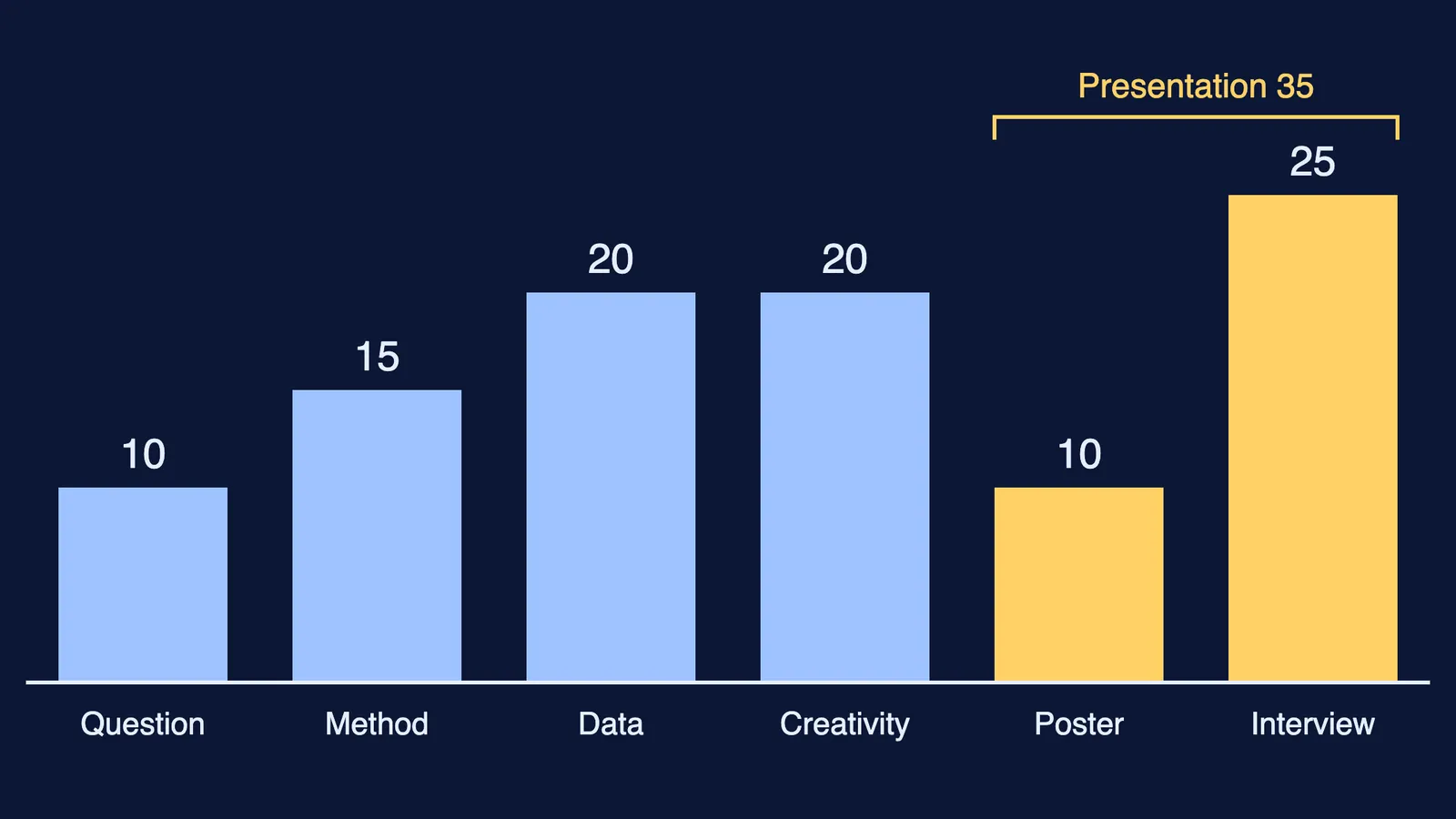
At ISEF, a science project is scored out of 100 points: research question 10, design and methodology 15, execution (data collection, analysis and interpretation) 20, creativity and potential impact 20, and presentation 35, according to the Society for Science grand award criteria.
The 35 presentation points split into 10 for the poster and 25 for the interview. The interview alone is worth as much as the question and the method put together. The same page says judges place considerable emphasis on creativity and presentation, especially the interview.
In India, the National Children's Science Congress lists 13 evaluation criteria on its judging page, from originality of idea and concept to data collection, analysis, team work, and report and presentation; a few apply only at district or state level. It states that the written report and the oral presentation are evaluated separately, and that a log book, kept as a daily diary and signed by the guide teacher, is mandatory.
What do judges look for in each part?
The ISEF rubric spells out what earns the points:
Question: clear, focused and testable with scientific methods. "Does light affect plants?" is vague. "Do radish seedlings grow taller with 12 hours of light a day than with 6?" can be tested.
Method: a planned way of collecting data, with variables and controls defined.
Data: systematic collection, enough data to support your conclusion, results someone else could reproduce, and maths or statistics that suit the data. Repeat each trial and show the spread, not only the average.
Creativity and impact: imagination in any part of the work, and a reason it might matter beyond the fair.
Poster: a logical order, graphs with clear labels and legends, and your supporting documents on display.
If you want to see one changed variable and repeated trials on a kitchen table, our drop-height and crater-size experiment in a flour tray and the freezer vs warm-ball bounce test both follow this shape.
What happens in the science fair interview?
The ISEF interview criteria ask judges to look for:
clear, concise, thoughtful answers to questions;
understanding of the basic science behind the project;
understanding of how to interpret the results, and their limits;
how independently you did the work;
recognition of the work's potential impact;
good ideas for further research;
for teams, that every member contributed and understands the project.
If the project was done at home or in a school lab, judges are also told to find out whether you had any mentoring or professional guidance. Be ready to say plainly who helped, with what, and which parts you did yourself.
The basic-science item is easy to underprepare: you measured something, but can you explain why it behaves that way? Before the fair, read up on the concept underneath your project. The Fermi Concept Library covers concepts across physics, chemistry, biology, mathematics and computing, so you can check that your explanation holds up before a judge asks.
How do you explain your project in two minutes?
Neither rubric we read fixes a time for your opening explanation, and fairs differ. A two-minute version is still a good habit: it leaves the judge time for questions, and the questions are where the interview points sit. Fill in this script:
Question (15 seconds): "I wanted to find out whether ... affects ..."
Why it matters (15 seconds): "This matters because ..."
Method (30 seconds): "I changed ..., measured ..., and kept ... the same. I repeated each test ... times."
Result (30 seconds): point at your main graph. "This shows ..." Say one number from your own data.
Limits and next step (30 seconds): "My biggest limitation was ... Next, I would test ..."
Say it aloud to someone who has not seen the project. If they cannot repeat your question back to you, shorten step 1.
What should you check the week before?
Your question fits in one testable sentence.
Your variables (changed, measured, kept the same) are written on the poster.
Your raw data table and log book are on the table, not only the averages.
Every graph has labelled axes, units and a legend.
Your sources are listed and checked; our guide to writing a school project bibliography shows how.
You can name one limitation and one next experiment without notes.
Parents can help by being the practice audience and asking "why?" three times in a row, then letting the student answer.
Print the ISEF rubric, score your own project against it, and spend the last week on the lowest line.