On this page
In an Indian ICU, the person adjusting a ventilator at 3 a.m. or helping a patient with COPD clear their lungs may be a respiratory therapist rather than a doctor or a nurse. The field now has a national regulator and a national curriculum. If you are in Class 11 or 12 with biology and want hospital work that is not MBBS, here is what the job involves, how the training works and how to judge a college.
What does a respiratory therapist do in a hospital?
Manipal College of Health Professions, which says its department, established in 1995, is the first in India, describes respiratory therapy as "an allied health specialty concerned with the evaluation and treatment of patients with breathing problems". The same page lists the day-to-day work:
giving medical gases such as oxygen, and humidifying the air patients breathe
giving inhaled drugs such as bronchodilators
chest physiotherapy and clearing secretions from the airways
running and interpreting lung function tests and arterial blood gas (ABG) tests
starting, managing and weaning patients off mechanical ventilators
pulmonary rehabilitation, including help to stop smoking, and assisting in cardiac emergencies
A 2021 survey of respiratory therapists in India, published in Respiratory Care, found that 77.6% of the 237 people who completed it worked as hospital staff therapists. Their most frequent tasks were supporting oxygenation and ventilation, infection control and keeping airways open. Pneumonia, asthma, COPD and ARDS were the conditions they managed most.
Is respiratory therapy a recognised profession in India?
Yes. The National Commission for Allied and Healthcare Professions Act, 2021 lists "Respiratory Technologist" in its Schedule. It sits under "Cardio-vascular, Neuroscience and Pulmonary Technology Professional", alongside perfusionists.
This matters because the field had no formal council before. Writing in the Indian Journal of Respiratory Care in 2021, Manjush Karthika and Madhuragauri Shevade noted that no central or state council governed the profession. They counted about 45 institutions offering programmes, mostly in south India, ranging from certificates to master's degrees.
In April 2026, Medical Dialogues reported that the commission had released curricula for 17 allied health courses, including Respiratory Technology, to be followed from the 2026-27 session. The same law covers related roles too; our guide to the anaesthesia technology allied health course explains a neighbouring option.
How long is the course and who can apply?
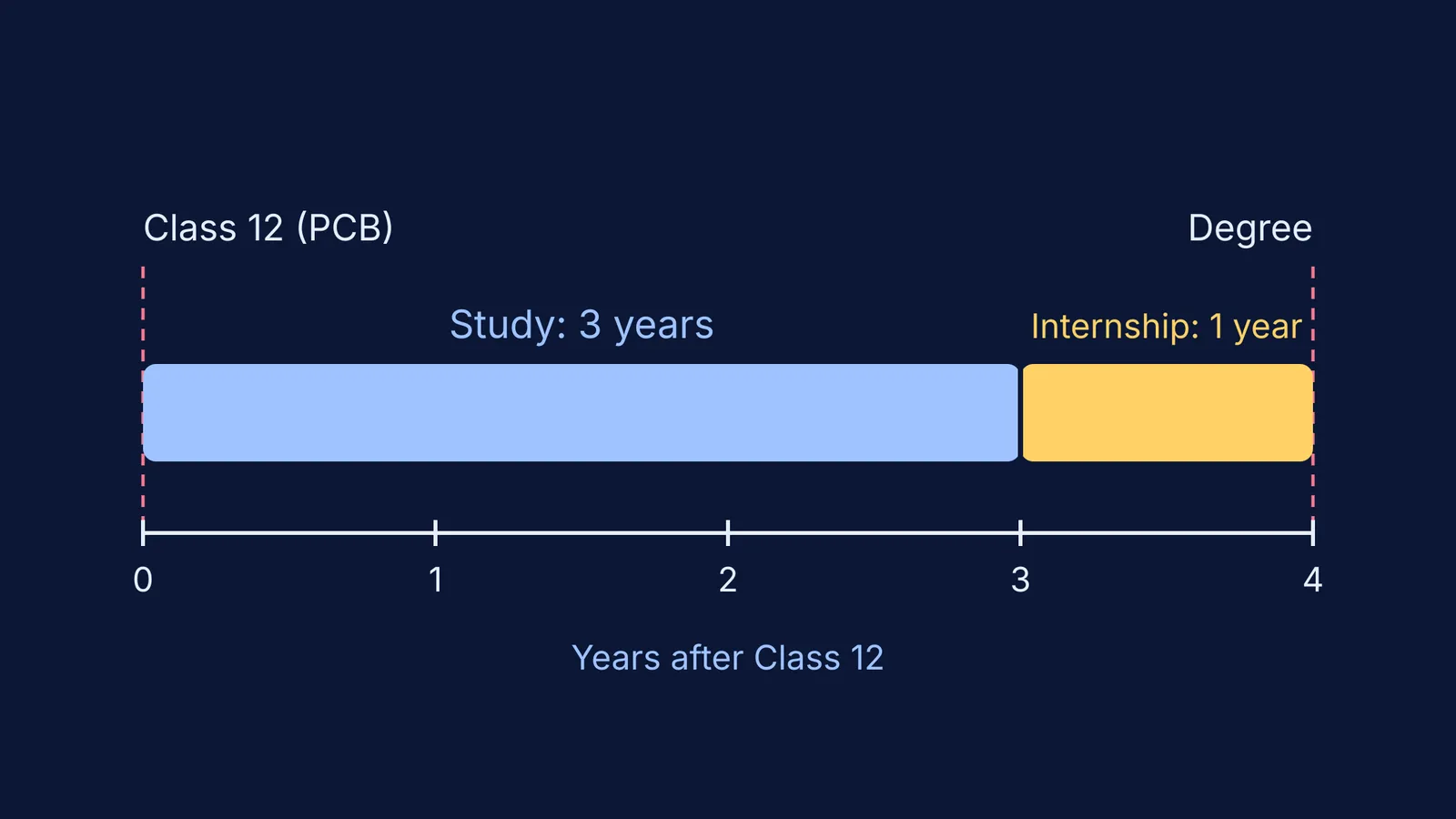
Colleges such as Manipal and Symbiosis now offer the degree as a Bachelor of Respiratory Technology (B.RT). Symbiosis Institute of Health Sciences, which lists its programme as aligned with the NCAHP, gives the shape:
4 years full time: 3 academic years plus 1 year of compulsory rotatory internship
Class 12 passed with Physics, Chemistry and Biology
aged 17 by 31 December of the year you join
a medical fitness certificate endorsed by a government medical officer
Admission routes differ by college and state, and entrance rules for allied courses have been changing, so read each current admission notice. Our piece on admission routes for PCB students outside NEET shows how to compare them.
What is the scope of respiratory therapy in India?
The need is large. The India State-Level Disease Burden Initiative estimated 55.3 million COPD cases and 37.9 million asthma cases in India in 2016. The same study found that 32.0% of the world's health loss from chronic respiratory diseases occurred in India.
Most jobs today are in hospitals, especially ICUs. The 2021 survey found home care and pulmonary rehabilitation were among the tasks therapists did least, so these parts of the profession are less developed. We found no official count of jobs or salaries, so treat unsourced figures with care.
How do you check a respiratory therapy college before you apply?
Ask each college these questions and note the answers side by side.
Does the degree follow the NCAHP Respiratory Technology curriculum, with a one-year internship?
Which hospital is attached, and does it have adult and neonatal ICUs?
Will you work hands-on with ventilators, lung function tests and ABG analysis, or mostly watch?
Do respiratory therapists teach the core subjects?
Where did last year's graduates go to work?
What are the total fees for four years, and is there a service bond?
A script for the call: "I am applying for respiratory technology. Where does the internship happen, and do students handle ventilators during training?"
What should you study now if this interests you?
Three Class 11-12 topics carry straight into the course:
breathing and exchange of gases in biology, plus the lung diseases in our explainer on asthma and emphysema
gas laws and pressure in physics, because a ventilator works by changing pressure and volume
pH, acids and bases in chemistry, which you will use to read blood gas results
If a concept from these chapters feels shaky, the Fermi Concept Library has a lesson for every concept in physics, chemistry and biology. For ideas such as pressure and volume that are easier to see than read, try the interactive simulations in the Fermi Simulation Lab.
Next step: shortlist three colleges and call each one this month.