On this page
Every building starts as a drawing and a budget. Someone has to turn the drawing into a list: how much earth to dig, concrete to pour and steel to order, and what each will cost. That person is the quantity surveyor, usually called the QS. On Indian sites you will also hear a closely related title, billing engineer.
What does a quantity surveyor actually do?
RICS, the professional body for surveyors, describes the quantity surveyor as "the financial linchpin of any construction job" (RICS: What is a quantity surveyor?). On the same page, RICS sums up the core job as being to "carefully estimate costs, calculate material needs and map out project timelines."
In practice, the work follows a project from start to finish:
Before the tender: measuring quantities from drawings (called take-off) and writing the bill of quantities, the itemised list that contractors put prices against.
During construction: measuring the work done, checking the running bills and pricing any changes.
At the end: settling the final account and any claims.
NICMAR says graduates of its quantity surveying diploma work as quantity surveyors, billing engineers and contract administrators (NICMAR PGD QSCM).
How do quantity surveyors measure work in India?
India has a shared rulebook for this. The Bureau of Indian Standards publishes IS 1200, Methods of measurement of building and civil engineering works, in separate parts for different trades. Part 1 covers earthwork (IS 1200 Part 1, BIS). Its foreword explains why: different agencies and departments measured the same work differently.
Three rules from Part 1 are worth learning first:
Book dimensions in a fixed order: length, then breadth or width, then height, depth or thickness.
Unless stated otherwise, measure each dimension to the nearest 0.01 m, work out areas to the nearest 0.01 m² and volumes to the nearest 0.01 m³.
Some work is not paid for separately because it counts as part of the main item. Setting out and site clearance are two examples.
The same standard says the bills of quantities "shall fully describe the materials and workmanship, and accurately represent the work to be executed."
A worked example: one trench, two items
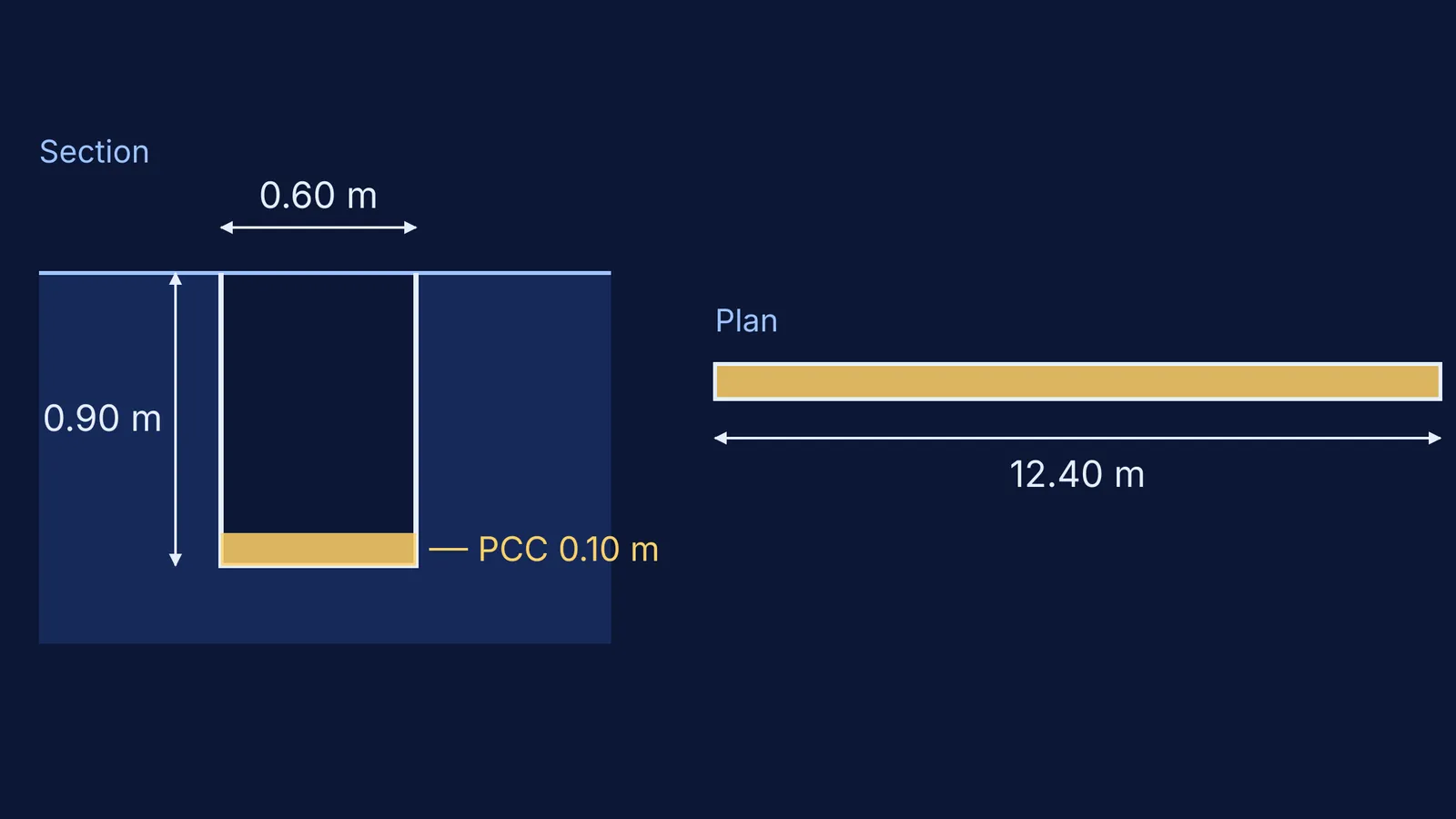
Take a footing trench for a boundary wall: 12.40 m long, 0.60 m wide and 0.90 m deep, with a 0.10 m bed of plain cement concrete (PCC) at the bottom (practice numbers). Round volumes to 0.01 m³, as IS 1200 Part 1 asks.
Book the dimensions in order: L 12.40, B 0.60, D 0.90.
Excavation: 12.40 × 0.60 × 0.90 = 6.696, which rounds to 6.70 m³.
PCC bed: 12.40 × 0.60 × 0.10 = 0.744, which rounds to 0.74 m³.
Cost: multiply each quantity by its rate. Say you take ₹400 per m³ for excavation and ₹6,000 per m³ for PCC (both made-up rates). That gives ₹2,680 plus ₹4,440, so ₹7,120 for the two items.
Real rates come from a schedule of rates, the tender or supplier quotes, and they change.
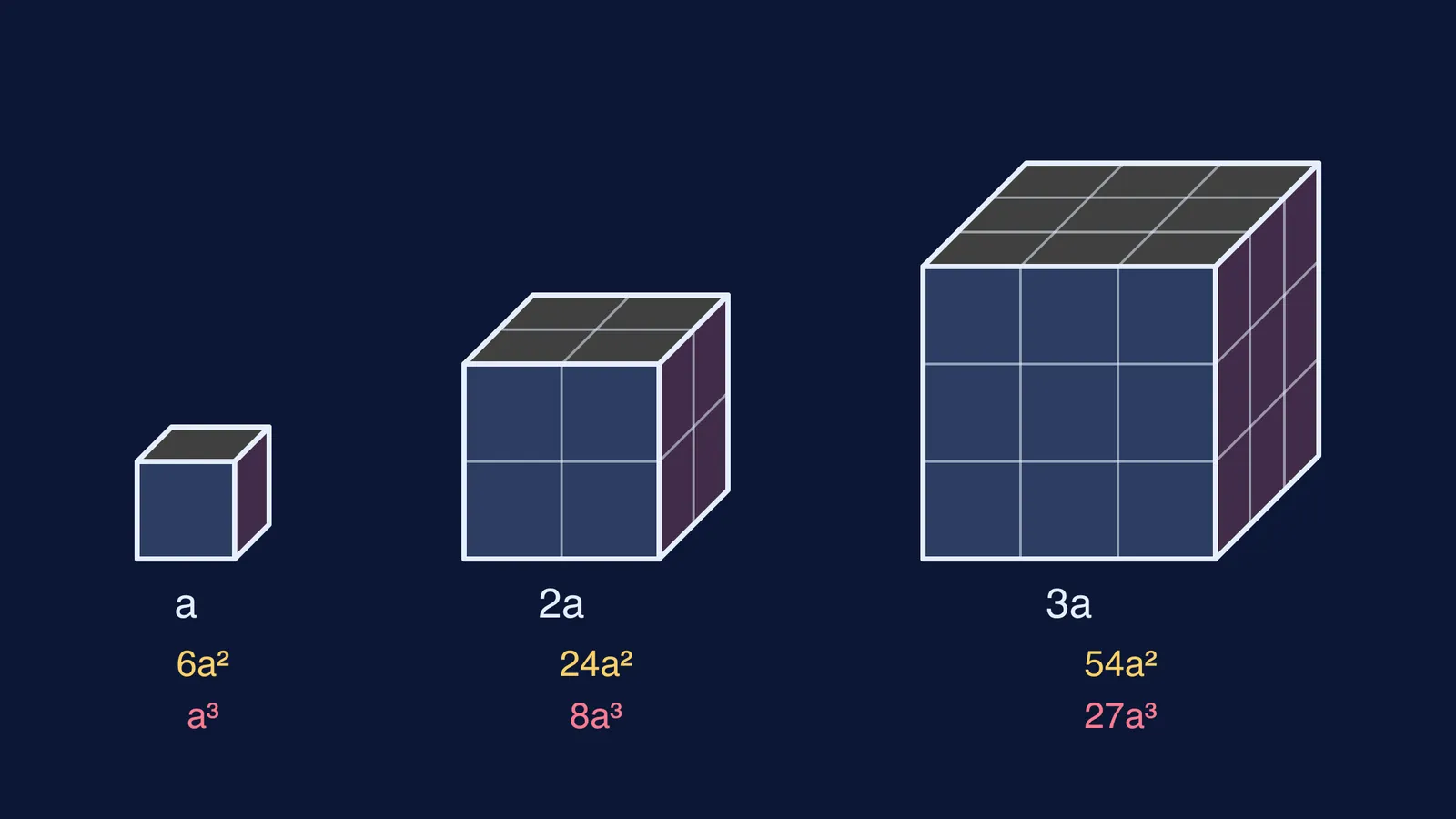
Most of this is school mensuration. If volumes of prisms and frustums feel shaky, the Fermi Concept Library has a lesson on every concept in mathematics, so you can fix the gap before your estimation course depends on it.
How can a civil student become a quantity surveyor?
Here is a plan you can follow through a BTech or diploma:
Second year: treat your estimation and costing course as a career course. Take off a small house plan by hand, then again in a spreadsheet.
Third year: ask a contractor's billing team for an internship; see our guide to finding an internship as a BTech student. Learn what a site engineer does in civil construction, because you will be measuring their work.
Final year: build a portfolio of two or three take-offs, each with its own bill of quantities.
After graduation: start as a billing engineer or assistant QS. NICMAR's postgraduate diploma accepts graduates from any discipline with at least 50% aggregate marks (NICMAR PGD QSCM). The Indian Institute of Quantity Surveyors, a professional body formed in December 1998, offers student membership (IIQS).
Long term: RICS lists three routes to chartered membership (MRICS): relevant experience plus an RICS-accredited degree, 5 years of experience plus any bachelor's degree, or 10 years of senior-level experience (RICS: What is a quantity surveyor?).
If you later want to move into contracts and project control, read our guide to construction management after civil engineering.
Is quantity surveying the right fit for you?
RICS lists strong maths, numerical and data analysis skills, and excellent written and verbal communication among the skills the role needs. Ask yourself:
Do you enjoy checking a calculation?
Can you picture the 3D shape from a plan and section?
Could you calmly defend a number to a contractor?
If you answered yes to two, test it this month: take off one drawing from your course and compare your quantities with a classmate's. Finding out why they differ is most of the job.