On this page
A building goes up because someone decided which job comes first, how much each part may cost and who does it on which day. That someone is the construction manager, and for civil graduates it is a clear route from a degree to running real projects.
What does a construction manager actually do?
The US Bureau of Labor Statistics defines the job in one line: construction managers plan, coordinate, budget and supervise construction projects from start to finish (BLS Occupational Outlook Handbook). The same page says a bachelor's degree in construction, business, engineering or a related field is the usual requirement.
In practice the work has three parts:
Schedule: break the project into activities, decide their order and find the chain that sets the finish date.
Budget: estimate costs, track spending against progress and raise a flag early when the two drift apart.
Team: coordinate contractors, suppliers, consultants and the client so the right people and materials arrive on the right day.
Why does India need people who can plan projects?
Large public projects in India often finish late and over budget. The Ministry of Statistics and Programme Implementation (MoSPI) tracks central infrastructure projects worth Rs 150 crore or more, and in April 2024 it counted 792 delayed projects out of 1,838, with an average time overrun of 35.4 months (Outlook Business, reporting MoSPI). The same report put the total cost overrun at 20.09% of the original cost and listed land acquisition, environmental clearance, financial issues, contractual issues, manpower shortage and litigation among the causes.
By April 2026, MoSPI's PAIMANA portal was tracking 1,981 infrastructure projects worth Rs 42.78 lakh crore, with a reported cost overrun of about Rs 5.65 lakh crore (NBMCW, reporting MoSPI). Not every delay is a planning failure, but good scheduling and cost control are the parts a project team can control.
How do you read a construction schedule? A worked example
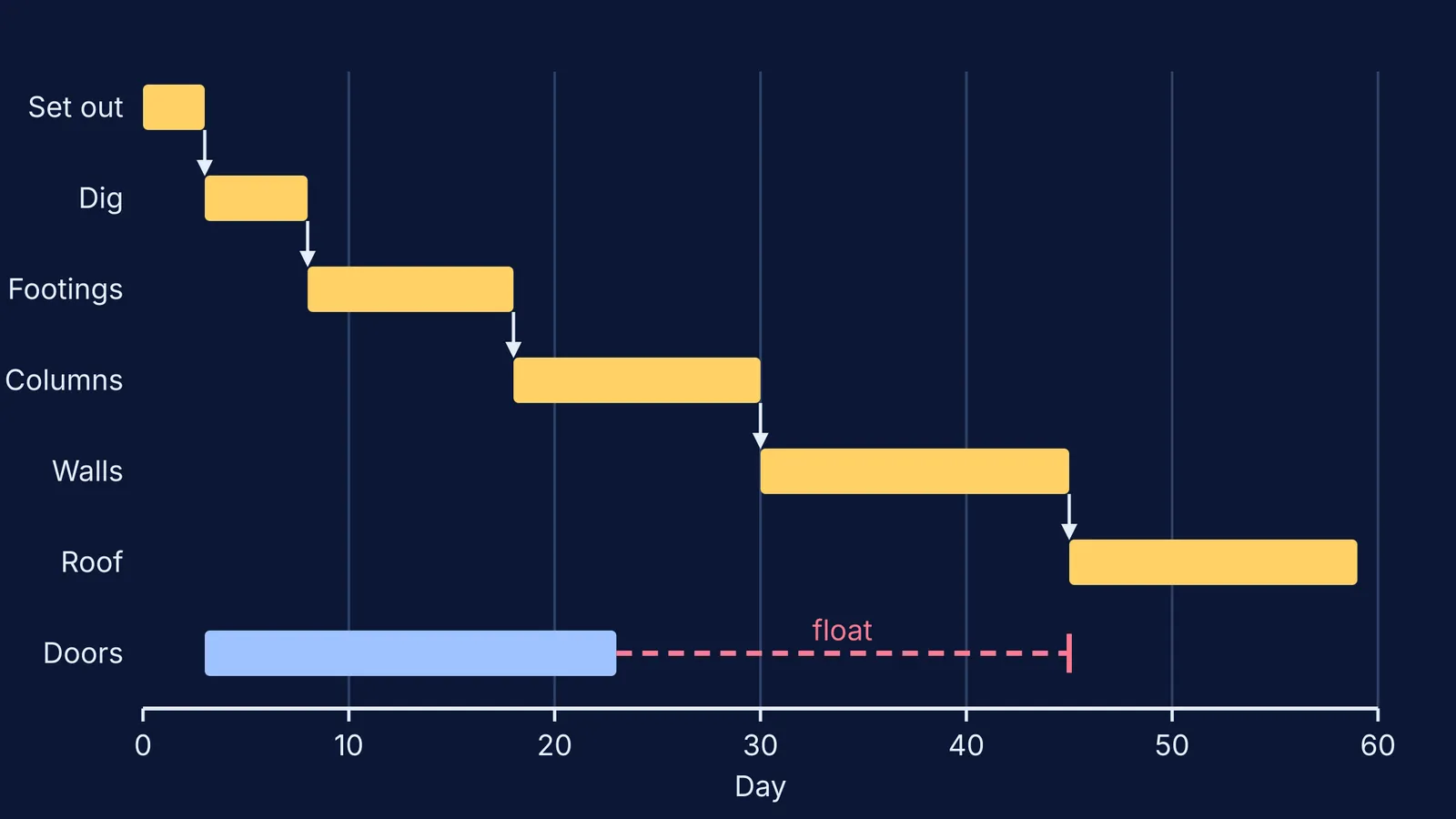
Here is a made-up schedule for the structure of a small house, the kind of plan a junior engineer helps build. Each activity has a duration and has to wait for the one before it:
Setting out the site: days 0 to 3
Excavation: days 3 to 8
Footings: days 8 to 18
Columns and plinth: days 18 to 30
Walls: days 30 to 45
Roof slab: days 45 to 59
Ordering doors and windows: days 3 to 23, needed on site by day 45
Activities 1 to 6 form a chain with no gaps. That chain is the critical path: it sets the finish date at day 59. If the footings slip by four days, the roof finishes four days late.
Activity 7 is different. It ends on day 23 but is not needed until day 45, so it has 22 days of float. The supplier can be a week late without moving the finish date. A manager watches the critical path first.
The budget works the same way. Suppose by day 30 the plan says half the work should be done. If half is done but you have spent 60% of the money, the schedule is fine and the budget is not. Catching that in week four, not at handover, is much of the job.
How do civil graduates move into construction management?
Many start on site. A site engineer's work on levels, quantities, daily reports and subcontractors is the raw material of planning; our guide to what a site engineer does in a first civil job covers that stage. With some site experience, many move into planning, billing or project coordination roles.
For formal study, there are two common routes:
A GATE-based M.Tech. IIT Madras, for example, admits students to its M.Tech in Building Technology and Construction Management on the basis of the GATE score and a personal interview (IIT Madras Civil Engineering).
A management degree in construction. NICMAR University's MBA in Advanced Construction Management runs for 24 months and accepts graduates in engineering, architecture or planning with at least 50% aggregate marks, or 45% for reserved categories (AIU admission listing).
If you are weighing a master's degree against starting work, our piece on choosing between GATE, a job or an MS after B.Tech sets out the trade-offs. For the wider map of options, see career options after civil engineering in India.
What should you do now?
In college: take any elective on construction planning or estimation, and learn one scheduling tool well enough to draw a critical path.
On internships: ask to sit in the weekly progress meeting and compare the schedule with the site.
For GATE: the maths and mechanics you need are the same ones that trip up early-year students. If a topic like statics or differential equations never quite clicked, the Fermi Concept Library gives each concept its own lesson and its place in the map, so you can fill the gap before it costs you marks.
A good next step this week: draw the critical path for one real project around you, then find which activity has the most float.