On this page
Plenty of engineering students hear "product manager" in placement season and wonder if it is a job they can walk into straight from a BTech. Some people do. For many, the path runs through a few years of building products first, and there are good reasons for that. Here is what the job involves, how engineers usually get there and a plan you can start in college.
What does a product manager actually do?
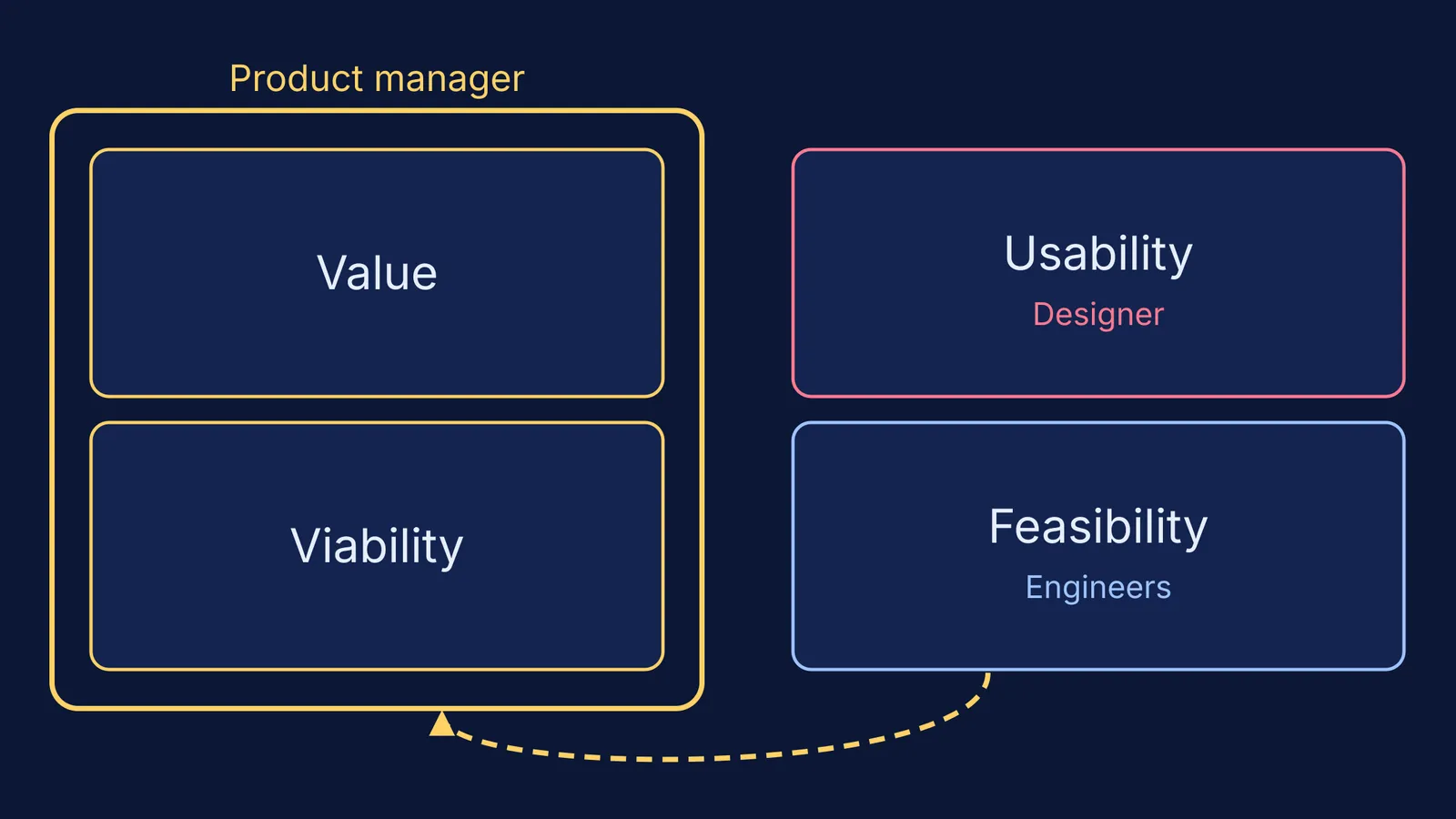
A product manager decides what a team should build and why, then works with designers and engineers to get it right. Marty Cagan of Silicon Valley Product Group puts the split simply: on empowered product teams, the product manager is responsible for value and viability, the designer for usability and the engineers for feasibility (SVPG, "Value and Viability", 2022).
In plain words, an engineer asks "can we build this?" A product manager asks "will people want it, and does it work for the business?" SVPG's sample product manager job description expects deep knowledge of users and customers, the data on how they use the product, and the business constraints from marketing, sales, finance, legal and privacy.
The job also changes with the company. A study of 212 LinkedIn job adverts for product managers in Hungary's software industry found that leadership and active listening matter more as companies grow, while micro and small firms put the most emphasis on cooperation (Sipos and Szabó, Budapest Management Review, 2024).
How do engineers become product managers?
Most routes share one step: you work on a real product first, then move across. The common ones are:
The internal move. You join as a software, hardware or data engineer, get close to users and product decisions, and ask to switch teams.
The MBA route. Some engineers work for a few years, then use an MBA to change track. Our guide to deciding whether CAT after engineering makes sense walks through that choice.
The startup route. In a small company, the engineer closest to customers often ends up doing product work. A well-written cold email for a startup internship is a practical way in while you are still studying.
If you are already in a job and thinking about any switch, our piece on career switching after BTech covers the wider decision.
Why does experience usually come first?
Look at what hiring managers ask for. SVPG's sample job description asks for "2 years working on technology-powered products as either a product manager, product designer, engineer, data analyst, data scientist, or user researcher" (SVPG). Engineering experience counts, but some experience is expected.
The reason is judgement. Product decisions rarely have a clean right answer. In his advice to engineers making the move, Cagan notes that technical decisions often have a clarity and closure that decisions about product definition and user experience lack, so you may need to change how you persuade and work harder to build support (SVPG, "Moving From Engineering To Product Management", 2008). That kind of judgement is easier once you have seen real products succeed and fail.
What skills does an engineer need to build?
Cagan's 2008 piece names the shifts that trip engineers up most (SVPG):
You are not the user. He warns engineers that "you are nothing like your target user", so you need to meet real users and watch them.
Optimise for the user, not the team. Your job becomes the end-user experience rather than developer productivity.
Let go of technical calls. Let the engineers do their job and bring them into discovery.
Expect users to reject your ideas. He describes the humility that comes from showing your ideas to users and customers and finding they don't respond as you hoped.
Add two everyday skills: clear writing, since the SVPG description asks for a well-structured, data-informed written argument, and comfort with basic statistics for reading usage data.
If probability and statistics feel shaky, the Fermi Concept Library has a lesson for every concept in mathematics and computing.
A plan from college to your first product role
Years 1-2: build something people use. A college app, a club website, a tool for your hostel. Count how many people use it and ask them why.
Year 3: take an engineering or data internship. Ask to sit in on one product review or user interview.
Year 4: write one product teardown a month. Pick an app you use, say what problem it solves, who it serves and one change you would test.
First job, years 1-2: be the engineer who talks to users. Volunteer for support rotations, bug triage and feature launches.
Then ask. Tell your manager you want to move towards product, and ask for a small product task to prove it.
Start with step one this term: build one small thing, and find out who uses it.