

On this page
If you are preparing for your engineering entrances, you or your parents might already be thinking about the next step. Many students wonder if they should pursue a B.Tech if their ultimate goal is to lead a company, manage products, or work in consulting.
The short answer is yes. Engineering builds a rigorous foundation in problem-solving and quantitative reasoning that pays off heavily in management entrances like the Common Admission Test (CAT) and in business school itself.
Are engineers still dominating the IIMs?
In recent years, top Indian Institutes of Management (IIMs) have pushed for academic diversity, awarding slight bonus points to students from arts, commerce, and science backgrounds. Despite this, engineering graduates continue to secure the majority of seats.
At IIM Ahmedabad, engineers make up 61% of the 2024–2026 Post Graduate Programme (PGP) batch. At IIM Bangalore, that number is even higher, with engineers forming 73% of the same cohort.
The reason is the CAT exam. It leans heavily on quantitative aptitude and logical data interpretation. Students who have spent years mastering calculus, mechanics, and combinatorial mathematics for engineering entrances naturally have a head start in the numbers game. If you are building your quantitative skills early, understanding concepts like the sum of all numbers formed from given digits or calculating odds in favour and odds against will serve you well long after high school.
Do you need work experience before an MBA?
The most common question students ask is whether to take the CAT during their final year of B.Tech or wait until they have worked for a few years.
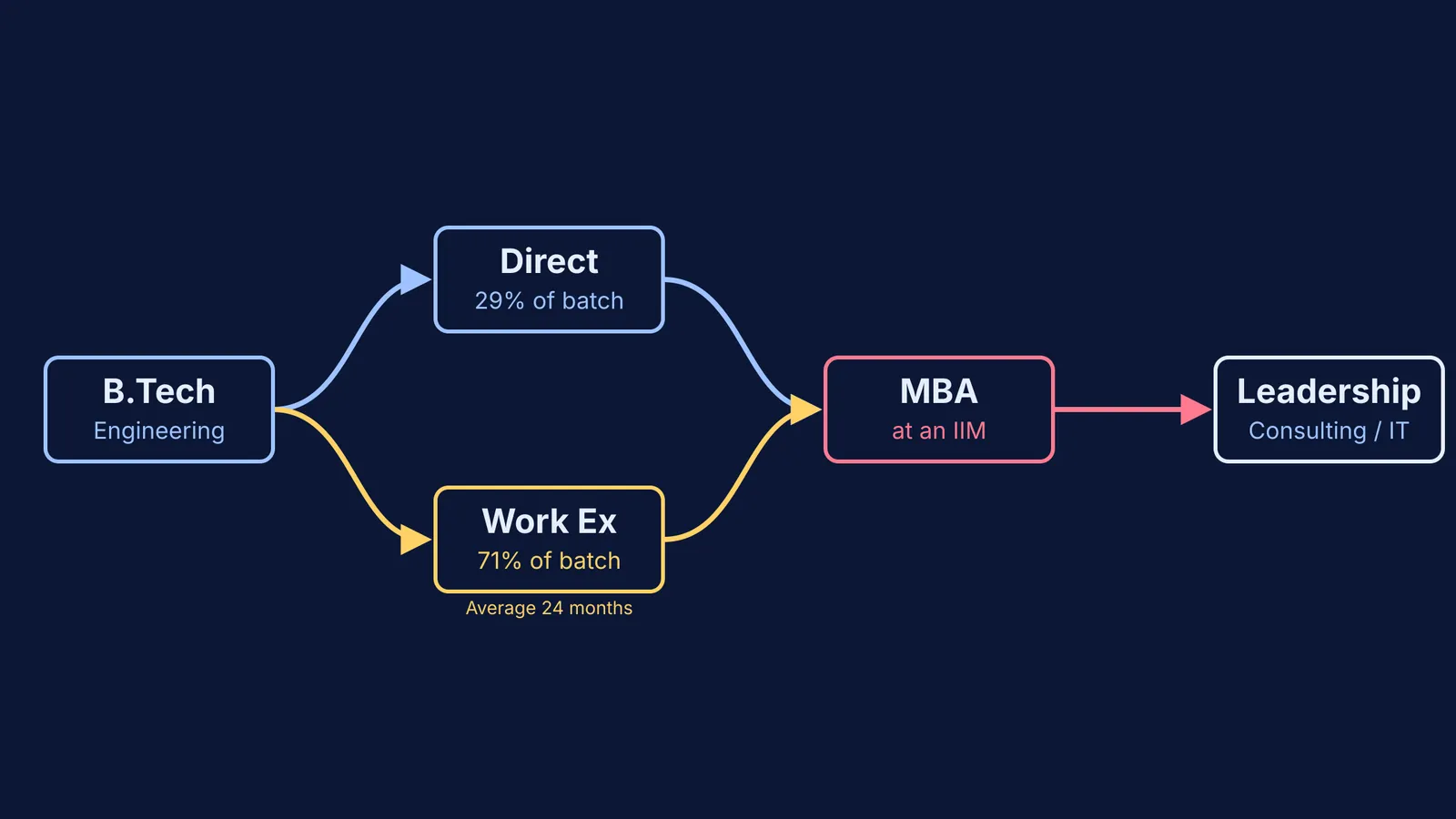
While going straight to an MBA is possible, work experience is the norm at top schools. In the 2024–2026 batch at IIM Ahmedabad, 71% of the students have work experience, with the batch average sitting at 24 months. Only 29% of the batch joined as freshers straight out of college.
Working as an engineer before business school gives you practical exposure to corporate structures, project management, and teamwork. When professors discuss supply chains or software product lifecycles, you will have real-world context to draw upon.
What is the career and salary shift?
An MBA acts as a powerful career accelerator and a salary reset for engineers. It is the primary route for moving from writing code or working on a factory floor to deciding what a company should build next.
According to IIM Bangalore's 2024 placement reports, the median salary for their graduating batch was ₹32.5 LPA. Management consulting was the top choice, taking 42% of the offers, followed by finance, IT and e-commerce.
Firms heavily recruit engineers with MBAs because they can understand complex technical constraints while steering the business strategy.
How to build the foundation now?
If you are a 16-year-old looking at this long-term path, your immediate focus should be on building a bulletproof foundation in mathematics and analytical thinking.
Rote learning will not help you in competitive exams like JEE or CAT. You need to understand the logic behind the formulas. If you find yourself stuck on a concept, Fermi's AI tutor can work out what you already know and build a plan for the session. When you are ready to test your reasoning, the Fermi Problem Library gives you worked problems with a step-by-step solver that explains the reasoning rather than printing an answer.
The B.Tech-to-MBA route is demanding, requiring you to clear two of the most competitive exams in the country, years apart. However, the combination of technical depth and strategic thinking it provides remains one of the most reliable paths to leadership.


