On this page
Many students pick a branch at 17, often from a rank list. By final year, plenty find that the work they want sits somewhere else: data, design, management, policy, a different engineering field. How hard the switch is depends on how far away the new field is, and which bridge you use to get there.
Is it normal to switch fields after B.Tech?
Yes. Economists call it field-of-study mismatch: working in a field other than the one you studied. An OECD working paper by Guillermo Montt found that both sides of the job market drive it: how crowded a field is and the level of general skills of its graduates both predict how often people end up working outside it.
In John Robst's 2007 study in Education Economics, which used US survey data, 20% of workers said their work was not related to their degree field. The same study found that the effect on wages varied considerably with the reason people gave for taking a job outside their field. So the reason behind a switch matters, not just the switch.
Skills are shifting too. Employers in the World Economic Forum's Future of Jobs Report 2025 expect roughly 39% of current skill sets to change by 2030, as summarised by the EU Digital Skills and Jobs Platform. So learning how to switch is useful even if you stay in your branch.
Which bridge gets you into another field?
There are three bridges. Use one as the main route and a second for support.
Exam bridge. A national exam can open a postgraduate course in the new field, though each institute sets its own admission rules. GATE is open to anyone in the third or later year of an undergraduate degree, or holding any government-approved degree in engineering, science, commerce, arts or humanities, according to the GATE 2027 eligibility page. Weigh it against a job or an MS with our guide on choosing between GATE, a job or an MS after B.Tech. For management, read whether to plan for an MBA after engineering.
Skills bridge. Short courses plus projects that prove you can do the work. NPTEL, an initiative of seven IITs and IISc, runs courses that are 4, 8 or 12 weeks long and are offered twice a year, according to the NPTEL FAQ.
Job bridge. A role that touches both worlds: a mechanical graduate doing quality analytics on a plant, or an electrical graduate testing software for power systems. If software is the target, see what recruiters want from non-CS students.
How long does a career switch after B.Tech take?
It depends on distance. Use this rough guide to plan, not as a promise.
Next door (same maths, new use, such as electronics to embedded software): one course cycle plus one solid project, about three to four months.
One field over (such as mechanical to data analytics): two 12-week courses back to back plus a portfolio, about six to nine months.
Far away (such as civil engineering to law): this usually needs a new degree and its own entrance exam. Plan in years, not months.
For group 3, check that degree's official admission page before spending money on anything else.
A worked example: civil engineer to data analyst in 12 months
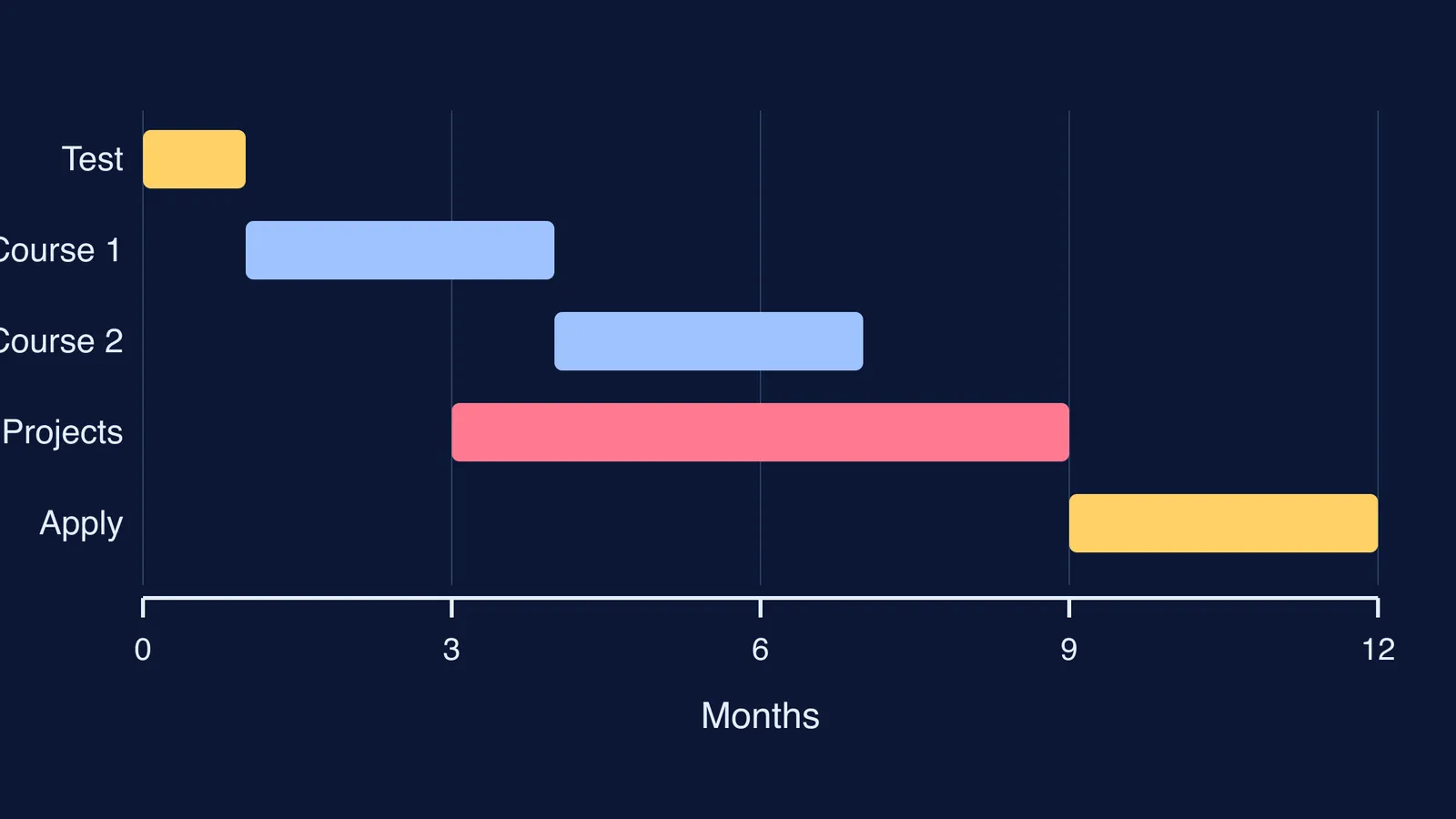
Take Meera, an illustrative example. She has a civil engineering degree and a site job. She likes the spreadsheets more than the site. This is a one-field-over switch.
Month 1: test the field with one 4-week course in statistics or data handling. If she dreads the assignments, she has lost a month, not a year.
Months 2 to 4: a 12-week course in statistics or probability.
Months 5 to 7: a second 12-week course in Python or databases.
Months 4 to 9: three projects using civil data she understands, such as concrete test results, project delays or rainfall and drainage. Her branch becomes her advantage.
Months 10 to 12: apply for analyst roles in construction, infrastructure and consulting firms first, where her degree counts in her favour.
If the maths is rusty, rebuild it before the courses. The Fermi Concept Library covers every concept in mathematics and computing, each with its own lesson, so you can fill gaps in probability or matrices one at a time.
What do you say when an interviewer asks why you switched?
Keep it to three sentences: what you studied, what pulled you, what you have done about it. For example:
"I studied civil engineering and worked on site, where I kept building the reports everyone relied on. I realised I enjoyed the analysis more than the construction, so I completed two courses in statistics and Python. Here are three projects using real construction data."
Never apologise for your branch. Present it as domain knowledge that other candidates lack.
If you do not know where to start, Fermi's AI tutor works out what you already know and builds a plan for the session, so your first evening on a new subject has a clear next step. Pick your bridge this week, then book the first 4-week course.