On this page
If you are studying civil engineering, physics or botany, the software industry can feel like a closed club. Campus recruiters often arrive with a strict filter, asking only for computer science (CS) or information technology (IT) students. But the rules of tech hiring are changing. You do not need a computer science degree to build a career in software.
Are tech companies still hiring non-CS graduates?
The short answer is yes. The shift towards "skills-first" hiring means what you can build is starting to matter more than what you studied. According to NASSCOM, 85% of colleges surveyed report a shift from credentials to skills.
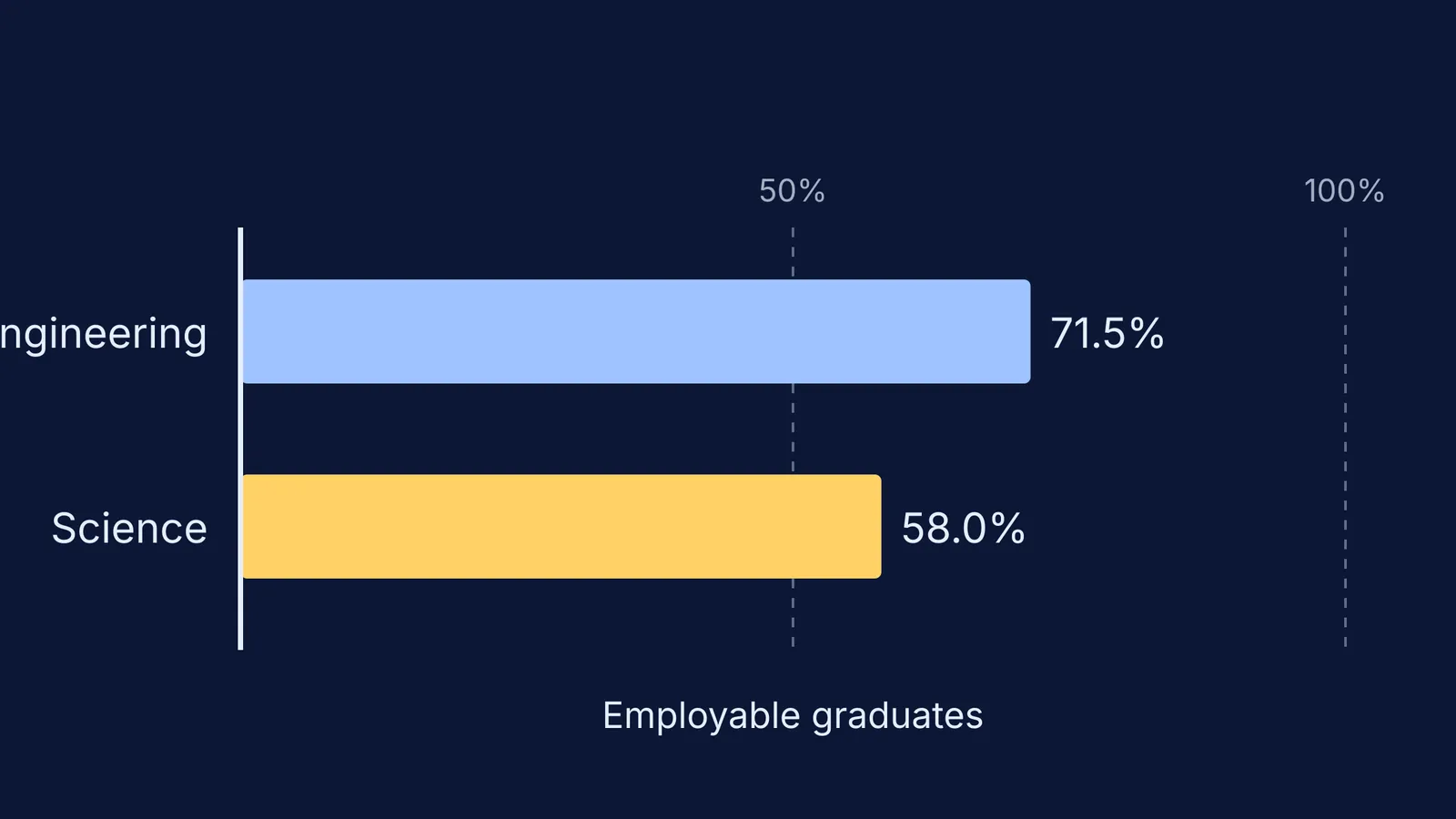
Because tools and programming languages change quickly, companies are looking for problem-solving ability rather than just a specific degree. The India Skills Report 2025-2026 shows that 58.0% of Science (B.Sc) graduates are employable. The same report found that 71.5% of Engineering graduates are employable. While CS students have a head start on the theory, a non-CS student who can write clean code is highly competitive.
How do recruiters view other branches?
Your non-CS degree is not a disadvantage; in many fields, it is an asset. Software is not written in a vacuum. It is used to model fluid dynamics, sequence DNA and manage supply chains. A software engineer who understands the real-world physics or biology behind the code is incredibly valuable.
If you study mechanical engineering, your knowledge of mechanics makes you ideal for companies building industrial software or robotics. If you study biology or chemistry, learning Python is useful in bioinformatics and computational chemistry. When recruiters see a non-CS student who has taken the time to learn programming, they see someone with self-discipline and a broader range of domain knowledge. It is worth talking about STEM careers beyond engineering and medicine, because the lines between traditional sciences and software are blurring.
Should you apply off-campus or wait for placements?
While NASSCOM found that 85% of colleges say skills matter more, some traditional campus recruiters still use branch filters simply to reduce the number of applicants. If your college placement cell restricts software roles to CS and IT students, you will need to look off-campus.
Off-campus hiring is where a skills-first approach is most obvious. Startups, in particular, rarely care about your degree title. They care about your GitHub profile and your ability to pass a coding assessment. Global Capability Centres (GCCs) are also hiring freshers based on specialised skill sets rather than just CS degrees. When applying off-campus, your portfolio is your primary tool to get noticed. You can send cold emails to recruiters linking directly to your domain project, which demonstrates both your coding ability and your initiative.
How to build coding skills alongside your degree
To get a software job, you must pass the same technical interviews as a CS student. This means you need a solid grasp of data structures, algorithms and at least one core programming language like Python, Java or C++.
When learning computing concepts, Fermi's AI tutor holds a line of reasoning across a session and notices where a student is stuck, deciding whether to explain, ask or show. This is far more effective than just reading code. The key is to start early and be consistent. Decide how to build a study routine that lasts, dedicating a few hours each week to writing code, rather than cramming before placement season.
A framework for your software portfolio
Recruiters need proof that you can code. Since you do not have a CS degree to vouch for you, your projects become your resume. Here is a practical framework to build a portfolio that stands out:
Pick a core language: Choose one language (Python is excellent for beginners and widely used in AI and data science) and learn it deeply.
Build a domain project: Combine your branch with your code. If you study physics, write a program that simulates a pendulum's motion. If you study finance, build a tool that pulls stock data and calculates moving averages.
Learn version control: Put all your code on GitHub. Knowing how to use Git (commit, push, pull, branch) is a basic requirement for almost every software team.
Master the fundamentals: Dedicate time to learning data structures (arrays, linked lists, trees) and algorithms (sorting, searching). You will need these to clear the initial coding rounds of interviews.
When you sit down in an interview, you can confidently point to a working piece of software you built from scratch. That speaks louder than the name of the branch on your degree.