On this page
A school event, whether a science exhibition, a quiz or the Class 12 farewell, is a small project: a fixed date, a budget, a team and a teacher who has to say yes.
India's school policy counts this kind of work as part of learning. The National Education Policy 2020 lists "no hard separations" between curricular and extra-curricular activities among its principles, and names "life skills such as communication, cooperation, teamwork, and resilience" alongside them.
How do you organise a school event as a student, step by step?
Get permission in writing first. Agree the date, venue, budget and guest list with the teacher in charge.
Write a one-line goal and a headcount. "A science exhibition for Classes 6 to 10 and parents, about 300 visitors."
Plan backwards from the date. Put the event day at the end of a calendar and fill in what must be finished each week before it.
Give every task one owner. A name, not "the team".
Make the budget before you spend anything. Every rupee goes in a shared sheet with its bill.
Write a run sheet. Who opens the hall, who handles the mic, who has the first-aid box.
Debrief within a week. What to fix, what to keep, and a handover note for next year.
How far ahead should you start planning?
Start earlier than feels necessary. In a set of studies on the planning fallacy, Buehler, Griffin and Ross (1994) found that people's predictions of how long their own tasks would take were too optimistic, for both academic and non-academic tasks. People focused on how the future would go rather than on past experience. In one study, the optimistic bias disappeared when participants were told to connect relevant past experiences to their predictions.
So before you set deadlines, ask a teacher or senior how long last year's annual day or fest actually took. Then keep the final week free of build work as a buffer.
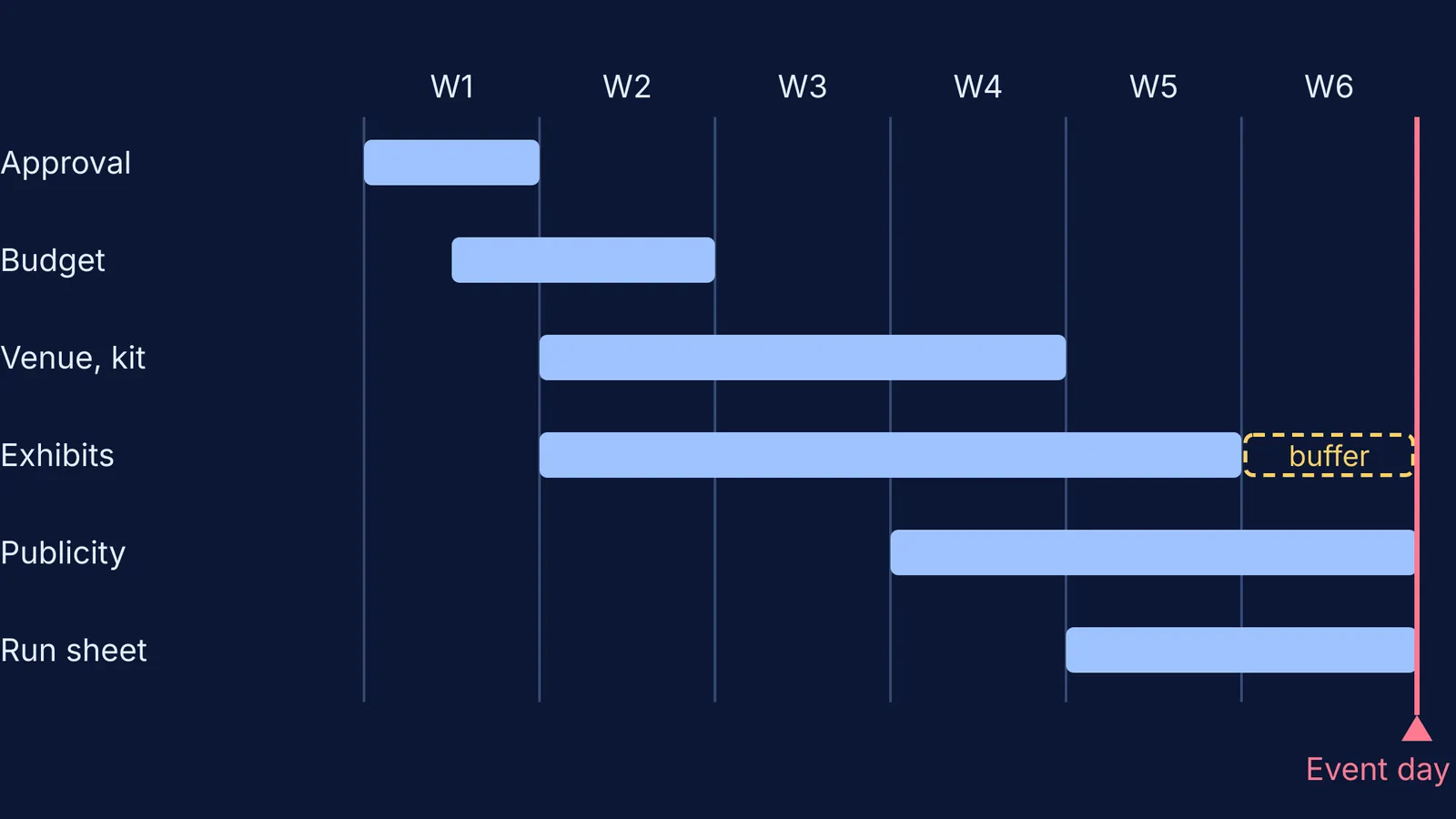
What does a six-week plan for a science exhibition look like?
Week 1: approval from the science head of department, hall booked, draft budget.
Week 2: budget agreed, team roles fixed, list of exhibits finalised.
Weeks 2 to 4: venue and kit: tables, extension boards, chart paper, borrowed lab equipment logged in and out.
Weeks 2 to 5: exhibits built and tested, with week 6 kept as buffer.
Weeks 4 to 6: publicity: posters, class announcements, invitations to parents.
Weeks 5 and 6: run sheet written, full rehearsal two days before.
Suppose the school gives you ₹12,000. A simple split: ₹5,000 for exhibit materials, ₹3,000 for printing and chart paper, ₹2,000 for volunteer refreshments, ₹800 for certificates, and ₹1,200 held back for surprises. Our guide to making a simple budget spreadsheet shows how to track it.
How do you divide work in a student team?
Groups have a known weak spot. Social loafing is the tendency for individuals to put in less effort when working collectively than when working alone, according to a meta-analysis of 78 studies by Karau and Williams (1993). The same review found that whether individual work could be evaluated, what people expected of their co-workers, and how meaningful the task felt had an especially strong influence on it.
That suggests three fixes. Make each person's part visible with a named owner on the shared sheet. Let people pick roles they care about. Hold a ten-minute check-in each week where every owner reports in one sentence.
How you phrase tasks also matters. A meta-analysis of 94 independent tests by Gollwitzer and Sheeran (2006) found that implementation intentions, plans that spell out when, where and how you will act, had a medium-to-large effect on reaching goals. "Book the hall" becomes "Riya asks the office to book the hall on Monday at lunch."
What does organising a school event teach you?
Estimation: you learn how long things really take.
Money sense: a budget with bills attached is your first accounts statement.
Talking to adults: booking rooms and asking for funds are professional conversations.
Delegation: leading means checking in, not doing everything yourself.
Recovery: something always goes wrong, and fixing it calmly is what people remember.
If you want to build on this, read about growing leadership skills through school clubs.
The catch is the study time it eats. Block your exhibition weeks into your timetable early using our plan for balancing school events and duties with study. If a chapter slips while you are busy, Fermi's AI tutor can work out what you already know and build a plan for the session, so your catch-up hour starts with a clear next step.
Pick your event date, count six weeks back, and write the first owner's name today.