

On this page
Annual day rehearsals that run past five, a sports week that starts at 7 am, gate duty as a prefect: for a few weeks each year, school itself takes your study time. The goal for those weeks is not to cover new chapters. It is to keep the thread, so you do not come back to a cold syllabus and a pile of missed homework.
Why does studying stop during annual day and sports week?
Usually the plan breaks, not you. A normal evening plan assumes two free hours that no longer exist, so it becomes all or nothing, and nothing wins. The fix is a smaller plan built for the weeks you actually have.
What is the smallest study plan that still works?
1. One fixed block. Pick 25 to 30 minutes at the same time every day, tied to something that happens whatever the rehearsal schedule: finishing dinner, say, or your bath. Write it as an if-then plan: "If I finish dinner, then I sit at my desk with the physics notebook."
An implementation intention is an if-then plan that names when, where and how you will act. Across 94 independent tests, implementation intentions had a medium-to-large positive effect (d = 0.65) on goal attainment, according to a meta-analysis by Peter Gollwitzer and Paschal Sheeran38002-1).
2. Portable tasks. Rehearsals involve a lot of waiting for your turn. Keep a pocket list of five-to-ten-minute tasks that need no desk.
3. One catch-up slot. Book 60 to 90 minutes at the weekend for whatever slipped. For how much slack to keep in an ordinary week, see how much buffer time to keep in your study timetable.
What should you do in a 30-minute block?
Test yourself rather than reread. Close the book, write down what you remember from that day's classes, then check and fix the gaps.
In experiments by Henry Roediger and Jeffrey Karpicke, students who took recall tests on a passage remembered more after 2 days and after 1 week than students who restudied it, even though restudying made them feel more confident. A review of ten learning techniques by John Dunlosky and colleagues rated practice testing and distributed practice as high utility, and rereading and highlighting as low utility.
Short daily blocks are also spaced practice. A synthesis by Nicholas Cepeda and colleagues pooled 317 experiments from 184 articles and found that the best gap between study sessions grows with how long you need to remember the material.
Which study tasks can you do between rehearsals?
Write five formulas from one chapter on a card from memory, then check.
Redo one solved maths example without looking at the solution.
Draw one biology diagram from memory and label it.
Say three chemistry reactions aloud, with their conditions.
Answer ten flashcards from your weakest chapter.
None of these needs a phone. If a task shows up a concept you cannot explain, note it on the card and look it up that evening; the Fermi Concept Library has a lesson for every concept in physics, chemistry, biology and mathematics.
What does a sample event week look like?
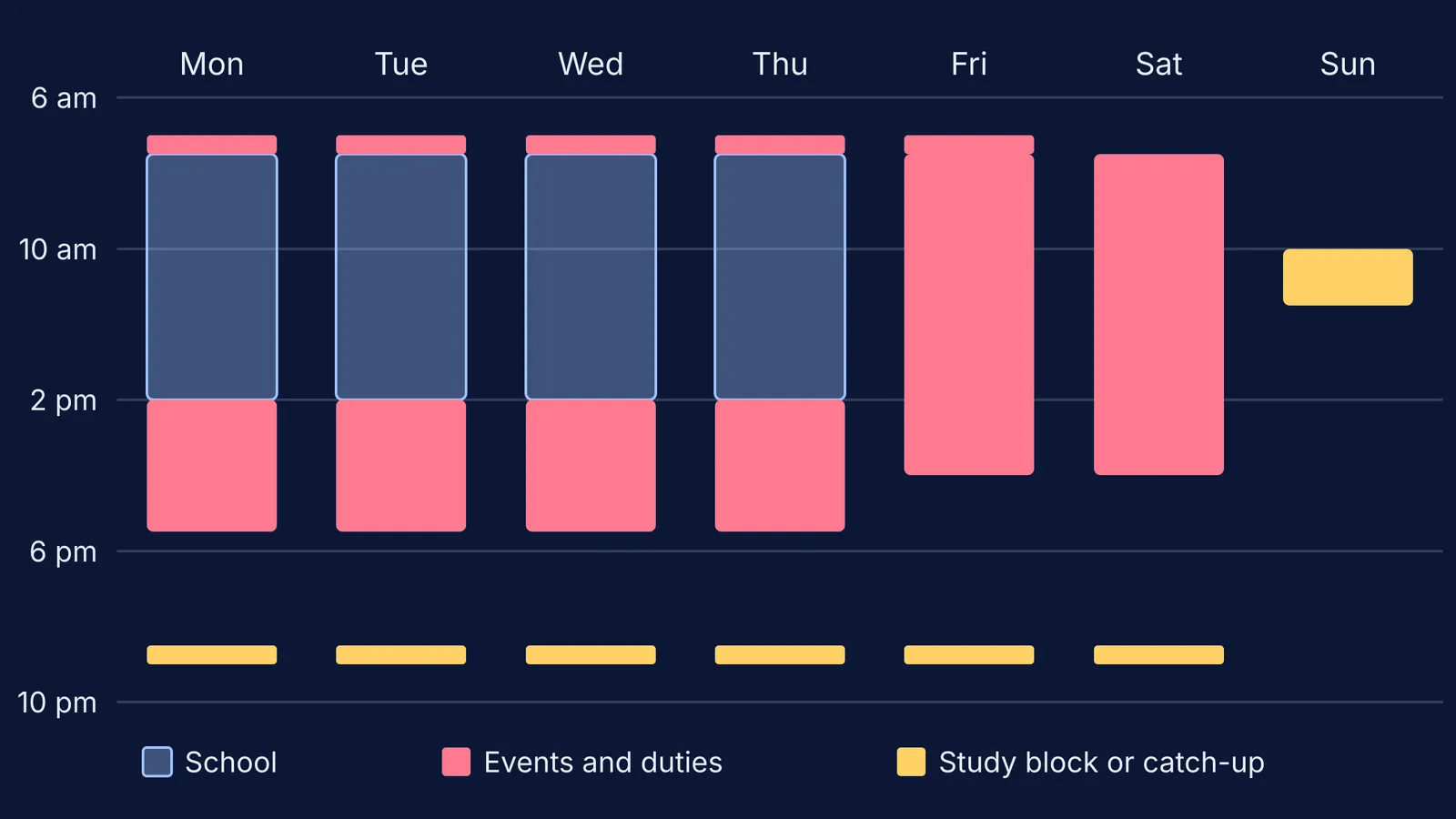
Here is the week in the diagram above, for a Class 11 student with rehearsals until 5:30 pm Monday to Thursday, sports week on Friday and Saturday, and gate duty at 7 am on weekdays.
Monday to Saturday, 8:30 to 9:00 pm: the fixed block. Recall that day's classes, then do one exercise question.
Rehearsal and sports-day waits: two portable tasks a day from the pocket list.
Sunday, 10:00 to 11:30 am: catch-up. Spend the first 15 minutes listing what you missed (notes, homework, test dates), then work through it in order of deadline.
Sunday afternoon: rest.
That is four and a half hours at the desk, far less than usual, but no chapter goes cold. If homework problems pile up in the catch-up slot, the Fermi Problem Library has worked problems with a step-by-step solver that explains the reasoning rather than printing an answer. If you have lost more than a week, use the fuller plan in how to catch up after missing a week of classes.
What should you say to teachers and parents?
Ask early, with a plan attached. To a subject teacher: "Ma'am, I have annual day rehearsals until 5:30 this week. Could I submit the worksheet on Monday? I have kept Sunday morning to finish it."
For parents, swap "You haven't studied at all this week" for "What's in your block tonight?" It keeps the talk on the 30 minutes that are possible.
If event season leaves you anxious or unable to sleep for weeks, talk to a parent or your school counsellor, or call Tele MANAS, the government's free mental-health helpline, on 14416.
When the curtain comes down, go back to your normal timetable, or rethink it with fixed hours or task lists: which study timetable works.


