

On this page
Missing a week of school or coaching feels like falling off a moving train: the class has moved on and new homework keeps arriving. A missed week can often be made up in a week, if you do the right things in the right order.
It is worth fixing quickly. A 2010 meta-analysis by Credé, Roch and Kieszczynka, pooling 69 samples and 21,195 college students, found a strong correlation between class attendance and class grades (ρ = .44) (Credé et al., 2010). That was college students, and a correlation does not prove that missing class causes lower grades, but it suggests a missed week deserves a plan, not just a pile of notes.
What should you do first after missing a week of classes?
Spend Day 1 collecting, not studying. You need a complete picture of what you missed before you can decide what matters.
The topic list. Ask each teacher which topics they covered and which ones the next test will include.
Notes from two classmates. One set always has gaps, so two sets let you fill them.
Homework, worksheets and any practice sheets handed out while you were away.
Dates. Any test, assignment or practical that is coming up soon.
Put it all on one page per subject: your catch-up map.
Our guide on how to ask better questions in class has more scripts.
How do you find the must-know ideas?
For each subject, pick out the five to eight ideas everything else depends on. Good signals: what the teacher boxed on the board, what the homework asks you to use, and the solved examples in your NCERT textbook.
Then check each one: can you state it in one sentence and use it in one simple question? If not, that is a concept gap to fix before harder problems. The Fermi Concept Library gives every concept in physics, chemistry, biology, mathematics and computing its own lesson, which helps when your classmates’ notes skip the explanation.
How do you catch up without rereading everything?
Rereading feels productive, but the evidence for it is weak. A 2013 review by Dunlosky and colleagues rated ten study techniques and gave rereading, highlighting and summarising a low utility rating, while practice testing and spacing your study out earned a high utility rating (Dunlosky et al., 2013).
Testing yourself also helps you remember for longer. In Roediger and Karpicke’s 2006 experiments, students who restudied a passage did better on a test 5 minutes later, but students who had practised recalling it remembered substantially more after 2 days and after 1 week (Roediger and Karpicke, 2006).
So make your catch-up mostly solving and recalling. For each must-know idea, study one worked example closely, then solve two or three core problems without looking. Our piece on worked examples versus solving from scratch explains when each one helps. When you get a problem wrong and cannot see why, the Fermi Problem Library has a step-by-step solver that explains the reasoning rather than printing an answer.
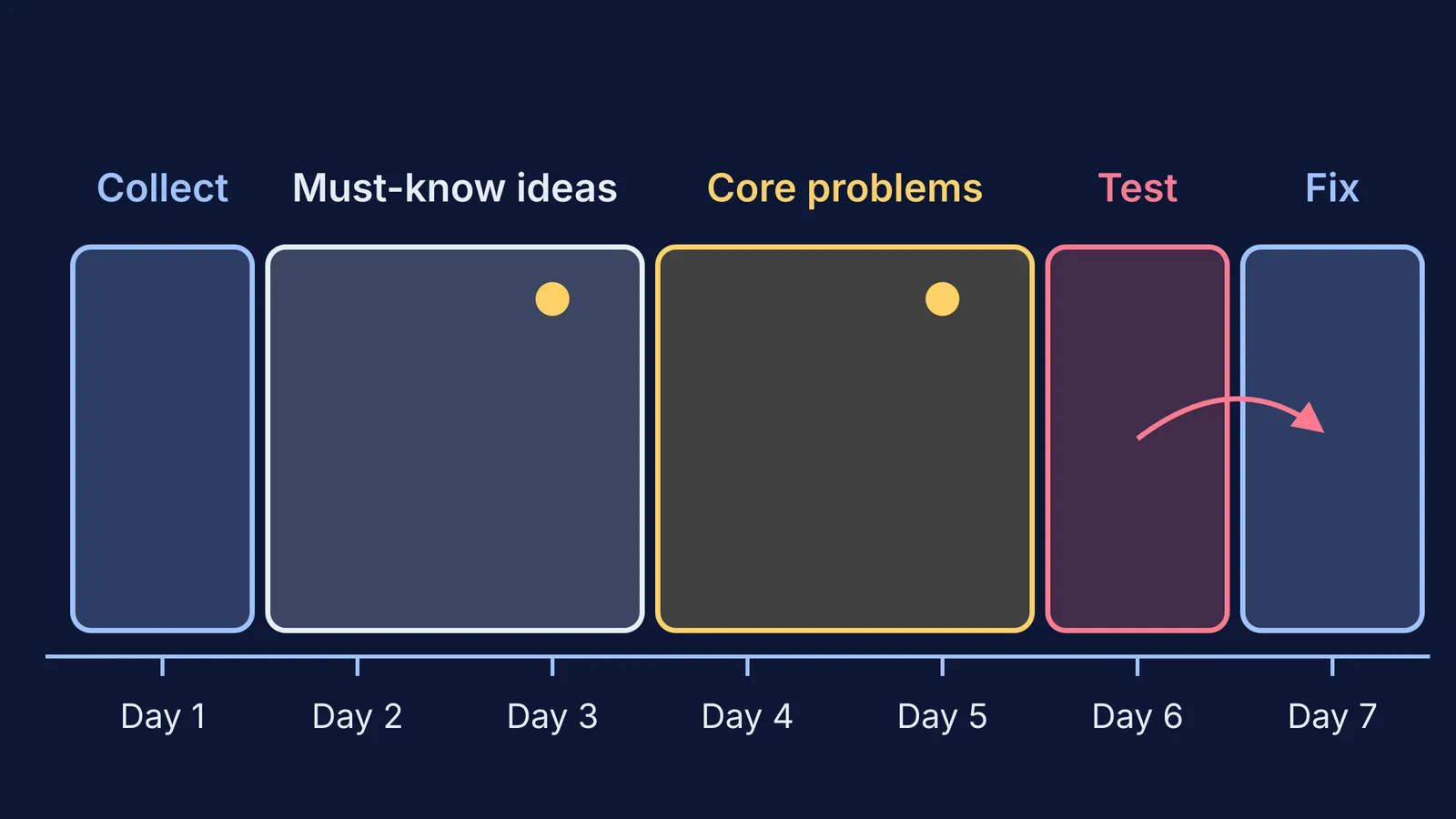
A 7-day catch-up plan
Give this an hour or so a day. Keep up with new classes first, so you don’t fall further behind.
Day 1, collect. Topic lists, two sets of notes, worksheets, dates. Make one page per subject.
Day 2, must-know ideas (subject A). List the core ideas, read only what you need, and write each idea from memory.
Day 3, must-know ideas (subject B). Same steps. Start with a short recall quiz on Day 2’s ideas.
Day 4, core problems (subject A). One worked example, then two or three problems on your own for each idea.
Day 5, core problems (subject B). Same steps, starting again with a short recall quiz.
Day 6, mixed test. Ten to fifteen questions across everything you missed, closed book, timed.
Day 7, close the gaps. Redo every question you got wrong, then take your list of real doubts to your teacher.
If you missed more than a week, or the gap is several chapters deep, this plan is too small. Use our triage plan for clearing a chapter backlog instead.
What if catching up is about more than the notes?
Sometimes a week away comes from illness, a family situation or feeling low, and those don’t vanish when you return. Parents help most by handling logistics, like the call to the class teacher, and by asking “What do you need?” rather than “Why aren’t you done yet?” If someone needs to talk, Tele MANAS is a free, 24x7 national mental-health helpline launched by the Ministry of Health and Family Welfare.
For the studying itself, start Day 1 today: one page per subject, and the topic list from your teacher.


