On this page
When you receive your monthly allowance or a part-time wage, it is easy to spend it without a plan. Before the month ends, the money is gone. A simple budget spreadsheet changes this by giving every rupee a job before you spend it.
The numbers show that learning this early makes a tangible difference. The 2024 OECD PISA Results (Volume IV) on financial literacy found that 15-year-old students with higher financial literacy are 72% more likely to save money than low performers (OECD, 2024). The report also notes that across 14 OECD countries, 18% of 15-year-olds on average fail to reach a basic level of financial understanding, struggling to tell a need from a want.
Why use a spreadsheet for your budget?
Apps can automate tracking, but building your own spreadsheet forces you to look closely at your money. It is a blank canvas where you write down what comes in and what goes out. When you build your spreadsheet, you are organising numbers so you can see them clearly—much like how William Playfair and the bar chart first taught us to draw data for the eye.
When you categorise your expenses yourself, you learn your own habits. You notice if you are spending too much on eating out or subscriptions. This awareness is the first step to financial independence. If you find the percentage calculations or the algebra of personal finance tricky, the Fermi Problem Library has a step-by-step solver that explains the reasoning rather than printing an answer.
What to include in your student budget?
A student budget does not need complex accounting. You can divide your sheet into four main areas:
Income: This is money coming in. It includes your monthly allowance from parents, wages from a part-time job, or scholarship payouts.
Needs: These are essential expenses you cannot avoid. For a student, this means rent (if living away from home), groceries, transport passes, and phone bills.
Wants: This is money for fun. It covers eating out, cinema tickets, hobbies, and shopping.
Savings: This is money you keep for the future. You should treat savings as a strict expense line, paying yourself first before spending on wants.
How to make a simple budget spreadsheet?
You can use a free tool like Google Sheets or Microsoft Excel to build your budget. Tracking your budget often involves basic arithmetic and percentages. Mastering these fundamentals is important; in fact, early skills in fractions and division predict later maths success.
Here is a step-by-step plan to set up your sheet:
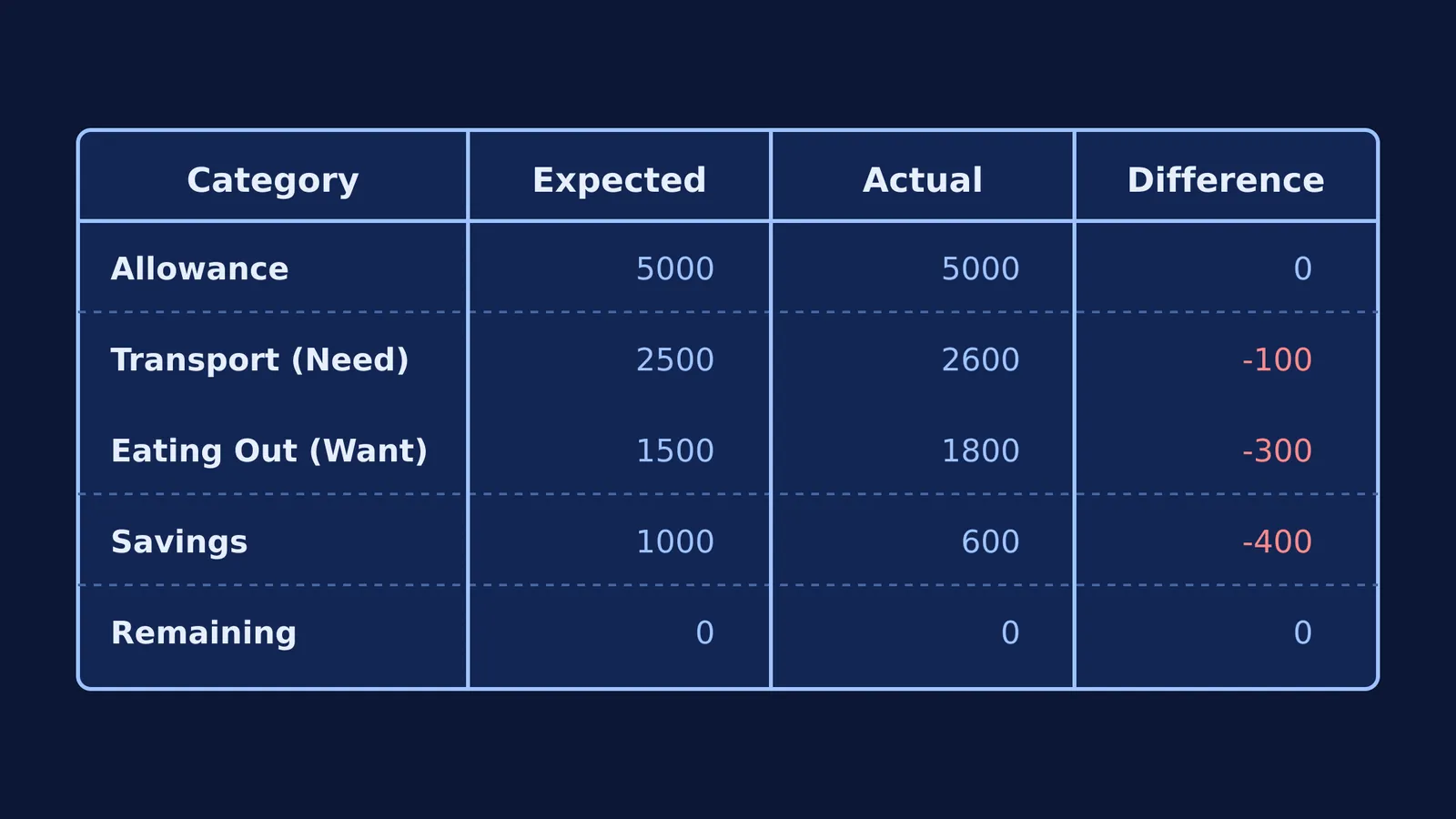
Step 1: Set up your columns. Open a new sheet and create four column headers in the top row: *Category*, *Expected*, *Actual*, and *Difference*.
Step 2: List your income and expenses. In the *Category* column, write "Income" and list your sources below it. Leave a blank row, then write "Expenses". Under this, list your Needs, Wants, and a dedicated row for "Savings".
Step 3: Enter your expected numbers. At the start of the month, fill the *Expected* column with what you plan to earn and spend. Ensure that your total expected expenses and savings equal your total expected income. A zero-based budget means every rupee is assigned.
Step 4: Track your actual spending. As the month goes on, update the *Actual* column. If you buy a coffee, add the cost to your "Eating Out" category.
Step 5: Calculate the difference. In the *Difference* column, use a simple formula (Expected minus Actual) to see if you are overspending. If your Actual spending on transport is higher than Expected, you will see a negative number. This tells you to cut back somewhere else.
If you ever want to understand how your savings grow with compound interest over time, Fermi's AI tutor can work out what you already know and build a plan for the session, so you sit down to a clear next step.
What if your expenses change?
A budget only works if you look at it. Set a reminder on your phone to update your spreadsheet every Sunday evening.
Do not worry if your first month is messy. The goal is not perfection; it is learning where your money goes. If you overspend on wants in October, adjust your expectations for November. The habit of tracking your money now will serve you long after you graduate.