On this page
You finish Laws of Motion, move on to Work, Energy and Power, and three weeks later a friction question feels like a stranger. That is normal, and the fix is a small, fixed daily habit that keeps old chapters ticking over while new ones come in. We call it the maintenance slot.
Why do old chapters fade while you study new ones?
Memory fades when it is not used, and it fades fastest soon after learning. Our piece on what Ebbinghaus actually measured about forgetting walks through where that idea comes from.
Two findings shape the rule below. First, testing beats rereading. In Roediger and Karpicke's 2006 study in Psychological Science, students who took recall tests on prose passages retained substantially more after 2 days and 1 week than students who restudied, even though restudying made them feel more confident.
Second, the gap matters. In a 2008 study by Cepeda and colleagues, more than 1,350 people learned a set of facts, got a review after a gap of up to 3.5 months, and were tested up to a year later. For a test 1 year away, the best gap between study and review was about 5 to 10% of that year.
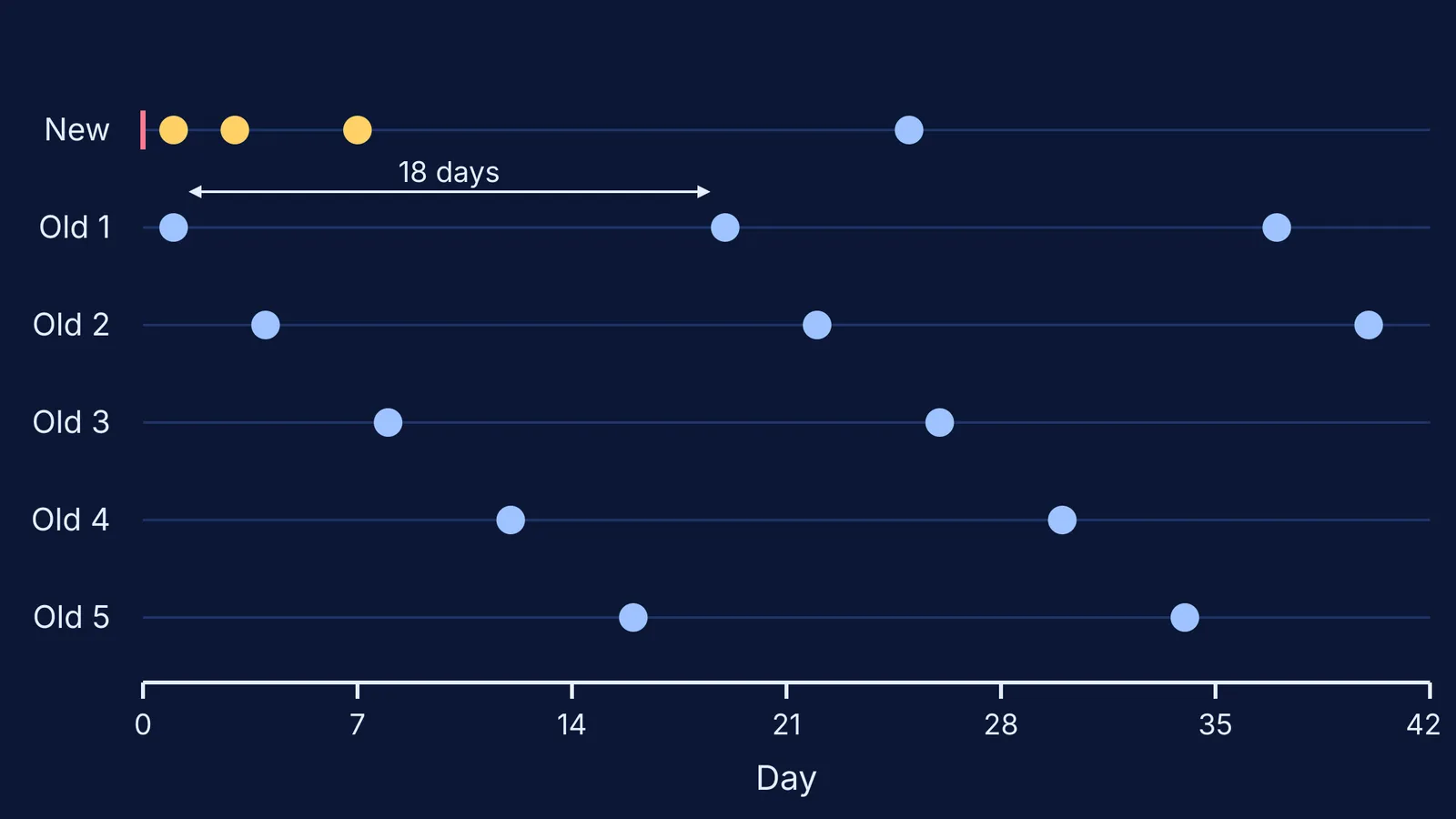
For a board exam or JEE Main about a year away, 5 to 10% of 365 days works out to roughly 18 to 36 days. The study tested a single review, so treat this as a rough guide. The loop below brings each old chapter back about every three weeks.
What is the maintenance revision rule?
The rule has three parts.
Fixed slot: 20 minutes every study day, at the start of your session, before any new chapter, so it never gets squeezed out.
Rotation order: every finished chapter goes into one list, across all subjects. Each day you take the chapter at the top, then move it to the bottom.
Quick test, not rereading: the slot is a closed-book test, never a read-through of notes.
A 2013 review of ten study techniques by Dunlosky and colleagues rated practice testing and distributed practice as high utility, and rereading and highlighting as low utility.
How do you run the 20-minute slot?
Minutes 0 to 10: answer five questions on paper. Two definitions or formulas from memory, two short numericals or reasoning questions, and one question you got wrong in a past mock.
Minutes 10 to 15: open the book and mark each answer right, shaky or wrong.
Minutes 15 to 20: fix the single worst gap. Rework the problem, or rewrite the idea in three lines.
Note the shaky and wrong items on that chapter's card, so next time's five questions start there.
When a wrong answer comes from not understanding the idea, look it up in the Fermi Concept Library, where each concept in physics, chemistry, biology and mathematics has its own lesson. When you knew the idea but used the wrong method, a worked problem in the Fermi Problem Library shows the reasoning step by step.
How should new chapters join the rotation?
A just-finished chapter slips fastest, so give it three short extra checks before it joins the loop: 1 day, 3 days and 7 days after you finish it. Each check is three questions and about five minutes, added to that day's slot. After the day-7 check, put the chapter at the bottom of the rotation list. For one chapter in detail, see our 4-week spaced revision schedule for any chapter.
What does this look like in a real week?
Say you are in Class 11 with 18 finished chapters across physics, chemistry and maths. You finished Gravitation on Sunday and start Oscillations on Monday:
Monday: Kinematics from the list, plus the day-1 check on Gravitation.
Tuesday: Mole concept.
Wednesday: Sets, plus the day-3 check on Gravitation.
Thursday: Laws of motion.
Friday: Atomic structure.
Saturday: Straight lines.
Sunday: Work, energy and power, plus the day-7 check on Gravitation, which then goes to the bottom of the list.
With 18 chapters in the list, each one comes back every 18 days, inside the 18 to 36 day range worked out from the Cepeda study. Once your list grows past about 36 chapters, take two chapters a day and stretch the slot to 30 minutes. That keeps the gap at about five weeks or less until the list reaches about 70 chapters.
What if the slot keeps slipping?
Missed a day: do not double up. Take the next chapter tomorrow and carry on.
A chapter scores five out of five three times in a row: keep it in the list, but you can drop it to three questions.
Several chapters score two or less: that is a backlog, not a maintenance problem. Use a triage plan to clear your chapter backlog first, then restart the loop.
Parents: the most useful question is "which chapter was in today's slot?", not "what did you score?". It keeps the habit going without a daily exam.
Tonight, write the list of chapters you have finished. Tomorrow, the one at the top is your first 20 minutes.