

On this page
Neuroscience is the study of the nervous system, from single neurons to behaviour. In India it is mostly taught after your first degree, so the real choice is your first degree and what you do during it.
Can you study neuroscience straight after 12th?
Yes, but there are only a few options. Manipal Academy of Higher Education runs a B.Sc.–M.Sc. integrated course in basic medical sciences and clinical/computational neurosciences. You can leave with a B.Sc. after 3 years, a B.Sc. Honours with research after 4, or an M.Sc. after 5. It asks for Biology, Chemistry and English in Class 12, plus one of Physics, Biotechnology, Mathematics or another life science, and selects through the Manipal Entrance Test (MET) and Class 12 marks.
If another university offers a bachelor's with neuroscience in its name, read the syllabus, ask where recent graduates went next, and check whether the faculty run research labs you could join. But you do not need a neuroscience bachelor's to become a neuroscientist.
Which undergraduate subjects lead to neuroscience?
IISc's Centre for Neuroscience says: "Given the interdisciplinary nature of neuroscience, we welcome students from diverse backgrounds." The National Brain Research Centre (BRIC-NBRC) in Manesar says its PhD students come from backgrounds such as life sciences, physics, chemistry, mathematics, computer science, psychology and medical science.
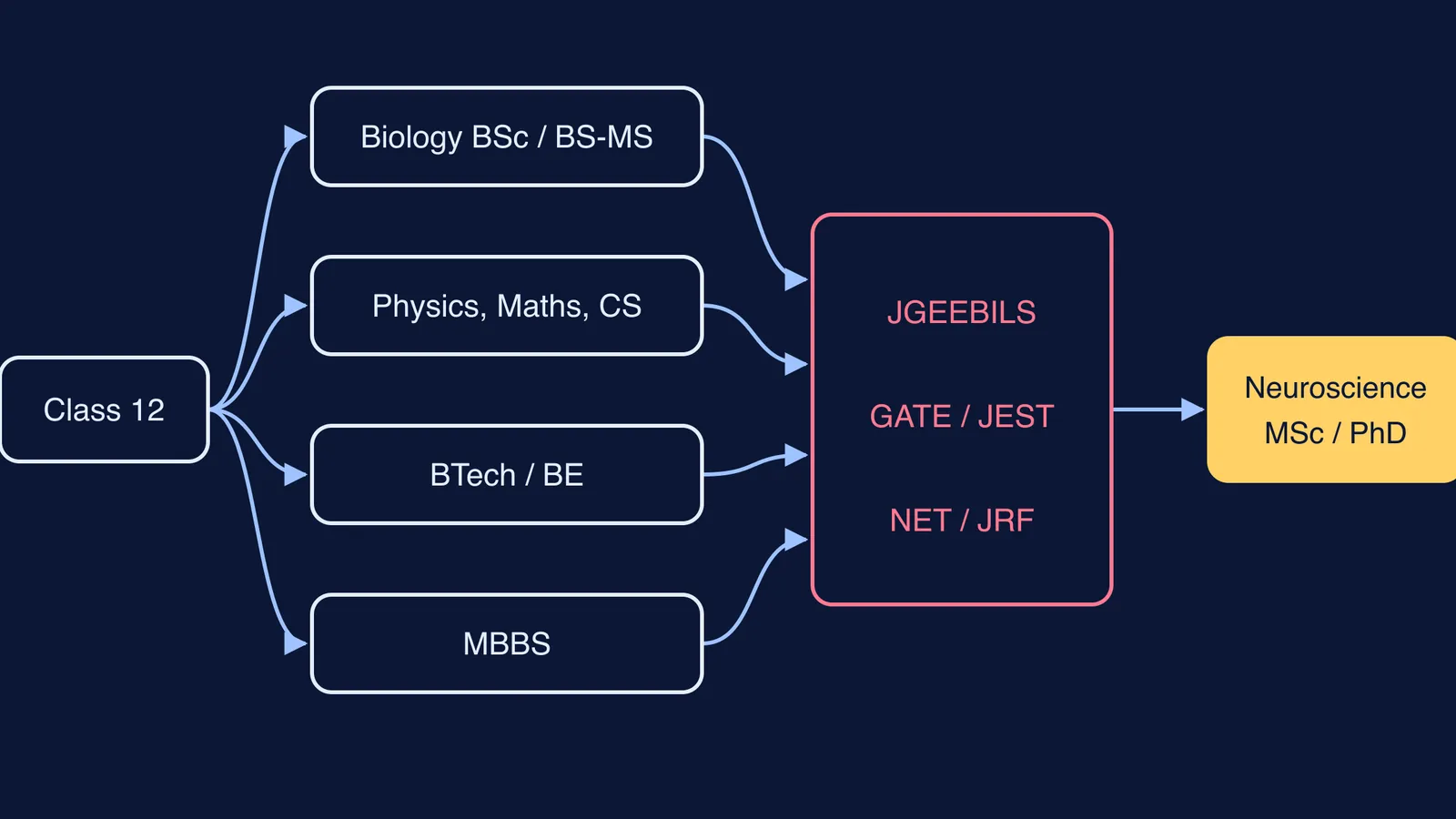
Each starting point tends to lead to a different part of the field:
Biology (a BSc or an IISER BS-MS): molecules, cells, circuits and behaviour, studied in the lab.
Physics, maths or computer science: computational neuroscience, brain imaging, and models of how neurons compute.
Engineering (BTech or BE): recording devices, signal processing and brain-computer interfaces.
Medicine (MBBS): research on brain disorders that links the clinic to the lab.
Psychology: perception, memory and decision-making, often through a cognitive science degree that mixes mind and computing.
If you are leaning towards biology with a research focus, the BS-MS route starts with the IISER Aptitude Test and how to prepare for it.
How do most people enter neuroscience after their first degree?
Usually through a national entrance test followed by an interview.
The Joint Graduate Entrance Examination for Biology and Interdisciplinary Life Sciences (JGEEBILS) is a common entrance exam coordinated by the Tata Institute of Fundamental Research. Institutes that use it include IISc, the IISERs, the TIFR centres (among them NCBS in Bengaluru) and NBRC. Several of them also offer an integrated MSc-PhD through it. The 2026 test is on 13 December 2026, and applications closed on 25 October 2026.
For its neuroscience PhD, IISc's research admissions page accepts a master's in science, technology, engineering, medicine, psychology or some related fields, or a 4-year bachelor's in science, technology, engineering or medicine. You then need to qualify in one test from a list that includes GATE, CSIR-UGC NET for JRF, ICMR JRF, DBT JRF, JEST, INSPIRE and JGEEBILS.
At NBRC, every admitted PhD student must secure a Junior Research Fellowship (JRF) for the first two years, from CSIR, UGC, ICMR, DBT, DST, NHBM or another funder, and then qualify for a Senior Research Fellowship. New students also do 6 months of coursework covering everything from molecular to computational neuroscience.
What does a research career in neuroscience look like?
The PhD is the main step: years in one lab answering one question in depth, supported by a fellowship such as a JRF. Afterwards, many people do postdoctoral research before applying for scientist or faculty posts; others take the same skills into data analysis, medical devices or drug research. For the wider picture of fellowships and research degrees, see how to become a scientist in India after 12th.
A plan from Class 11 to your PhD application
Class 11–12: keep Biology, and keep Mathematics too if you can. Maths keeps both the biology and the computational routes open.
First year of college: learn basic statistics and one programming language. Almost every neuroscience lab analyses data.
Second year: read about two or three labs whose work interests you, and write to them about a summer project.
Third year: shortlist programmes, write down each test's application window, and register on time. The JGEEBILS window, for example, closes weeks before the December test.
Final year: take the tests and get ready for interviews. Be ready to explain one paper you have read and why it interests you.
You can adapt this short email for step 3: "Dear Dr ___, I am a second-year BSc student at ___. I read your paper on ___ and wanted to understand how you measured ___. I have taken courses in ___ and can code in ___. Could I work in your lab as a summer student this year?"
Expect gaps: a biology student meets differential equations in a neuron model, a physics student meets synapses. The Fermi Concept Library has a lesson for every concept in physics, chemistry, biology, mathematics and computing, so you can close one gap at a time.
Start with the subject you enjoy most in Class 12. Neuroscience has a way in from almost every science.


