On this page
Every 28 February, India marks National Science Day with lectures, quizzes and open houses. The date commemorates C.V. Raman's discovery of the Raman effect in 1928, according to the government-run Vikaspedia page on National Science Day. Good projects for the day go back to Raman's question: what happens to light when it bounces off molecules?
Why is National Science Day celebrated on 28 February?
In 1986 the National Council for Science and Technology Communication (NCSTC) asked the Government of India to name 28 February National Science Day, and the first one was celebrated on 28 February 1987, Vikaspedia records. Raman did the work in the laboratory of the Indian Association for the Cultivation of Science in Kolkata.
Raman won the 1930 Nobel Prize in Physics "for his work on the scattering of light and for the discovery of the effect named after him", according to the Nobel Prize facts page.
It began at sea. Sailing home from England in 1921, Raman wondered why the Mediterranean looked so blue; Lord Rayleigh had suggested the sea simply reflects the sky, and Raman was not convinced, says the American Physical Society's history of the discovery. He pursued the question in a 1922 Royal Society paper on the colour of the sea.
What is the Raman effect in simple words?
The Raman effect is a change in the wavelength of light that happens when a light beam is deflected by molecules (Vikaspedia). Most scattered light keeps its colour. A small part comes out with other wavelengths, because some of the photon's energy can be passed to the molecule, the Nobel Prize summary explains. It is used to analyse different types of material.
Raman's group in Calcutta used sunlight: a coloured filter picked out blue-violet light, and yellow-green and other filters showed whether the colour changed after scattering (APS). In a short note in Nature, "A New Type of Secondary Radiation", Raman and K.S. Krishnan reported examining sixty common liquids and seeing the effect to some degree in all of them, APS adds.
Which National Science Day projects connect to the Raman effect?
1. Is the sea blue because of the sky? Fill your tallest clear container with water, stand it on white paper and look down through it in daylight. Shade the top with black card so no sky can reflect, look again, and photograph both; a longer column helps. Show what each explanation predicts and which your photos support.
2. Scattering in a glass of milky water. Add a few drops of milk to a glass of water and shine a torch through it in a dark room. Compare the side view with the view through the far end as you add drops, then rotate polarising sunglasses in front of the side glow. Connect it to why the sky is blue and its light polarised. The key point: here the scattered light keeps its colour, while Raman looked for light whose wavelength had changed.
3. Raman's filter test, and the trap he avoided. Put blue cellophane over the torch and yellow cellophane over your eye, then try plain water, sugar solution and water with highlighter ink. The ink glows: that is fluorescence, not the Raman effect. The effect is weak, so Raman concentrated sunlight with a seven-inch telescope, and he showed his new light was polarised, which set it apart from fluorescence (APS). A torch cannot show Raman light; explain why your glow is fluorescence.
4. A CD spectroscope. Raman measured the exact wavelengths of the incoming and scattered light with a spectroscope (APS). Make one from a CD piece and a slit in a shoebox, then compare an LED bulb, a tube light and a sunlit white wall, sketching each spectrum. Our explainer on how a prism splits white light covers the idea.
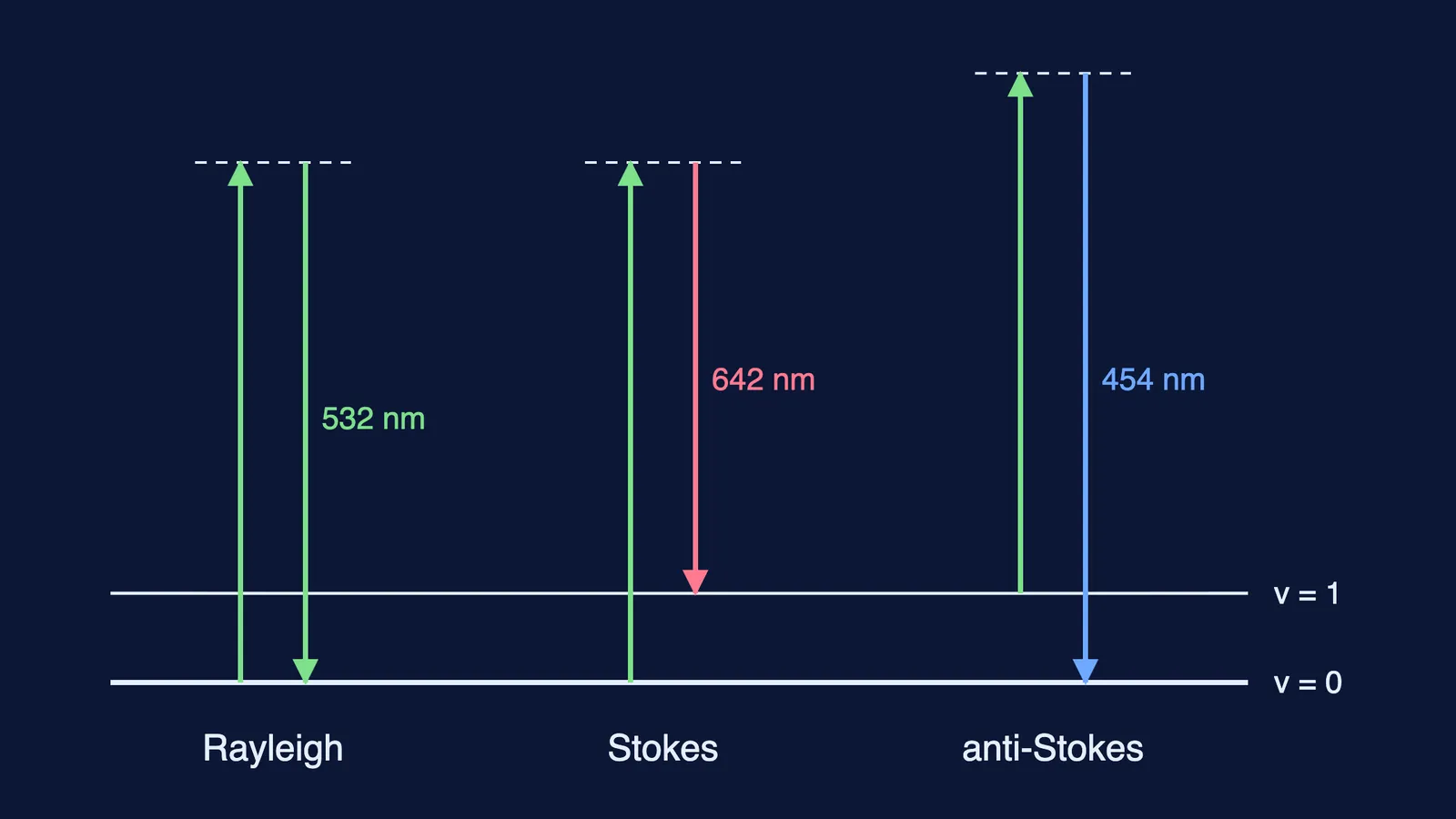
5. The energy bookkeeping, on paper. Photon energy is E = hc/λ; with h in eV from NIST, hc is about 1240 eV nm.
A green 532 nm photon carries 1240/532, about 2.33 eV.
Suppose a molecule needs 0.40 eV to vibrate (illustrative; real values depend on the molecule).
Stokes light: 2.33 - 0.40 = 1.93 eV, so 1240/1.93, about 642 nm, which is red.
Anti-Stokes light (from a molecule already vibrating): 2.33 + 0.40 = 2.73 eV, about 454 nm, which is blue.
Unchanged (Rayleigh) light stays at 532 nm.
If energy levels are hard to picture, the Fermi Simulation Lab has interactive simulations for ideas that are easier to see than to read.
How do you plan a science day project in four weeks?
Week 1: choose one idea; write your question and your prediction, one sentence each.
Week 2: run it three times, change one thing at a time, photograph every run.
Week 3: poster: question, prediction, method, results, what went wrong, the link to Raman.
Week 4: rehearse a one-minute explanation and an answer to "How do you know?"
Not sure where to begin? Fermi's AI tutor can work out what you already know and build a plan for the session. For more experiments, see our science fair project ideas for Class 8.