On this page
Most Class 8 science fair projects go wrong at the first step. A volcano model looks impressive, but it asks no question, so there is nothing to find out. Here is how to pick a testable question, six cheap ideas to run at home, a worked example, and a way for parents to help that keeps the project your child's own.
What makes a science fair question testable?
A testable question names one thing you change and one thing you measure. In Oak National Academy's lesson on variables, the independent variable is what you change, the dependent variable is what you measure, and control variables are what you keep the same.
A fair test is one where only the variable being tested is changed, so it is clear that it made a difference (Oak National Academy).
Use this template: "Does [the thing I change] affect [the thing I measure]?" Then check it:
Can I change it on purpose, in steps?
Can I measure the result as a number (centimetres, seconds, a count)?
Can I keep everything else the same?
"Which soap is best?" fails all three. "Does water temperature change how long sugar takes to dissolve?" passes.
What are low-cost science fair project ideas for class 8 at home?
Most need only a ruler, a phone stopwatch, measuring spoons and kitchen supplies.
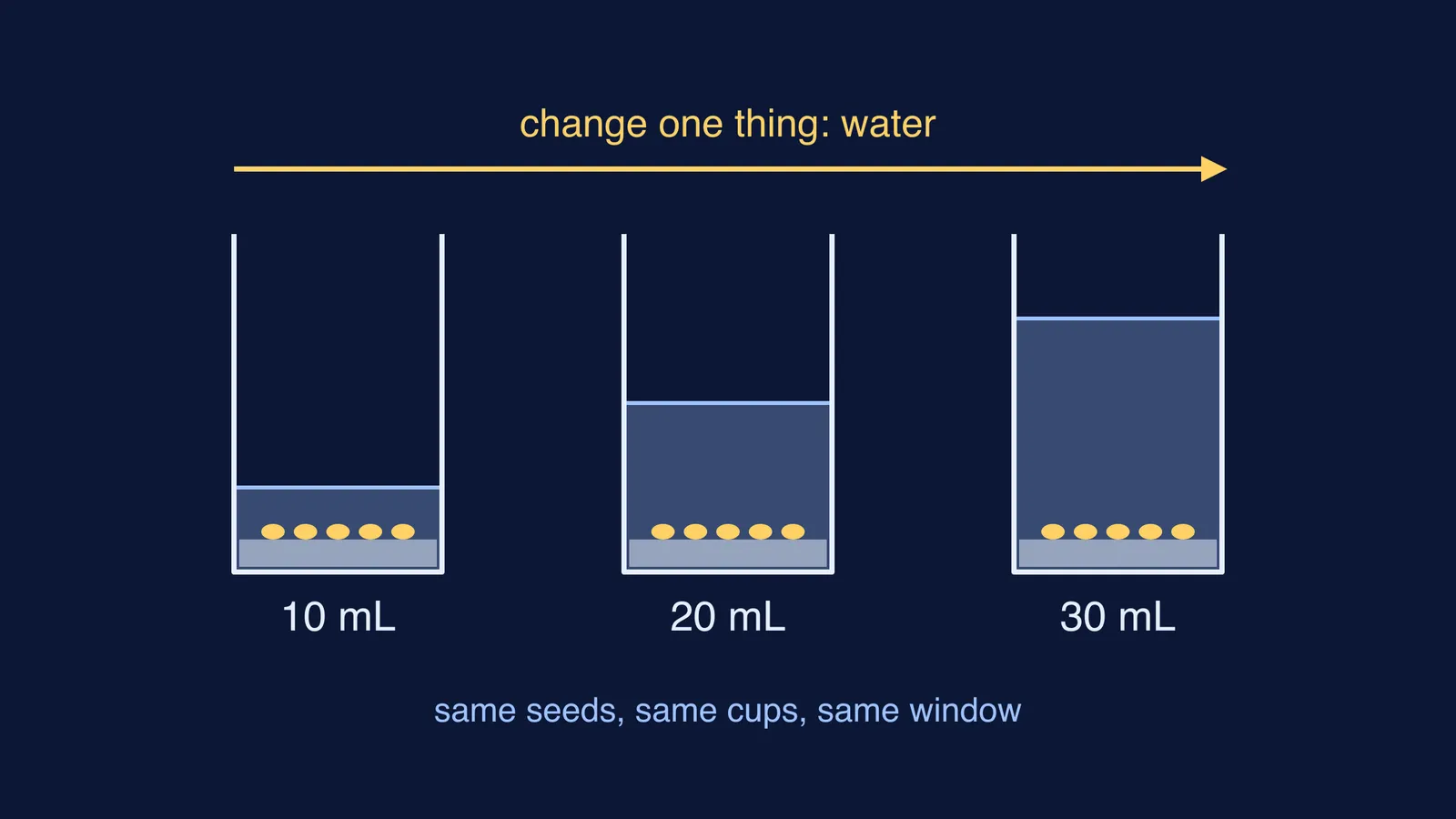
Does the amount of water change how many moong seeds sprout? Change: millilitres of water. Measure: seeds with a visible root.
Does water temperature change how fast sugar dissolves? Change: cold, room-temperature, warm. Measure: seconds. An adult handles warm water.
Does ramp height change how far a toy car rolls? Change: books under the ramp. Measure: centimetres.
Does salt decide whether an egg floats? Change: spoons of salt per glass. Measure: sinks, hovers or floats.
Does string length change a pendulum's swing time? Change: length. Measure: time for ten swings.
Does the surface change how far a coin slides? Change: tile, cloth, paper. Measure: distance from a fixed flick.
A worked example: the moong sprouting project, step by step
Question: does the amount of water change how many moong seeds sprout in three days?
Set up identical cups, each with a cotton pad and 10 moong seeds from the same packet.
Add 10 mL, 20 mL and 30 mL of water. Keep every cup on the same windowsill.
Add a cup with dry cotton for comparison; here is why experiments need a control group.
Make two of every cup, so one odd cup cannot decide the result.
Each evening, write the date, cup and number of seeds with a visible root in a notebook.
On day three, average each pair, draw a bar chart, and write what happened and a possible reason.
When the result raises a "why", the Fermi Concept Library has a lesson for every concept in physics, chemistry, biology, mathematics and computing, so your child can read the science behind the result and explain it in their own words.
How much should parents help with a science project?
Less, and of a different kind. A 2008 meta-analysis by Patall, Cooper and Robinson pooled 22 samples from 20 studies. Parent involvement in homework was positively associated with achievement-related outcomes in elementary and high school but negatively associated in middle school, and parent rule-setting had a stronger association than other kinds of involvement. These are correlations, not proof, but they favour structure over doing.
Ownership matters too. In a survey of more than 300 US high school students by Grinnell, Dalley and Reisch, parents, teachers and internet articles were the main sources of help for more than half of students. About 10% of students who had no interest in science careers and were required to take part engaged in research misconduct, such as plagiarism or making up results.
So split the jobs. You buy materials, handle anything hot or sharp, and set a fixed time for daily counting. Your child chooses the question, runs the trials, records, writes and presents. See our guide to splitting a school project when your child asks you to make it.
What to say instead of taking over:
"What exactly are you changing, and what are you measuring?"
"What do you think will happen, and why?"
"Would someone repeating this tomorrow get the same answer?"
"That's not what you expected. What could explain it?"
Where can a good home project go next?
A careful home project can become a competition entry. The IRIS National Fair is open to students in Classes 5 to 12 at schools in India; its 2026–27 submission window closed on 13 October 2026. Read our explainer on IRIS National Fair research projects and how to enter. For this year's school fair, pick one question tonight and set up the cups tomorrow.