On this page
When you walk into a science centre, the exhibits seem to explain themselves. But behind the interactive displays, the roaring tesla coils, and the immersive planetarium dome is a dedicated team of scientists, educators, and designers. If you want a career that bridges rigorous research and broad public engagement, a science museum is one of the most rewarding places to work.
Working in these spaces means translating complex ideas for a general audience. Whether you are running a live chemistry demonstration, designing a wave-tank exhibit, or writing the script for a star show, the ultimate goal is to make science accessible, accurate, and thrilling.
What are the key roles in a science centre?
The most visible staff in any science centre are the educators and frontline interpreters. They run the live demonstrations, guide school groups, and answer questions directly on the museum floor. The Association of Science and Technology Centers (ASTC) and the Association of Children’s Museums (ACM) released a joint Workforce Survey in 2023 based on 138 participating institutions. They found that 65% of these institutions were actively hiring for floor and frontline staff, making this the highest demand category in the field.
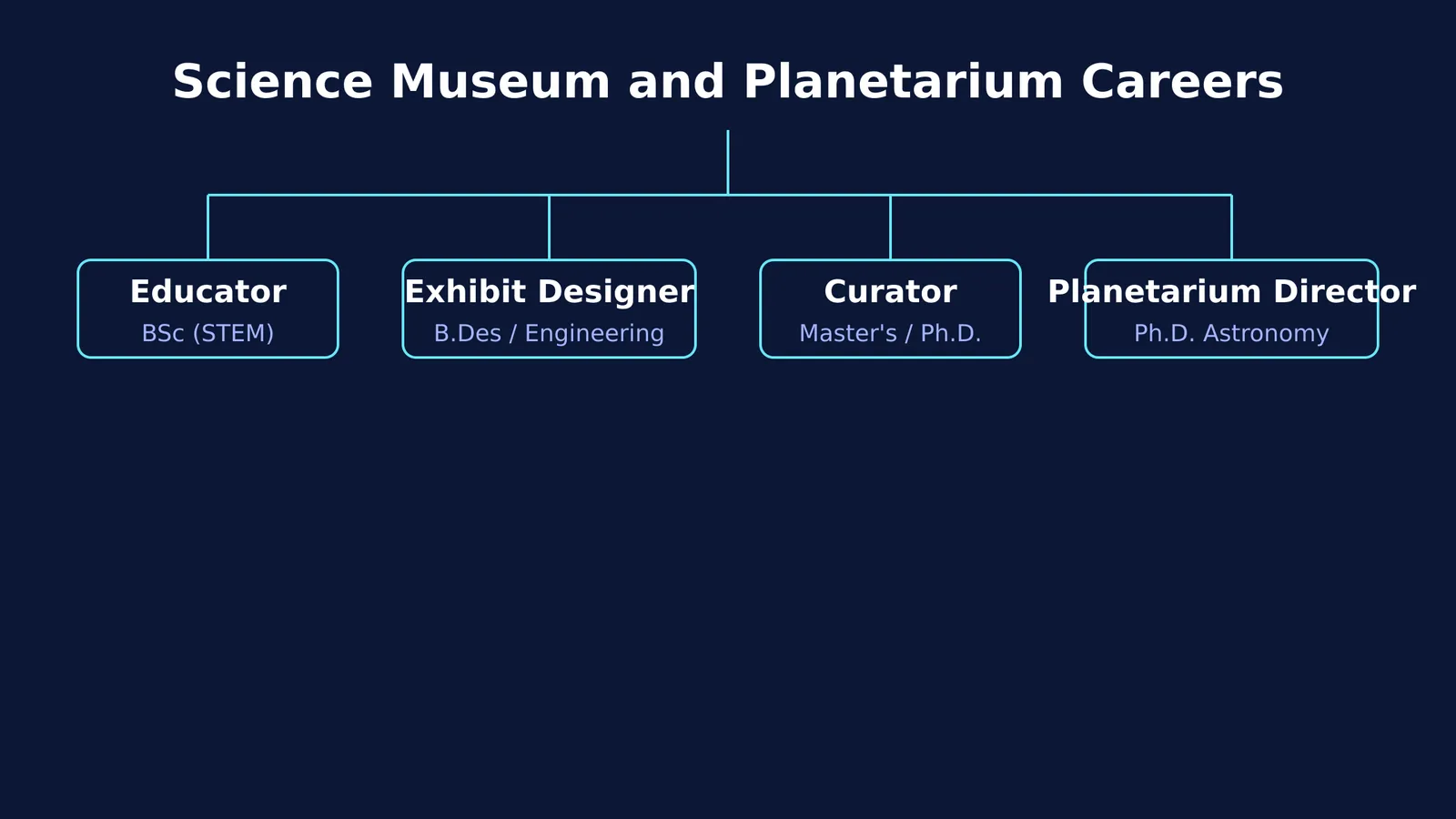
Behind the scenes, exhibit designers build the physical and digital components of the museum. Much like the career paths after a B.Des degree, this role involves industrial design, prototyping, and rigorous user testing to ensure exhibits can withstand thousands of eager hands. They work closely with curators to turn a scientific concept into a hands-on activity. A curator acts as the subject-matter expert, providing the academic background, maintaining the museum's collections, and verifying that the physics or biology presented is absolutely accurate.
What does a planetarium director do?
A planetarium is a unique environment that requires its own highly specialized set of skills. The planetarium director manages the entire operation of the dome, which includes researching, scripting, and creating full-dome educational experiences. They are responsible for leading the narrative around astronomy, astrophysics, and space exploration.
Directors must perfectly balance technical oversight with public engagement. They maintain and operate complex digital projection systems and act as the primary bridge between academic space research and the public. They spend their time figuring out how to visualise hard physics ideas for an audience that might not have a formal maths or science background. During significant astronomical events, such as a solar eclipse, a meteor shower, or a new rover landing on Mars, the planetarium director is often the key expert explaining the science to the local news and the community.
What degrees do you need for a museum career?
The educational background required depends heavily on the role you want to pursue. If you are deciding between an MSc or a job after a BSc in chemistry, working as a museum educator offers a fantastic way to use your science degree outside a traditional research lab. For entry-level educator positions, a bachelor's degree in a STEM field—such as biology, chemistry, physics, or engineering—is the standard. Degrees in science education or museum studies are also very common and highly valued.
If you are planning to become an educator and need to ensure your own understanding of the fundamental science is flawless before you teach it to a crowd, the Fermi Concept Library can help you systematically fill in any gaps across physics, chemistry, and biology.
For advanced leadership and research roles, the academic requirements are much stricter:
Curators: Usually require a Master's or Ph.D. in a specialized scientific field. This ensures they can speak with absolute authority on the collections they manage and the content they approve.
Planetarium Directors: Often hold a Master's or Ph.D. in astronomy or astrophysics, particularly at university-affiliated planetariums where the director may also hold a faculty position.
Exhibit Designers: May come from industrial design, engineering, or architecture backgrounds, often holding bachelor's or master's degrees in those applied fields, alongside a strong portfolio of built projects.
How do you start your museum career?
If you are currently studying and want to work in informal science education, start building your specific skill set and portfolio now:
Volunteer on the floor: Join a local science centre, observatory, or zoo as a weekend volunteer to practice talking to the public about science in real-time.
Learn a specialized tool: If you want to design exhibits, learn CAD or 3D modelling. For planetariums, familiarize yourself with basic astronomy projection software, video editing, or scripting languages.
Build a demo portfolio: Create short, engaging videos of yourself explaining a scientific concept using simple household items to clearly demonstrate your communication skills.
Join the network: Follow the Association of Science and Technology Centers (ASTC) or similar regional professional bodies to keep track of job boards, conferences, and early-career fellowship opportunities.
Whether you are explaining the orbit of a distant exoplanet or the intricate mechanism of a human cell, a career in a science museum allows you to spend your day sharing the profound joy of discovery with the public.