

On this page
If you took PCB and like the idea of finding out what is behind a fever or anaemia without becoming a doctor, medical lab technology is worth a look. The course many colleges still call BMLT now has a national curriculum, which changes how long you study and how you get in.
What does a medical lab technologist actually do?
India's National Commission for Allied and Healthcare Professions Act, 2021 received the President's assent on 28 March 2021 and lists Medical Laboratory and Life Sciences first in its Schedule. It describes a medical and pathology laboratory professional as a person who performs clinical tests on samples of body fluids and tissues to learn about a patient's health or the cause of death. It names five job titles in this group: cytotechnologist, forensic science technologist, histotechnologist, hemato technologist and medical lab technologist.
In plain words: a doctor orders a blood count or a urine culture, and the lab team collects the sample, runs it, checks quality and reports a result the doctor can trust.
How long is the BMLT course and what do you study?
The NCAHP competency-based curriculum for medical laboratory sciences/Medicine/UG/Medical%20Laboratory%20Science%20UG-PG-Curriculum-Rules%20Regulations-Syllabus%20As%20per%20NCAHP-2026-27(Dt.23-04-2026).pdf) (approved syllabus 2025, Ministry of Health and Family Welfare) names the degree Bachelor of Medical Laboratory Science (BMLS). It sets the BMLS at four years, including one year of compulsory internship, for a total of 160 credits and 4,125 contact hours.
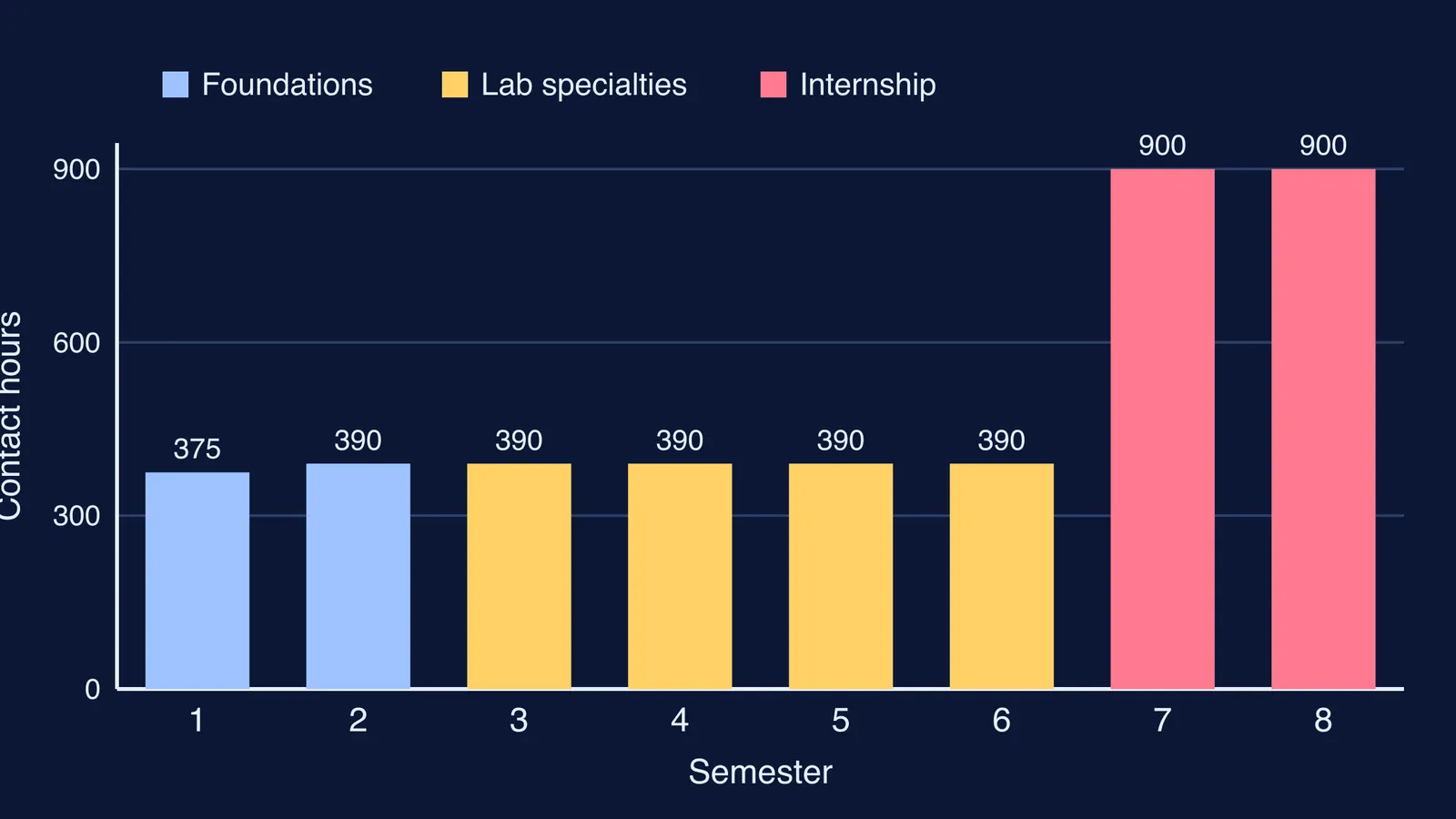
How the hours add up, from the semester tables:
Semesters 1 and 2 (765 hours): human anatomy and physiology, first aid, computer basics, then the fundamentals of microbiology, biochemistry and haematology.
Semesters 3 to 6 (1,560 hours): subjects include bacteriology, clinical haematology, virology and immunology, genetics and molecular biology, clinical pathology, mycology and parasitology, transfusion medicine, histopathology and cytology, clinical biochemistry, plus lab quality control, medical law and research methods.
Semesters 7 and 8 (1,800 hours): internship, as clinical lab postings or a research dissertation.
That last line is the big change. Of the 4,125 hours, 1,800 are internship, so more than two-fifths of the degree happens in a working lab.
What are the eligibility rules for BMLT after 12th?
The NCAHP curriculum/Medicine/UG/Medical%20Laboratory%20Science%20UG-PG-Curriculum-Rules%20Regulations-Syllabus%20As%20per%20NCAHP-2026-27(Dt.23-04-2026).pdf) asks for Class 12 or equivalent with at least 50% aggregate in Physics, Chemistry and Biology, and a minimum age of 17 by 31 December of the admission year. It says admission shall be made on the basis of NEET and a merit list based on Class 12 marks. Diploma holders in medical laboratory science can join directly in the second year, but only for up to 10% of seats.
Universities are adopting this curriculum on their own timelines (Veer Narmad South Gujarat University, which published the copy linked above, approved it from 2026-27), so read each college's current prospectus and your state's counselling notice. If NEET did not go the way you hoped, our guide to career options with PCB without NEET covers other routes.
Which lab jobs can you get, and how do careers grow?
The same curriculum/Medicine/UG/Medical%20Laboratory%20Science%20UG-PG-Curriculum-Rules%20Regulations-Syllabus%20As%20per%20NCAHP-2026-27(Dt.23-04-2026).pdf) sets out a career ladder:
Entry level: medical laboratory technologist, running routine tests under supervision in hospitals, private labs or blood banks.
Core roles: medical laboratory scientist, running complex tests independently, or a specialist in haematology, microbiology, clinical biochemistry, histopathology or molecular diagnostics.
Senior roles: section head, then laboratory manager or director, responsible for meeting standards such as NABL and ISO.
Side paths: clinical research, public health labs, forensic labs, transfusion medicine, genomics.
Teaching and research: assistant professor and research scientist roles. For higher study it lists a two-year Master of Medical Laboratory Science, an M.Sc in microbiology, biochemistry or biotechnology, or an MBA in hospital management.
Our guide on moving from lab technician to scientist covers the research route.
Is medical lab technology right for you?
Try this five-question check:
Did you enjoy your biology and chemistry practicals more than reading the theory?
Can you repeat the same careful steps many times without getting sloppy?
Are you comfortable handling blood, urine and stool samples under strict infection-control rules?
Do chemistry numericals like molarity and dilution feel manageable?
Are you happy working mostly behind the scenes, with less patient contact than doctors or nurses?
If four or five are a yes, shortlist the course. If question 4 is your weak spot, fix it early, because biochemistry runs on it. The Fermi Problem Library has worked problems with a step-by-step solver that explains the reasoning rather than printing an answer, and the Fermi Concept Library has a lesson for every concept in biology and chemistry.
What should you ask on a college visit?
"Does this programme follow the NCAHP BMLS curriculum, with a one-year internship?"
"Where do interns train? Is the partner hospital NABH-recognised, or the lab NABL-recognised?"
"Is the internship paid?"
"Can I see the biochemistry, microbiology, haematology and histopathology labs?"
These come from the curriculum/Medicine/UG/Medical%20Laboratory%20Science%20UG-PG-Curriculum-Rules%20Regulations-Syllabus%20As%20per%20NCAHP-2026-27(Dt.23-04-2026).pdf) itself: stand-alone colleges need a tie-up with an NABH-recognised hospital of at least 100 beds, or NABL-recognised labs, and an internship stipend is recommended.
To compare it with other allied health degrees, read our overview of allied health sciences courses.


