On this page
If you are working in a laboratory, or considering a technical role as your first job after an associate or bachelor's degree, you might wonder if it is a dead end or a stepping stone. The short answer is that many successful scientists started their careers on the bench as technicians.
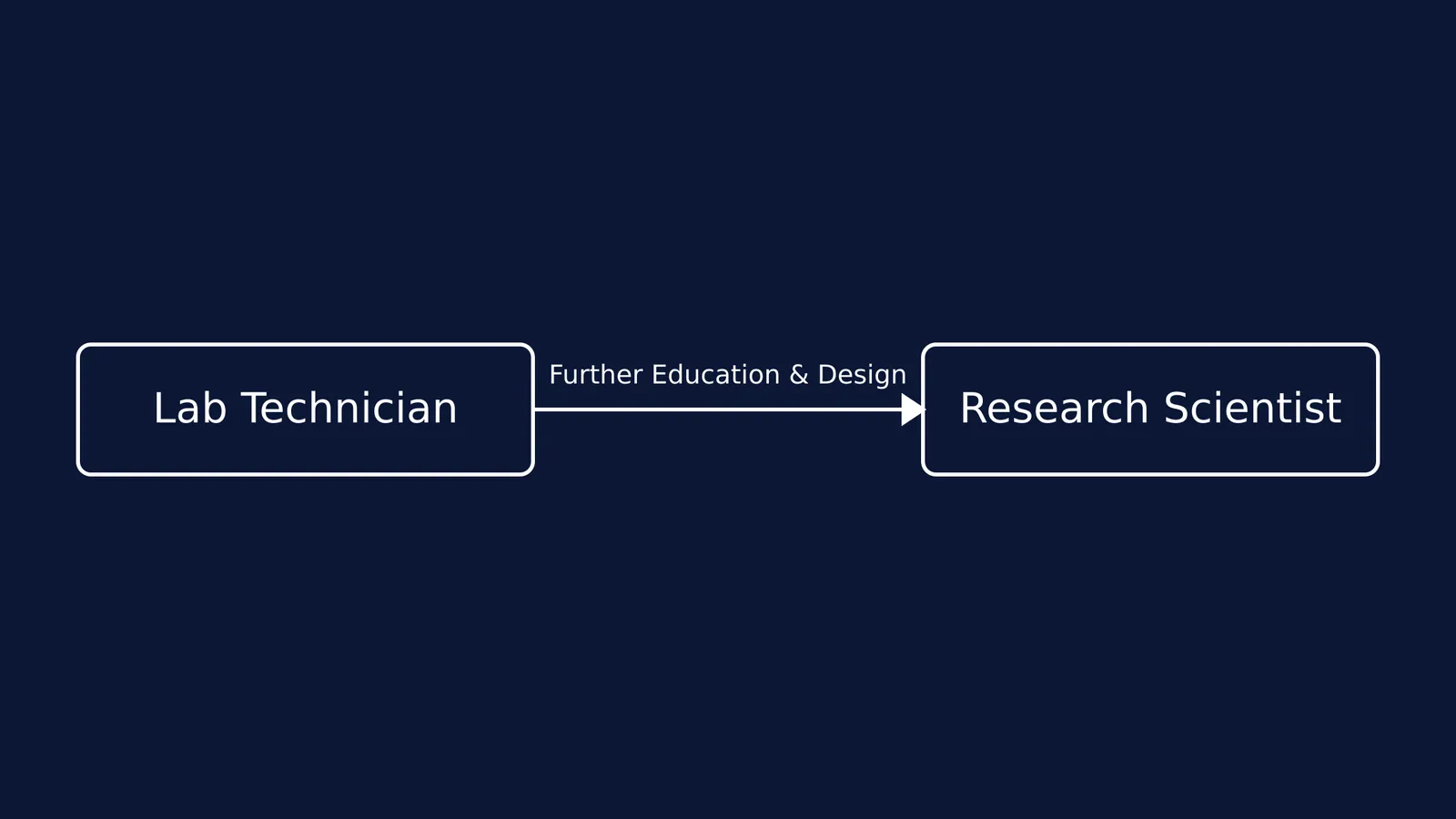
Transitioning from a technician to a scientist is a well-trodden path, but it does not happen automatically. It requires further education, a deliberate shift in how you approach your daily tasks, and a track record of independent thinking. Here is how the two roles differ and what it takes to bridge the gap.
Can a lab technician become a scientist?
A lab technician certainly can become a scientist, and the healthcare and biotechnology sectors rely heavily on this progression. The primary difference between the two roles lies in the level of independence and the complexity of the work.
Technicians are the engine of a laboratory. They perform routine, often automated tests, maintain equipment, and strictly follow standard operating procedures (SOPs). Scientists, on the other hand, handle complex analysis, interpret unexpected results, design new experiments, and write the SOPs that technicians follow.
The job outlook for both roles is steady. According to the US Bureau of Labor Statistics, employment of clinical laboratory technologists and technicians is projected to grow 3% from 2025 to 2035. However, there is a significant financial incentive to make the jump. In May 2025, the median annual wage for a clinical laboratory technologist and technician was $62,930, reflecting the advanced training and critical thinking required for the role.
What degree does a lab technician need to become a scientist?
The most common formal barrier between a technician and a scientist is the level of your degree. In a clinical or hospital setting, the titles are often clearly defined: a Medical Laboratory Technician (MLT) typically holds an associate degree, while a Medical Laboratory Scientist (MLS) holds a bachelor's degree.
If you are already working as an MLT, you do not necessarily need to quit your job to advance. Many universities offer "bridge programs" that allow working technicians to apply their practical experience and previous credits towards a bachelor's degree.
In research, academia, or the pharmaceutical industry, the requirements are different. While a bachelor's degree is the minimum, reaching a senior scientist or Principal Investigator (PI) role almost always requires a Master's degree or a PhD. If you are still an undergraduate planning your path, it is worth looking closely at programs that emphasize research over routine lab work, such as the IISc BS (Research) admission: entry routes, eligibility, cut-offs.
How do you shift from technician to researcher?
Earning a degree is the formal requirement, but proving that you can think like a scientist is the practical one. In a research lab, advancing means shifting your mindset from execution to experimental design.
When a technician runs an assay, their goal is to follow the protocol perfectly. When a scientist runs an assay, their goal is to test a hypothesis. Here is a practical plan to help you make this shift:
Master the standard procedures: Before you can innovate, you must be reliable. Execute your current tasks flawlessly.
Ask 'why': Learn the mechanism behind every assay. If you need to fill gaps in your theoretical knowledge, the Fermi Concept Library contains every concept in physics, chemistry, biology, mathematics and computing, each with its own lesson and its place in the map. Using it can help you move from simply following a protocol to deeply understanding the reaction.
Take ownership of data: Volunteer to analyse the results of your runs instead of just handing over the raw numbers.
Suggest solutions: When an experiment fails, do not just report the failure. Propose a troubleshooting step.
Aim for publication: Contribute enough intellectual work to earn a middle-author position on a research paper.
If you are new to academic literature, a good first step is learning how to read a scientific paper as a school or college student. You can also build these skills early by seeking out research internships for science undergraduates in India.
The story of Freddie Gutfreund
The transition from a technical support role to a leading researcher has a long history in science. One of the most famous examples is Herbert "Freddie" Gutfreund, whose career path has been widely celebrated by the Royal Society.
In 1941, Gutfreund—a refugee who had fled Austria and spent three years working as a dairyman on a farm—secured a job as a junior laboratory technician (then called a "lab boy") in the Department of Pathology at the University of Liverpool. He did not let the junior title define his output. He mastered the techniques of protein analysis so thoroughly that in 1943, while still a technician, he published a single-author paper in the *Biochemical Journal* detailing an improved method for separating protein mixtures.
His supervisors recognized that he was already thinking like a scientist. That publication became his launchpad. He was soon offered a research assistant position at Imperial College London, which led to a PhD from the University of Cambridge in 1947. Gutfreund went on to become a pioneer in molecular enzymology, a professor at the University of Bristol, and a Fellow of the Royal Society.
His career is a reminder that technical bench skills are not a dead end. When combined with curiosity and a drive to understand the underlying science, the role of a lab technician can be the perfect foundation for a lifelong scientific career.