

On this page
If you studied biology but do not want a lab bench or a clinic, consider medical coding, where knowing nephropathy from neuropathy is a working skill. Here is what the work involves, how training works in India and how to judge the market before you pay for a course.
What does a medical coder do with health records?
A medical coder reads what a clinician wrote and turns it into standard codes. The US Bureau of Labor Statistics says coders “assign the diagnosis and procedure codes for patient care, population health statistics, and billing purposes.”
The main diagnosis system is the International Classification of Diseases. WHO describes it as the basis for comparable statistics on causes of death and illness between places and over time. Its newest version, ICD-11, came into effect on 1 January 2022. ICD-11 has around 17,000 unique codes and more than 120,000 codable terms (WHO, ICD-11 2022 release).
In India, the job is recognised in law. The National Commission for Allied and Healthcare Professions Act, 2021 lists “Clinical Coder” under Health Information Management and Health Informatic Professional.
What does coding look like? A worked example
The codes below come from ICD-10-CM, the US version of ICD-10. The CDC's National Center for Health Statistics maintains it. You can check each code on the free NLM ICD-10-CM lookup.
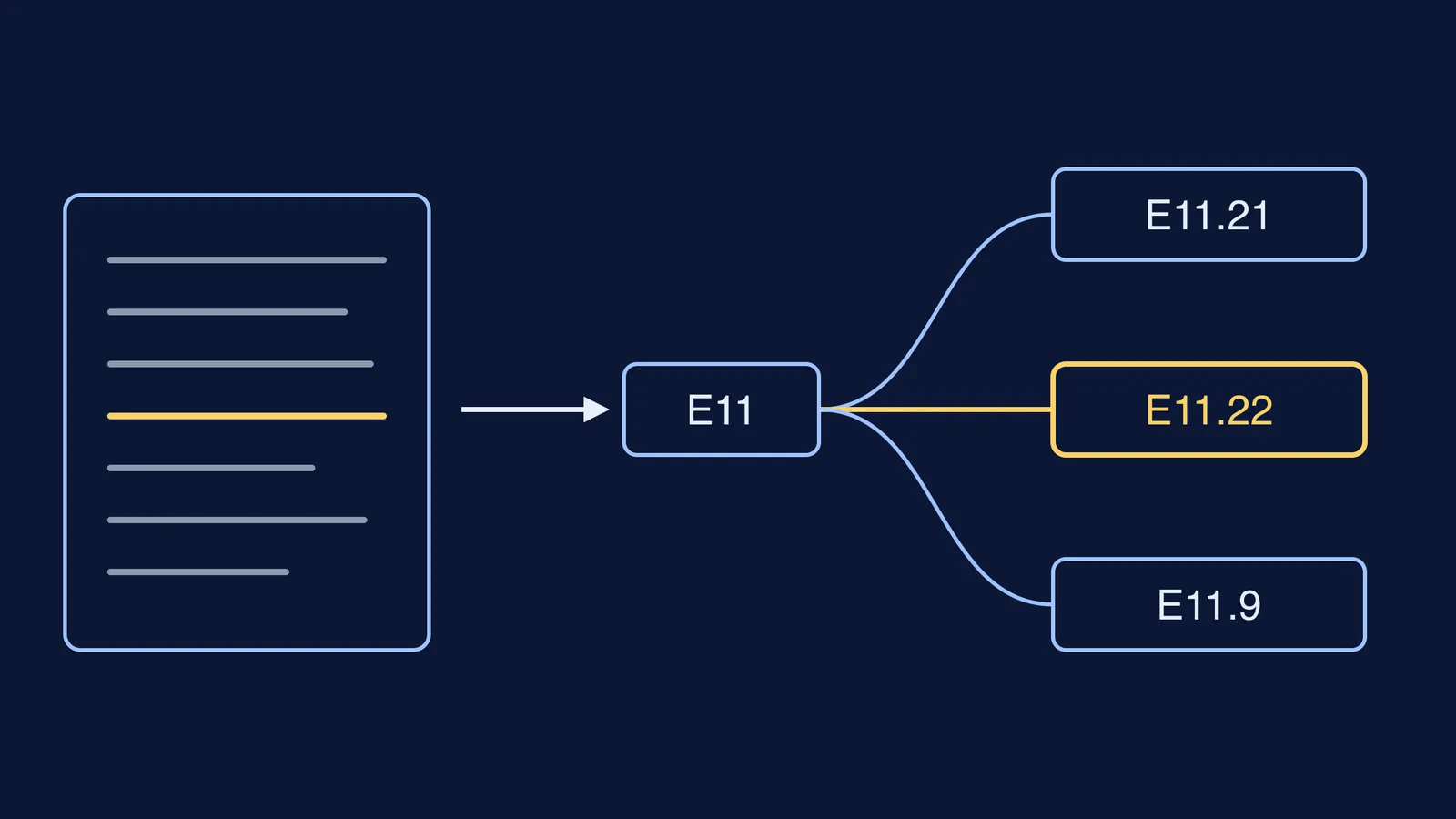
Note A records type 2 diabetes and no complications. The code is E11.9, “Type 2 diabetes mellitus without complications”.
Note B records type 2 diabetes with chronic kidney disease caused by the diabetes. The diabetes code becomes E11.22, “Type 2 diabetes mellitus with diabetic chronic kidney disease” (NLM lookup for E11.2x). E11.22 also carries a note to add a second code from category N18 for the stage of the kidney disease (ACOI coding guide; NLM lookup for N18).
Both diabetes codes start with E11, the category for type 2 diabetes. The characters after the dot add detail, and that detail comes from what the clinician wrote.
It is the same disease, but the codes change because the documentation changes.
Is medical coding a good career for biology graduates?
It suits you if you liked the naming side of biology: organ systems, disease terms and how things are classified. Your Class 11 and 12 work on the kidney, heart and endocrine glands will come up often. If those chapters feel rusty, the Fermi Concept Library has a lesson for every biology concept, so you can revise one system at a time.
The trade-offs are real. It is desk work, and the codes feed bills and health statistics (BLS), so accuracy matters. The rules also keep moving. WHO says its 2024 ICD-11 release added over 200 new codes for allergens (WHO). Compare coding with nearby routes, such as starting a clinical research career after a BSc or biotech careers beyond the lab.
How do you train as a medical coder in India?
Skills qualification: the Healthcare Sector Skill Council's Medical Records Assistant course is at NSQF Level 4 and takes 1,500 notional hours. You can enter straight after Class 12 (National Qualifications Register).
Coding certification: AAPC's CPC tests ICD-10-CM, CPT and HCPCS Level II, and AAPC lists an exam voucher starting at $425 (AAPC). The exam has 100 multiple-choice questions in four hours, and you need 70% to pass (AAPC exam page).
India-specific rules: at testing centres in India the code books are provided, and you need a DigiLocker-verified Aadhaar (AAPC international).
Apprentice stage: passing the exam first makes you a CPC-A. The “A” is removed once you show two years of experience, and 80 contact hours of a coding preparation course count as one of those years (AAPC).
How does the medical coder job market work?
In the US, medical records specialists, the BLS group that includes coders, held about 200,700 jobs in 2025. Their median pay was $51,140 in May 2025, and employment is projected to grow 8% from 2025 to 2035 (BLS). We could not find an official Indian count of coding jobs, so treat any salary or placement figure from a training institute as a claim to check.
Before you pay any institute, ask these questions:
Which code sets do you teach, and is it the current year's edition?
How many real, anonymised charts will I code during the course?
Can I speak to two past students who are working as coders now?
Does the fee include the certification exam, or is that extra?
A 30-day test before you commit
Week 1: revise the kidney, heart and endocrine chapters, and list 30 disease terms you can define without notes.
Week 2: look up 20 conditions on the NLM lookup and note why codes in the same category differ.
Week 3: speak to one working coder. Ask: “What does a normal day look like, and how is your accuracy checked?”
Week 4: score coding against other options with this career scorecard that looks beyond salary.
If you are not sure where to start, Fermi's AI tutor can work out what you already know and build a plan for the session.


