

On this page
Choosing a course at 16 or 17 often comes down to one dinner-table question: what does it pay? Pay matters: fees, loans and family budgets are real. But in this scorecard salary is one of five factors, and research suggests it is only weakly linked to how satisfied people are with their work.
Does a higher salary make you happier at work?
Only a little, on average. In a meta-analysis by Timothy Judge and colleagues, which combined 115 correlations from 92 independent samples, pay level correlated .15 with job satisfaction. The authors concluded that "pay level is only marginally related to satisfaction."
A correlation of .15 is small. So pay belongs on your list, but it is not the whole list.
What should you weigh besides salary?
Use five factors:
Interest: do you enjoy the daily work, not just the title?
Work environment: lab, ward, office or field; team or solo; fixed hours or shifts.
Growth: will you keep learning, and does the degree open more than one door?
Stability: how steady is demand, and how long before you earn?
Pay: starting salary and where it can go, against fees and years of study.
Interest deserves more weight than it usually gets. A meta-analysis by Christopher Nye and colleagues pooled 60 studies and about 568 correlations from more than 60 years of research, and found that interests are related to performance and persistence at work and in education. The fit between a person's interests and their environment predicted performance better than interest alone. A separate meta-analysis of 172 studies by Amy Kristof-Brown and colleagues linked fit with a job, organisation, team and supervisor to attitudes, performance, strain and how long people stay.
Many teenagers also choose from a short list. In the 2018 PISA survey, reported in the OECD's Dream Jobs report, 47% of 15-year-old boys and 53% of 15-year-old girls in 41 countries and economies said they expected to work in one of just 10 jobs by age 30. If your list holds only doctor, engineer and CA, widen it first.
How do you compare two courses fairly?
Take about 20 minutes:
Share 100 points across the five factors by how much each matters to you.
Score each option from 1 to 5 on every factor, using evidence such as a first-year syllabus or a talk with someone in the job.
Multiply each weight by its score, add the five results and divide by 5 to get a score out of 100.
Run the flip test: move points onto pay and see whether the winner changes.
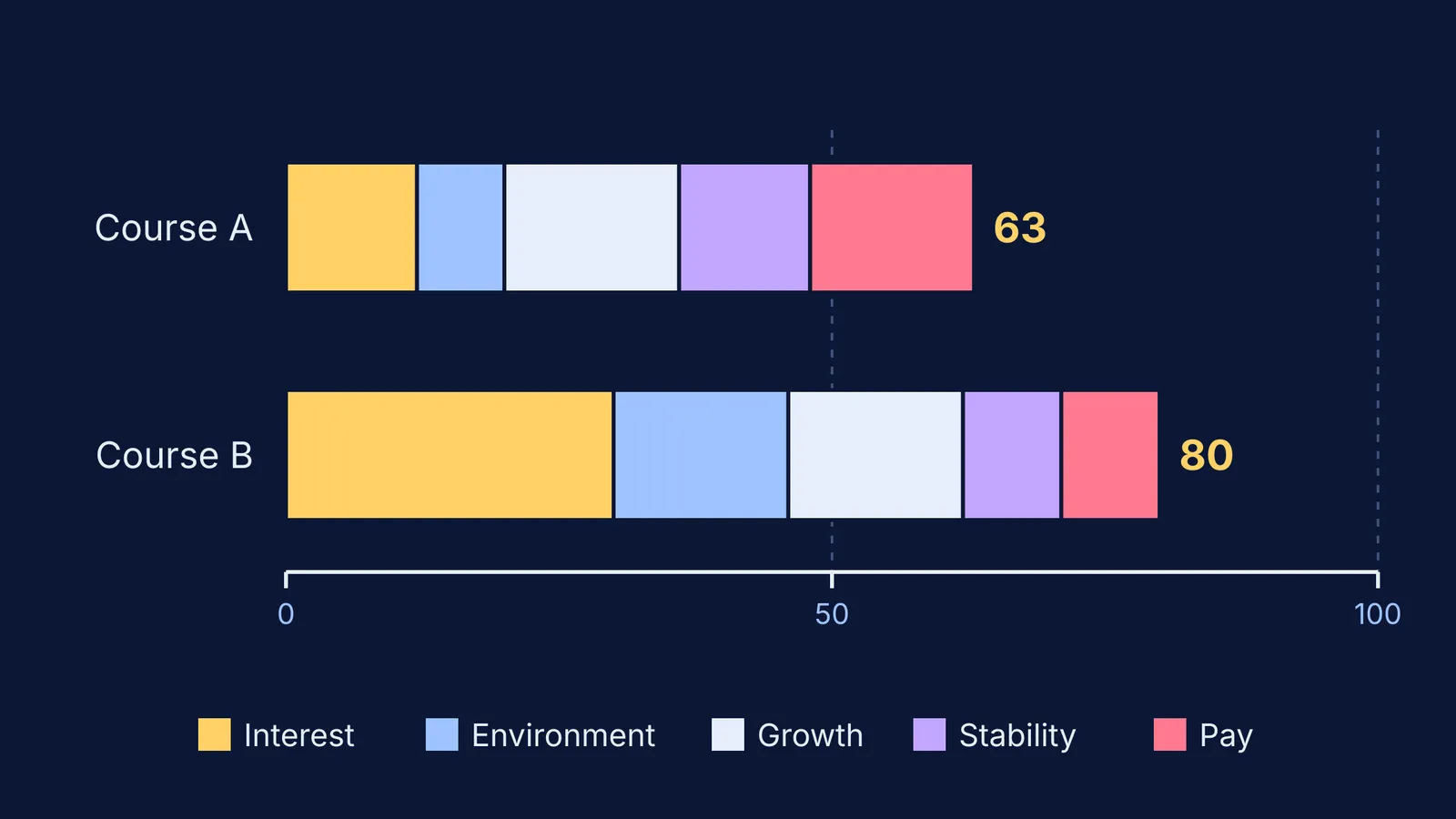
Say you are choosing between a B.Tech in computer science (Course A) and a BS in biological sciences (Course B), and you prefer lab work to long hours at a screen. You set interest at 30, environment 20, growth 20, stability 15 and pay 15.
Course A scores interest 2, environment 2, growth 4, stability 4, pay 5: (60 + 40 + 80 + 60 + 75) / 5 = 63.
Course B scores interest 5, environment 4, growth 4, stability 3, pay 3: (150 + 80 + 80 + 45 + 45) / 5 = 80.
Now swap the weights, so pay counts 30 and interest 15. Course A rises to 72 and Course B falls to 74. Even with pay as your biggest factor, Course B edges ahead.
The scores are guesses, so the scorecard will not decide for you. It shows which guess carries the decision, and what to check next.
How can you test your interest before you commit?
Study the subject itself for three evenings, not videos about the career. The Fermi Concept Library covers every concept in physics, chemistry, biology, mathematics and computing, each with its own lesson, so you can see whether you enjoy the material or only the idea of it.
Talk to two people who do the job. Ask what a normal Tuesday looks like, what they wish they had known at 17, and what would make them leave.
Use free official guidance. The National Career Service, an initiative of the Ministry of Labour and Employment, offers career content and counselling, and says it charges no fee for registration, job applications or interviews.
How can parents talk about this without a fight?
Fill in the weights separately and compare them before you compare courses. Many family arguments about careers are really about weights: a parent gives stability 40 points while the student gives interest 40. A parent might open with: "We worry about money because we care about you, not because salary is all that counts. Can we each fill this in and see where we differ?"
If the decision is causing stress that does not settle, talk to someone. Tele MANAS, the Indian government's free 24/7 mental health helpline, is on 14416 or 1800-89-14416, according to the Press Information Bureau.
Tonight, give the five factors 100 points and score your top two options before the next talk at home.


