

On this page
Mechanical engineering has a reputation problem in India. More students are choosing computer science and AI branches, and AICTE data reported by Careers360 shows mechanical and civil engineering enrolments declining from 2022-23 onwards. That tells you what families are choosing, not whether the work is needed.
What do mechanical engineers actually do?
The US Bureau of Labor Statistics defines the job plainly: mechanical engineers "research, design, develop, build, and test mechanical and thermal sensors and devices, including tools, engines, and machines" (BLS Occupational Outlook Handbook). If something moves, carries a load or handles heat, a mechanical engineer probably worked on it.
Day to day, the work falls into a few kinds:
Design: CAD models, stress calculations, material choices.
Analysis: checking a design by simulation before metal is cut.
Manufacturing: planning how a part is machined and inspected.
Testing and quality: finding why a part failed.
Operations: keeping plants and power stations running.
The same BLS page lists the qualities that matter: creativity, listening skills, maths, mechanical skills and problem-solving.
Is mechanical engineering a good choice now?
Demand is real. The BLS projects employment of mechanical engineers to grow 11% from 2025 to 2035, "much faster than the average for all occupations", from 298,500 US jobs in 2025 (BLS). It expects that growth "as automation and innovation create demand".
India is building more. The PLI scheme for automobiles and auto components, approved in 2021 with an outlay of ₹25,938 crore, had reported ₹25,219 crore of investment and 38,186 jobs by December 2024, according to the Ministry of Heavy Industries. Those plants, including new EV production capacity, need people who can design, make and test vehicles and parts.
The skills are shifting. The World Economic Forum's Future of Jobs Report 2025 says workers can expect 39% of their existing skill sets to be transformed or become outdated by 2030. AI and big data top its list of fastest-growing skills, and it lists autonomous and electric vehicle specialists and renewable energy engineers among the fastest-growing roles.
So the branch is a good choice if you like how physical things work and will add digital tools. It is a weak choice if you are taking it only because the CSE seat went elsewhere and you plan to ignore the subject.
Where do mechanical engineers work: core and allied sectors?
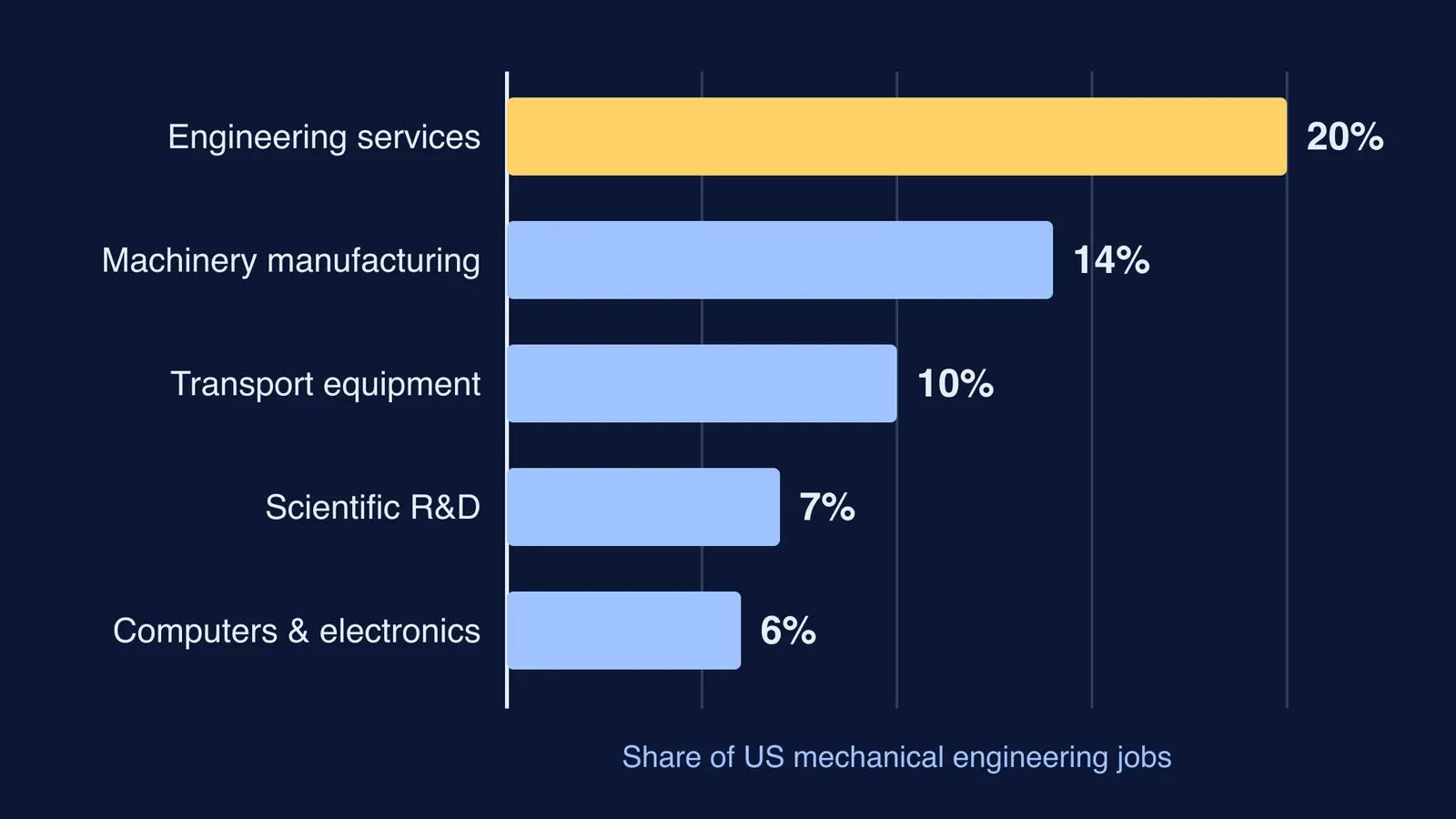
In the US, the largest employers are engineering services (20%), machinery manufacturing (14%), transport equipment (10%), scientific research (7%) and computers and electronics (6%), per the BLS. In India, think of two groups.
Core sectors:
Automobiles, auto components and EVs
Industrial machinery and tools
Power plants, oil and gas, and refineries
Aerospace and defence manufacturing
Heating, ventilation and refrigeration
Allied sectors, where mechanical thinking meets another skill:
Robotics and industrial automation, with electronics and control
CAD and simulation services for global clients
Renewable energy equipment
Supply chain, operations and quality management
Software and data roles that need engineering knowledge
If vehicles interest you, our guide to automobile vs mechanical engineering, GATE and EVs compares the two branches.
Which skills help mechanical engineers get hired?
Build skills in layers:
Fundamentals: mechanics, thermodynamics, fluid mechanics, strength of materials and maths.
Tools: one CAD package, reading engineering drawings, and basic simulation.
Code: Python or MATLAB for calculations and test data.
Proof: a robotics or vehicle team, a part you designed and made, or an internship.
Communication: explaining a design choice to someone who is not an engineer.
Layer one starts in Class 11: torque, free-body diagrams and energy conservation return in every mechanical course. If rotation or fluid flow is hard to picture, the Fermi Simulation Lab has interactive simulations for ideas that are easier to see than to read.
For layer three, read whether mechanical students should learn coding, which has a semester-wise plan.
A 30-minute test before you pick the branch
Pick three things at home: a pressure cooker, a ceiling fan and a bicycle.
For each, write what moves, what carries the load, where the heat goes and what would fail first.
Solve one rotational mechanics problem and explain each step aloud. If you get stuck, the Fermi Problem Library has a step-by-step solver that explains the reasoning rather than printing an answer.
Open a design engineer job listing on a manufacturer's careers page and mark each skill: have it, can learn it, or not interested.
Score each step from 1 to 5 for enjoyment.
If steps 2 and 3 felt like puzzles you wanted to finish, that is a strong signal. If they felt like a chore and the main pull is a college name, compare other branches before the counselling round.
When you are closer to final year, our guide on preparing for core engineering company placements covers the tests and interviews.


