

On this page
Final-year B.Tech students and working engineers can apply for a Master of Design (M.Des). The first deadline is close: registration for CEED 2027 closes on 31 October 2026 at the regular fee, and at 5 pm on 6 November 2026 with a late fee. Applications for NID's M.Des close on 30 November 2026, according to the NID M.Des Admissions Handbook 2027-28.
Can you do an M.Des after B.Tech?
Yes. The CEED 2027 page accepts any graduate degree of at least three years after Class 12, which covers a B.Tech or B.E., and students appearing for their final exams by July 2027 can also apply. NID accepts a bachelor's degree in any discipline. Final-year students can apply if they appear for their final exams by 28 June 2027 with no pending backlogs and pass in the first attempt (NID handbook). General-category Indian applicants must be born on or after 1 July 1995.
Institutes add their own rules. IIT Jodhpur's 2026-27 M.Des advertisement asked for a four-year bachelor's degree with at least 60% marks, or a CGPA of 6.0, for general and OBC candidates.
What are the two routes into a design master's?
Route 1: CEED, then each institute. CEED is a three-hour exam on 17 January 2027, run by IIT Bombay (CEED 2027). Part A is objective (MCQ, MSQ and numerical-answer questions) and covers visual and spatial ability, reasoning, language, observation and design sensitivity. Part B has five questions that test design, drawing and writing. Your final score is 0.25 times your Part A marks plus 0.75 times your Part B marks, and it stays valid for one year.
CEED alone does not get you a seat: the official page says qualifying "does NOT guarantee admission to any programme". You apply separately to each of the 11 participating institutes, including IIT Bombay, IIT Delhi and IISc Bangalore, and each runs its own tests or interviews. IIT Hyderabad, which accepts engineering graduates, shortlists on CEED score, then holds an in-person studio test and/or interview and portfolio evaluation.
Route 2: NID's two-stage DAT. NID's M.Des lasts two and a half years and is taught at Ahmedabad, Bengaluru and Gandhinagar (NID handbook). DAT Prelims, a pen-and-paper test on 20 December 2026, is used only for shortlisting. NID Ahmedabad shortlists 4.5 times the number of seats in each category for DAT Mains, which is a studio test plus an interview.
The disciplines closest to engineering work include Product Design, Interaction Design, Transportation & Automobile Design, Toy & Game Design and Universal Design. Each has 19 seats except Toy & Game Design, which has 12. You can apply for up to three disciplines, following the combination rules in the handbook.
What portfolio do design master's programmes expect?
Few institutes publish a format, but IIT Jodhpur's 2026-27 advertisement did. It asked for a single 11-page PDF under 10 MB: one title page, four pages for each of your two best projects, one page of sample sketches and one page of skills such as CAD modelling, model making or rendering. Shortlisting for its fellowship seats combined your CEED score and your portfolio.
Engineers usually have projects that solved a real problem; the gap is showing how you got there. Here is how to turn a B.Tech mini-project, say a low-cost walking aid, into those four pages:
The problem: who struggled with what, in one photo or sketch of a real person.
The options: three or four rough sketches of different ideas, and why you dropped each.
The build: your chosen design, CAD views or prototype photos, and one mistake you fixed.
The result: what you tested, what changed, and what you would do next.
Keep calculations to a line or two and spend the space on the people who will use the thing. If the physics behind a project has faded and you may have to explain why it works, the Fermi Concept Library has a lesson for every concept in physics, chemistry, biology, mathematics and computing, so you can refresh the principle before your interview.
What should you do between now and March?
This plan follows the official dates on the CEED 2027 page and in the NID handbook:
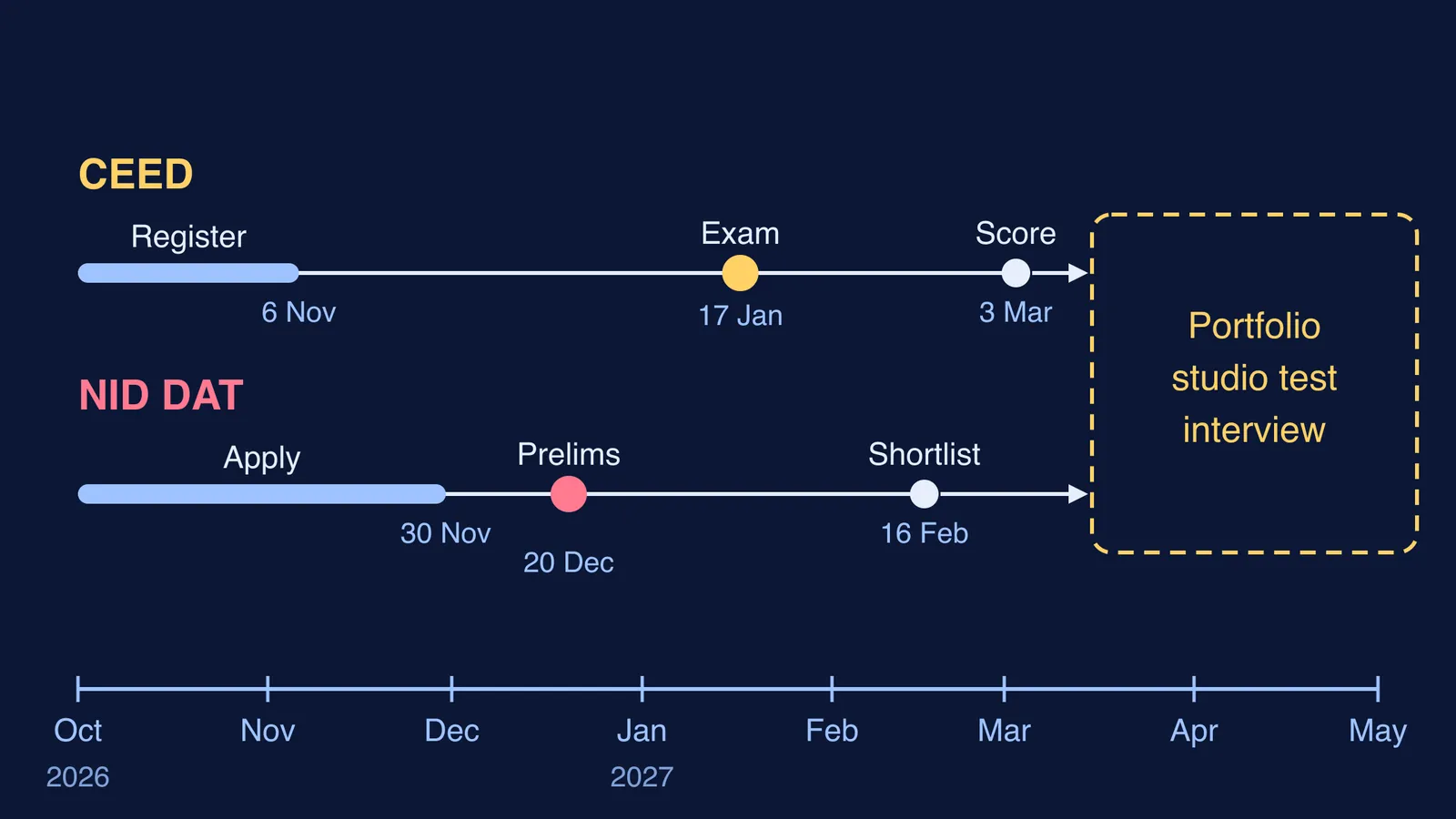
By 5 pm on 6 November 2026: register for CEED (late fee after 31 October).
By 30 November 2026: apply to NID. Choose disciplines carefully; you cannot change them later.
November to January: sketch daily (objects, hands, people) and pick your two best projects.
20 December 2026: NID DAT Prelims.
17 January 2027: CEED.
February: draft your portfolio. NID Prelims results arrive on 16 February 2027.
3 March 2027: CEED results. Apply to each institute as its applications open, and watch for studio test and interview dates.
Still weighing design against other options? Our guide to switching careers after B.Tech covers bridges and timelines, and GATE, a job or an MS after B.Tech helps you compare. For one common destination, read about UX design career paths for science students.


