

On this page
Transitioning from a science background to User Experience (UX) design is a common and highly effective career move. The demand for digital experiences is growing rapidly; for instance, the U.S. Bureau of Labor Statistics projects a 5% job growth for web developers and digital designers from 2025 to 2035, with a median annual salary of $99,520.
What do UX designers actually do?
UX design operates within technical and business constraints, much like biology or physics operates within strict natural laws. A UX designer is responsible for ensuring that a digital product—such as a fintech app, an e-commerce website, or educational software—is logical and easy to use.
The process is deeply rooted in research. Depending on your science major, different roles might suit you:
UX Researcher: Ideal for psychology or neuroscience backgrounds, focusing on understanding human cognition and mental models.
Product Designer: Suits biology and chemistry students who excel in systematic thinking and iterative testing.
UX Analyst: Perfect for data science and physics students comfortable with quantitative data and A/B testing.
Why do science students make good UX designers?
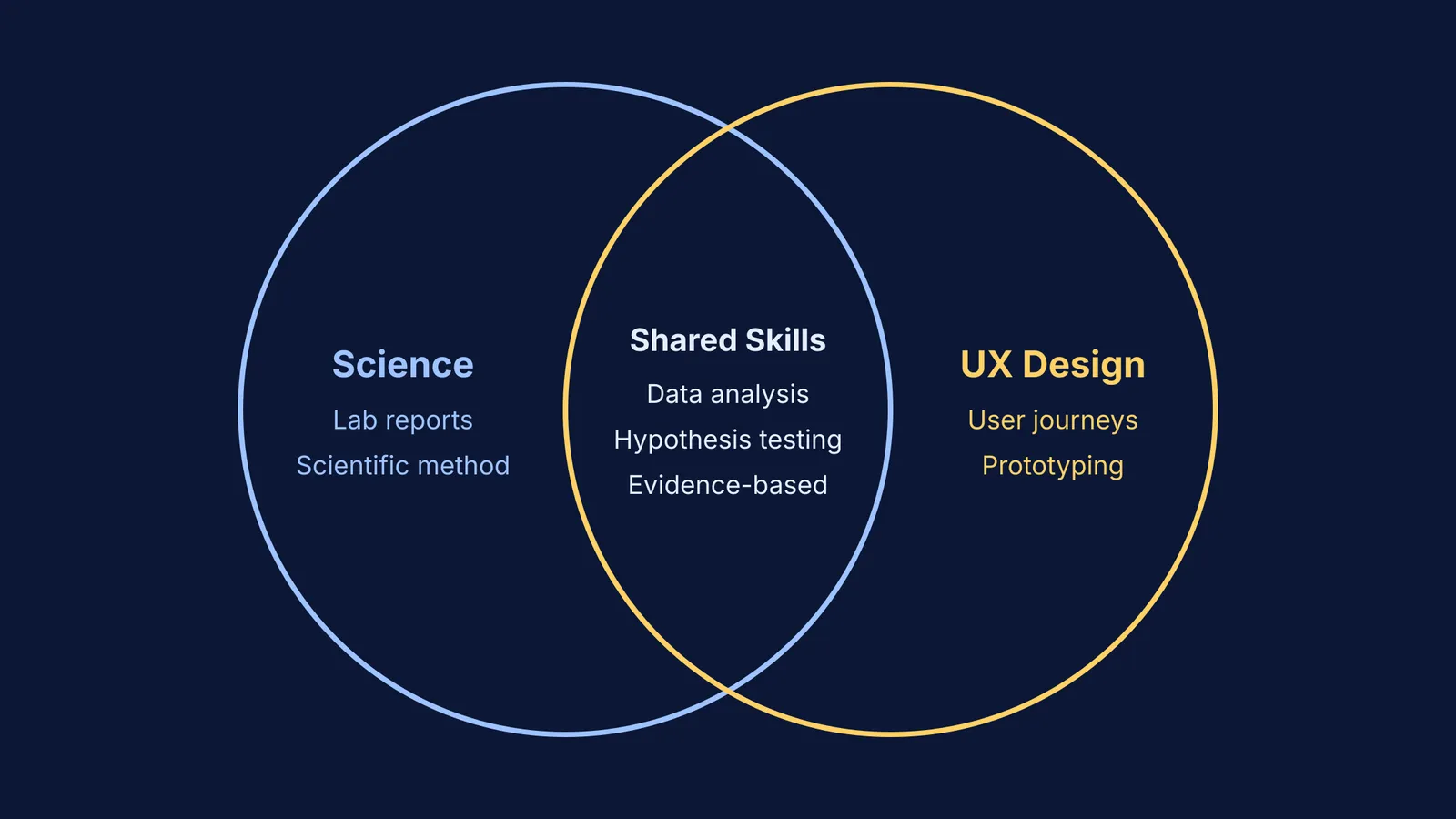
The scientific method is remarkably similar to the UX design process. Both involve observing a problem, forming a hypothesis, testing it through experimentation, and iterating based on data.
If you have experience with lab reports, literature reviews, or data collection, you already have a foundation for UX research. Science students are trained to look at data objectively and analyze user behavior without bias. This analytical rigor is a significant advantage when you are evaluating a product's usability metrics. Just as Fermi's AI tutor can work out what you already know and build a plan for the session, UX designers break down complex user problems to build structured user journeys.
For parents discussing these paths, it helps to read about talking about STEM careers beyond engineering and medicine.
How to get a degree in design (B.Des) in India?
For students who want formal education, pursuing a Bachelor of Design (B.Des) with a focus on UX Design is a strong path. Science students (PCM or PCB) are eligible for all major design entrance exams in India.
UCEED: The Undergraduate Common Entrance Examination for Design is accepted by IIT Bombay (IDC), IIT Guwahati, and others. It tests analytical and visualization skills.
NID DAT: The National Institute of Design entrance exam is open to science students and leads to strong programs in interaction design.
The return on investment for these degrees is substantial, with strong demand from top technology companies. It is completely fine when your child's career choice differs from yours, especially when the outcomes are this promising.
How to build a UX portfolio without a degree?
You do not need a design degree to get started, but you do need a portfolio. A science student's case study should focus on data-driven decisions rather than just aesthetics.
Try building a case study around a problem you encountered in the lab. Here is a framework to apply your scientific method:
The Observation: Identify a pain point, such as researchers spending hours searching for reagents in an outdated Excel sheet.
The Hypothesis: Conduct interviews to find the root cause (e.g., it is inconvenient to update while wearing lab gloves).
The Experiment: Map out a user flow and create low-fidelity wireframes for a voice-compatible or mobile-first interface.
The Validation: Test the prototype with your peers and collect data on where they struggle.
The Conclusion: Iterate on the design based on the feedback and summarize the impact.
When interviewing, lean into your science background. Use terms like "evidence-based design" to show that you are comfortable with ambiguity, rigorous testing, and data synthesis. You can also explore tools like the Fermi Simulation Lab to see how concepts that are hard to picture are transformed into intuitive, user-centered digital experiences.


