On this page
Moving in with a mama, chachi or older cousin for coaching saves money and gives you home food. It also makes you a guest in someone else's routine. Three things help most, done early: learn the rhythm of the house, set up one place to study, and agree how you will help before anyone has to ask. (Still deciding? Our guide to choosing a PG or hostel for coaching sets out the alternatives.)
How do you fit into a relative's household routine?
Every home runs on unwritten timings: when the bathroom is busy, when dinner is served, when the lights go off. In your first week, watch and ask rather than assume, then fit your study hours around those fixed points.
Sleep is the one block you should not trade away. Teenagers aged 13 to 18 should sleep 8 to 10 hours per 24 hours on a regular basis, according to the American Academy of Sleep Medicine's consensus statement (Paruthi et al., 2016). It links too little sleep to attention, behaviour and learning problems. In a home where everyone is up at 6:30, that puts your lights-out near 10:30 pm, not 1 am.
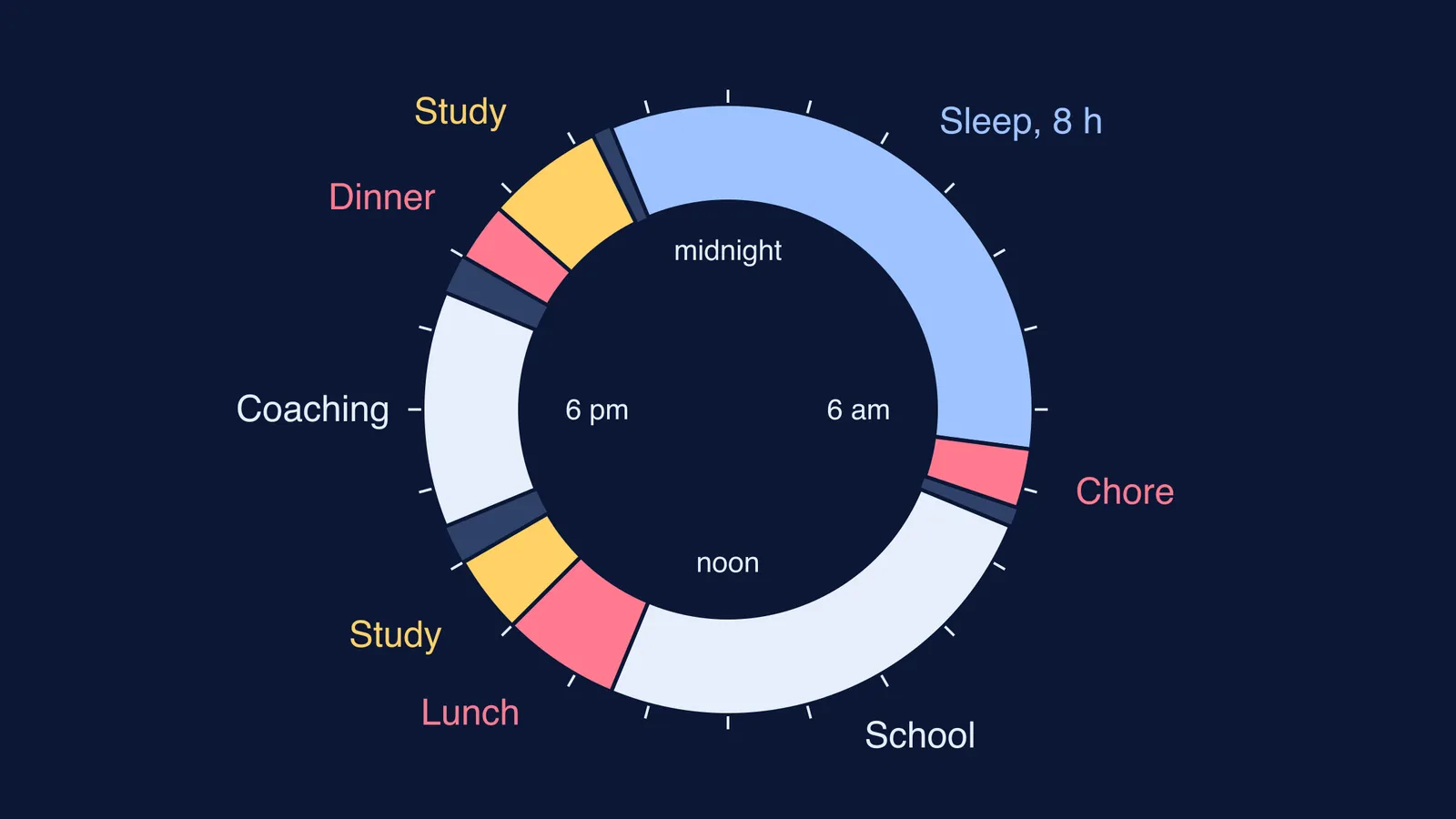
Here is one weekday plan for a Class 12 student at an aunt's home, with school in the morning and coaching in the evening:
6:30 to 7:15 am: get ready in your agreed bathroom slot, then one fixed morning chore.
7:30 am to 1:30 pm: school.
1:30 to 3 pm: lunch and a short rest.
3 to 4 pm: first study block, while the house is quiet.
4:30 to 7:30 pm: coaching.
8 to 8:45 pm: family dinner, with no books at the table.
8:45 to 10:15 pm: second study block in your corner.
10:30 pm: lights out, which gives you 8 hours before a 6:30 start.
That is two and a half hours of self-study on a school day, and the plan bends around the family's meals rather than fighting them.
Where do you study when you don't have your own room?
You need one spot that is yours for set hours, not a whole room: the cleared dining table after dinner, a folding table on the balcony, a cousin's desk while they are out, or your coaching centre's self-study room. Keep everything in one bag so you can set up and pack away in two minutes.
On phones, the evidence is mixed. Adrian Ward and colleagues (2017) found people with their phone in another room did better on tests of cognitive capacity than those with it on the desk, but a 2020 partial replication with 302 participants found no overall difference on memory tasks (BPS Research Digest). Leaving the phone outside your corner costs nothing, so do it anyway. Sharing with younger cousins? Our piece on studying with siblings in the same room applies.
How much should you help with chores?
Offer before you are asked, and pick something regular. A diary study of 752 adolescents aged 14 to 15, from Latin American, Asian and European backgrounds, found that helping the family generally was not stressful and was linked to higher happiness, largely through a sense of role fulfilment (Telzer and Fuligni, 2009).
Small jobs that fit a coaching timetable:
Fill the water bottles every morning.
Pick up vegetables or milk on the way back from coaching.
Wash your own plate and keep your bed and books tidy.
Help a younger cousin with homework for 20 minutes at the weekend.
What should you say to relatives about expectations?
Say it in the first week, before small irritations build up. A script to adapt:
"Chachi, my coaching runs 4:30 to 7:30 and I have tests on Sundays. Could I use the corner by the window from 8:45 to 10:15 at night? I'll do the water bottles every morning and the vegetables on Saturdays. If anything I do isn't working for you, please tell me directly."
Also agree who you tell if you will be late and whether you can stay back at the coaching library, then check in again after a month. Parents can help by calling the relatives themselves, thanking them, and asking what is hard on their side.
Evening doubts are harder with no batchmate down the hall. The Fermi Problem Library has worked problems with a step-by-step solver that explains the reasoning, and Fermi's AI tutor can work out what you already know and build a plan for the session, so a 90-minute block starts with a clear next step.
What if it starts to feel like too much?
Feeling out of place in the first months is common. Tell your parents early; our guide to handling homesickness during coaching has ideas that apply at a relative's home too. If low mood, worry or poor sleep lasts, talk to a doctor or counsellor, or call Tele MANAS on 14416 or 1800-891-4416, a free, 24x7 helpline from the Ministry of Health and Family Welfare (IIT Kanpur Counselling Service).
This week, write down the house's timings, pick your corner, and choose one chore that is yours.