

On this page
If you love science, one relative will say, "Do a PhD and become a professor," and another, "Join a company, that is where the money is." Both describe real research jobs. Here is how they compare on freedom, pay, pace and stability, with data rather than stereotypes, plus a short test to try on yourself.
Do industry scientists have less freedom than university scientists?
The stereotype is that professors pick their own questions and company scientists follow orders. The evidence is more mixed. Henry Sauermann and Paula Stephan surveyed over 5,000 life and physical scientists in universities and private firms (Organization Science, 2013). They found real differences between the sectors, but also that both universities and firms let scientists stay involved in the wider scientific community and give them "considerable levels of independence" in their jobs, as the abstract of their earlier working paper puts it (NBER working paper, 2010). They also found large differences within each sector and across fields, and concluded that "stereotypical views of industrial and academic science may be misleading."
One practical difference is who sets the final goal. In a university you choose a question, but must win funding and publish to keep going. In a company, the question usually ties back to a product, and the firm decides what is shared outside.
Which pays more, industry or academia?
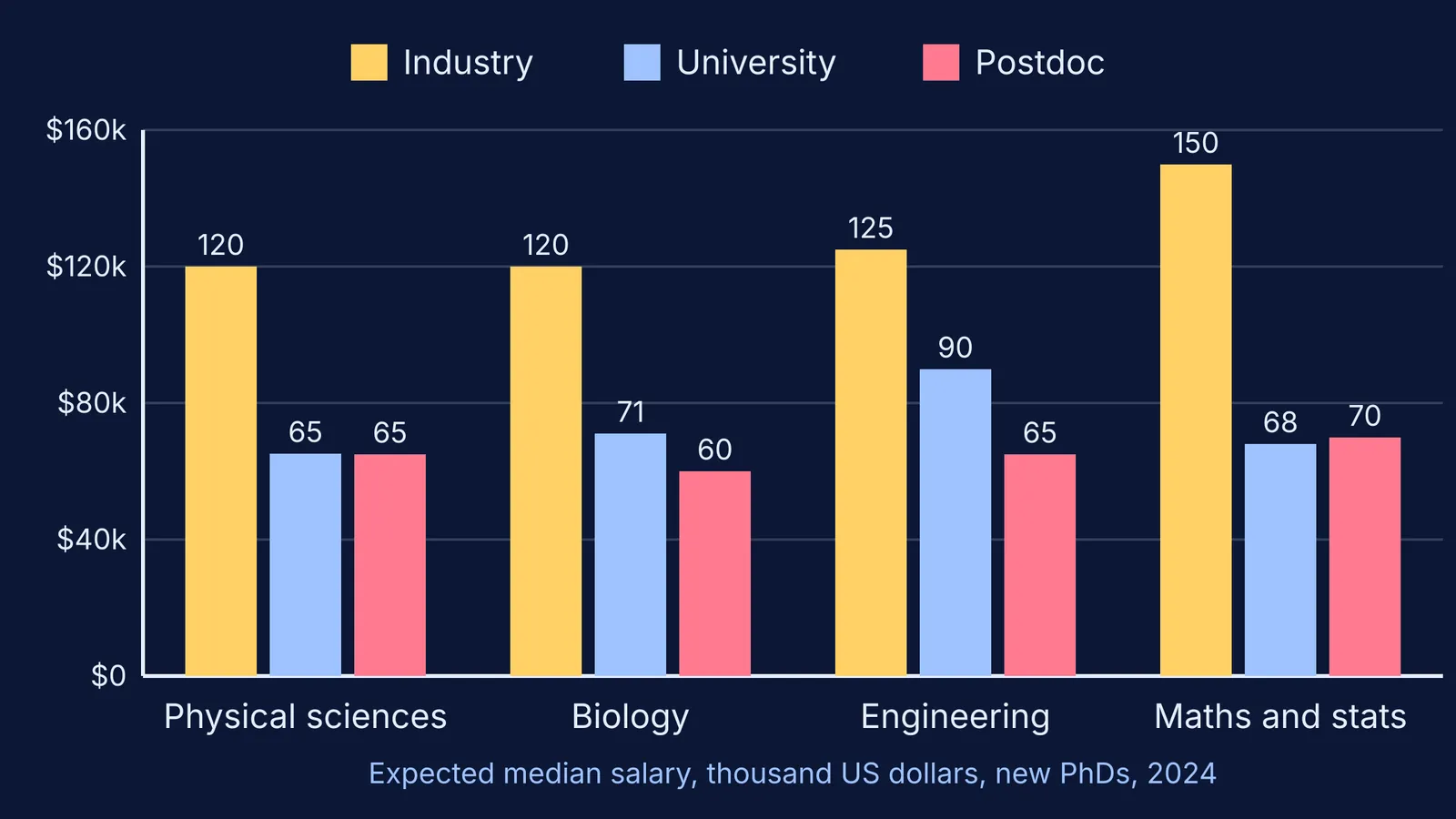
A February 2026 US National Science Foundation report found that, in every broad field, expected median salaries for new PhDs taking industry jobs were higher than for those taking academic jobs or postdocs (NSF NCSES, 2026).
Physical sciences: $120,000 in industry, $65,140 in academia, $65,000 as a postdoc.
Biological and biomedical sciences: $120,000 in industry, $71,000 in academia, $60,000 as a postdoc.
These are US figures, so treat them as a picture of the gap, not a price list. In India, PhD years are usually paid by a fellowship: under the central government's rates effective from 1 January 2023, a Junior Research Fellow receives Rs 37,000 a month and a Senior Research Fellow Rs 42,000 (Ministry of Education order, PDF).
Pay also reflects who chooses each path. In a survey of over 400 science and engineering PhD students, those who preferred industry cared more about salary and access to resources, liked work closer to products, and showed a weaker "taste for science" (Roach and Sauermann, 2010).
Which is faster-paced and which is more stable?
Pace follows the money. Company projects run on product timelines and can be stopped if priorities change. University projects run on grant cycles and PhD timelines, which are slower but give you longer with one question.
Stability is where the academic route asks the most of you. Among 2024 US doctorate recipients with definite plans, 54.8% in the physical sciences and 64.6% in the biological sciences were heading into a postdoc or other training position (NSF NCSES, 2026). A postdoc is a fixed-term research job after the PhD. Of those taking up a regular job instead, 70.7% of physical sciences PhDs and 51.9% of biology PhDs were going to industry or business (NSF NCSES). For how the academic ladder works after that, read how academic careers work after a PhD.
A five-question test: which kind of lab suits you?
Answer each question with an A or a B. More A answers lean towards academia; more B answers lean towards industry.
When you finish a problem, do you most want it understood and published (A) or built into something people use (B)?
Would you rather choose your own question and find the money for it (A), or be handed a question with the equipment to answer it (B)?
Can you live with fixed-term contracts into your thirties (A), or do you want a regular salary sooner (B)?
Do you like staying with one question for years (A), or switching when a project ends (B)?
Does teaching and mentoring students sound like a pull (A) or a cost (B)?
Here is a made-up example. Riya, a second-year BSc Chemistry student, answers A, B, B, B, A. That leans towards industry, with a liking for teaching, so the sensible next step is one summer in a university lab and one in a company lab, not a final decision.
How can you find out before you commit?
Spend a summer in a research lab and keep a diary of what you enjoyed each day.
Ask a working scientist three questions: "Who decided what you worked on last week?", "What happens to your work if an experiment fails?" and "How many years were you on short contracts?"
Read the routes in how to become a scientist in India after 12th and research jobs you can do without a PhD.
If you want to see whether university-level science holds your interest, Fermi Courses are taught by working scientists, with the AI tutor available on every lecture.
Start with the five questions tonight, and show your answers to someone who does research.


