On this page
If you want a B.Arch or B.Planning seat through JEE Main, you don't sit Paper 1. You sit Paper 2A for B.Arch or Paper 2B for B.Planning. The two papers start the same way but end very differently.
What is the difference between JEE Main Paper 2A and 2B?
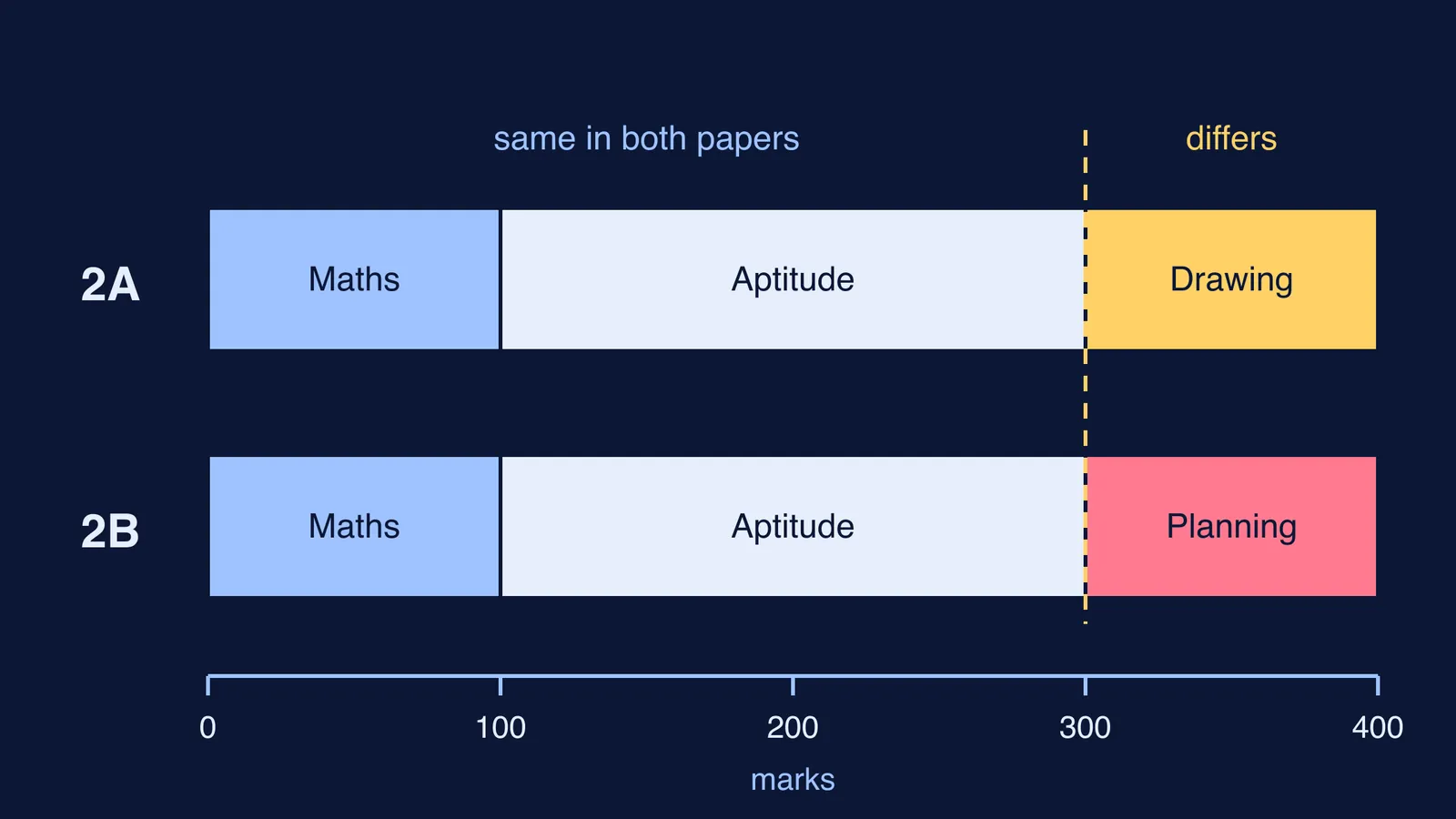
The JEE (Main) 2027 Information Bulletin from NTA sets both papers at 400 marks and 3 hours. Here is how the marks are split:
Part I, Mathematics (both papers): 20 multiple-choice questions and 5 numerical-answer questions, 100 marks, on computer.
Part II, Aptitude (both papers): 50 multiple-choice questions, 200 marks, on computer.
Part III in Paper 2A: Drawing Test, 2 questions, 100 marks, done with pen and paper on an A4 drawing sheet.
Part III in Paper 2B: Planning, 25 multiple-choice questions, 100 marks, on computer.
In the computer parts, a correct answer earns 4 marks and a wrong one loses 1, according to the same bulletin. The drawing test has no negative marking. You can register for both papers. If you do, you get 3 hours 30 minutes to cover all four parts. Session 1 exams fall on 20-24 and 28 January 2027, and Session 2 on 2-7 April 2027. Our post on JEE Main 2027 Session 1 registration covers the form and the deadlines.
What does the Paper 2A drawing test ask?
NTA's JEE Main 2027 syllabus describes the drawing test as sketching scenes and activities from memory. The scenes it lists are city spaces (markets, festivals, street scenes, monuments, public and recreational spaces), landscapes (riverfronts, jungle, gardens, trees) and rural life. NTA advises you to bring pencils, your own geometry box, colour pencils and crayons.
The key words are "from memory". Copying a photo trains your hand, not your recall of how a crowded sabzi market is laid out. So practise this way:
Spend five minutes really looking at a real place: a bus stop, a temple courtyard, your colony park.
Go home and draw it without any reference, with a time limit.
Check the drawing against four questions. Do the people look the right size next to the buildings? Do the receding lines meet at one vanishing point? Is there a clear foreground and background? Have you used light and shade?
The shared aptitude part asks you to picture 3D objects from 2D drawings, work with plans and elevations, judge scale and proportion, and build 2D and 3D compositions. Drawing the front, top and side views of everyday objects trains both parts at once.
What does the Paper 2B planning section ask?
The same NTA syllabus divides planning into three units:
General awareness: prominent cities, development issues and government programmes.
Social sciences: nationalism, colonial cities, resources and development, federalism, the Constitution, urbanisation, poverty and rural development.
Thinking skills: unseen passages, map reading (scale, distance, direction, area), critical reasoning, and reading charts, graphs and tables.
Much of this reads like school social science. Map-scale questions are really arithmetic. On a 1:50,000 map, 4 cm stands for 200,000 cm, which is 2 km.
Planning questions carry the same +4/-1 marking as the other computer parts.
How should you plan a practice week for each paper?
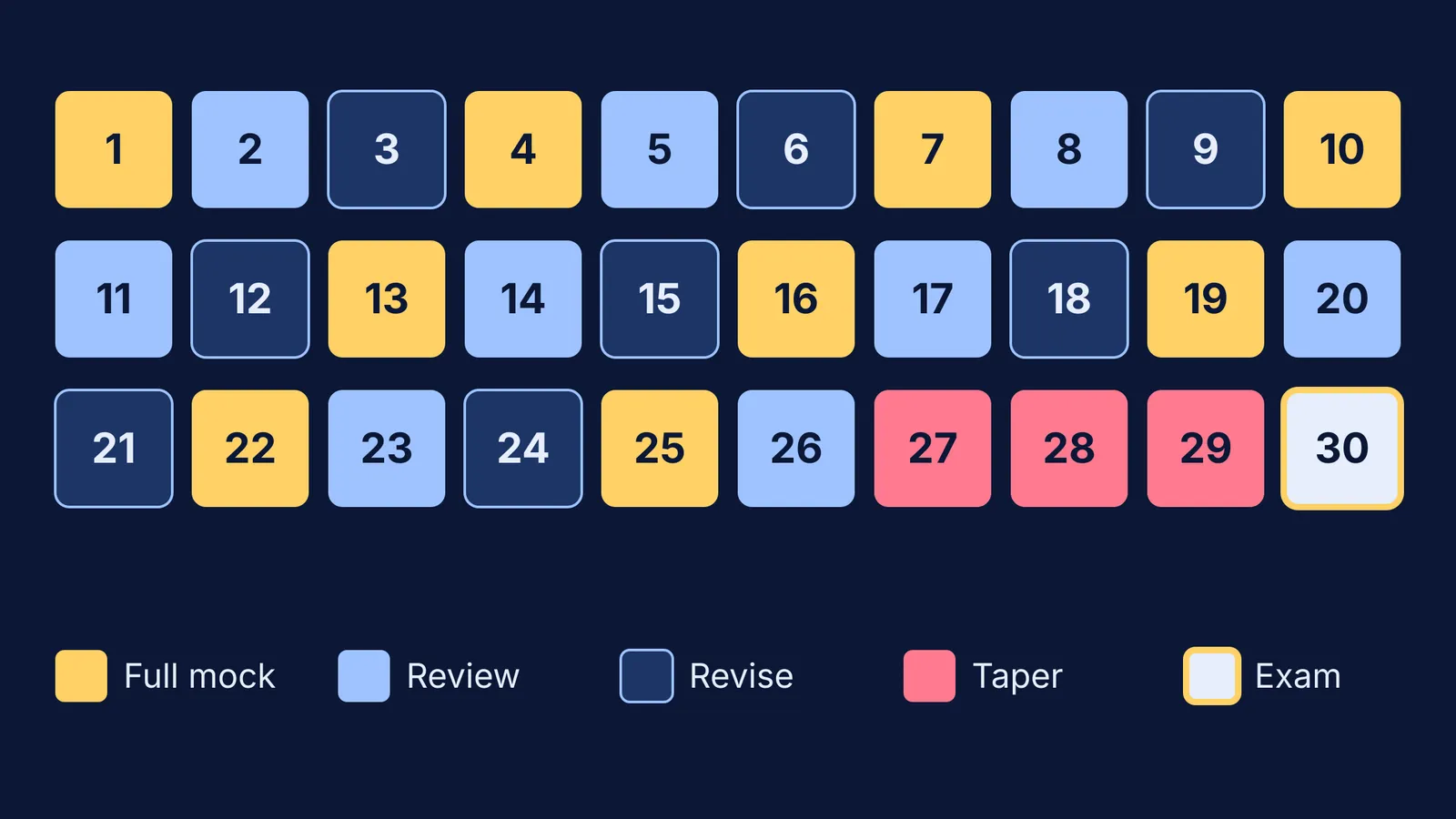
From early November to the January session is about 11 weeks. Use weeks 1 to 4 to fill gaps, weeks 5 to 8 for timed sections, and weeks 9 to 11 for one full paper a week, followed by a review.
A Paper 2A week
Monday, Wednesday and Friday: 45 minutes of maths (one chapter), then 30 minutes of 3D-visualisation aptitude questions.
Tuesday and Thursday: one memory sketch in 40 minutes, then 10 minutes checking it against the four questions above.
Saturday: a timed drawing question plus 25 aptitude questions, marked +4/-1.
Sunday: a review, or a full paper from week 5 onwards.
A Paper 2B week
Monday, Wednesday and Friday: the same maths and aptitude blocks.
Tuesday and Thursday: 30 minutes on one social-science topic from the syllabus, then a 15-minute map or chart drill.
Saturday: 25 planning questions under a timer, marked +4/-1.
Sunday: read about one Indian city's development problems and write three lines on it.
The maths part uses the same 20 + 5 format as Paper 1. If you keep getting maths answers wrong in the same way, the Fermi Problem Library has a step-by-step solver that explains the reasoning, not just the answer. If 3D geometry or vectors still feel shaky, look up the idea in the Fermi Concept Library before you do more questions.
Which paper should you choose?
Choose the degree, not the paper. Read what a five-year B.Arch involves and where B.Planning graduates work. Then register, and start this week's maths block.